No. 81
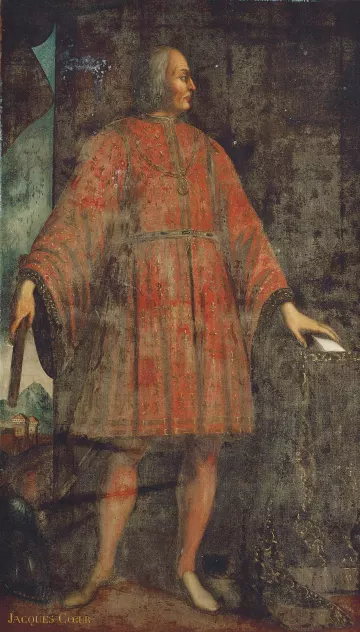
Jacques Coeur
Jacques Coeur, known as “Merchant Prince of the Middle Ages” was the 15th century merchant and financier who became one of the wealthiest men in Europe owning the greatest fortune ever made by an individual Frenchmen.
Born into a merchant family of Bourges, Jacques was determined to follow the family tradition from an early age. Marriage with Macée de Léodepart, the daughter of the provost of Bourges and former valet of the duc de Berry, opened his way to upper layers of Bourges society. His first employment was that of a manager of one of the twelve exchange houses of Bourges. In 1429 he started his own coinage business, but he ended up in prison for falsifying the quality of coins.
After 1432 he founded a trading company and exchange at Montpellier building a reputation as a capable merchant and financier.
Due to his rapid commercial success during the 1430s he became a main financial advisor of the French king Charles VII (r. 1422-1461). In 1436-1451 Coeur was appointed as an “argentier” (master of the mint), banker of the court, and a member of the king’s council. He was also put in charge of the collection of the taxes in Languedoc and as inspector general of the salt tax. He performed diplomatic missions in Spain and Italy as well.
Coeur's position at the court gave him perfect position for extending business. He supplied jewelry, silks, furs, spices, arms, horses and whatever else the king and his subjects needed. That gave him means to profit by supplying and extending credit to those who could not pay in cash, acting in the same time also as a banker.
Like the most medieval merchants who wanted to avoid risks, he wasn’t specialized in one particular line of business and was involved in different activities – in salt on the Loire and Rhone rivers, wheat in Aquitaine and in wool import from Scotland. He imported spices, cloth, and other products from the Levant. He also augmented his fortune by selling weapons to the king and possibly in Egypt, and from his own copper and silver mines. In Florence he owned a workshop for the manufacture of silks and was a member of “Arte della Seta” (Silk Maker’s Guild).
Coeur is considered as one of the founders of the trade between France and the Levant. By 1449 he owned a fleet of seven trading ships and established trading houses and exchanges in major towns in France, including Paris, Montpellier, Marseille, Lyons, and Tours. Allegedly, he was even able to compete with powerful Italian merchant states. Acquiring a trade monopoly from the French king Charles VII for supplying the large market in southern France with spices, and papal permission to trade with Mamluk, Muslim sultans in Egypt, he largely improved and intensified his business.
Coeur set up individual companies for each branch of trade and conducted business affairs from Bourges through a large network of trusted agents in Barcelona, Avignon, Lyons, Paris, Rouen, Bruges and elsewhere.
In 1441 he and his family were ennobled. He built a palace in Bourges that represents one of the finest monuments of Gothic architecture from the end of the European Middle Ages. Besides that, his family had many properties throughout France. He founded colleges in Paris, Montpellier and Bourges. His daughter was married to a nobleman; his son was named the archbishopric of Bourges and his brother bishopric of Luçon. The family was at the height of prosperity and prestige.
Immensely wealthy, Coeur was rich enough even to be able to lend the funds necessary to Charles VII for the reconquest of Normandy from the English in 1450, and to become creditor for a large part of the aristocracy.
An object of envy, he became the victim of various intrigues. Falsely accused for different financial crimes, alchemy and poisoning of Charles’s mistresses Agnes Sorel, in 1451 he was imprisoned, tortured and deprived of all his possessions. After two years he succeeded to escape from prison and take refuge first in Florence and later in Rome with pope Nicholas V.
In 1456, he assumed command of a naval expedition against the Ottoman Turks but he got ill and died on the island of Chios.