No. 1756
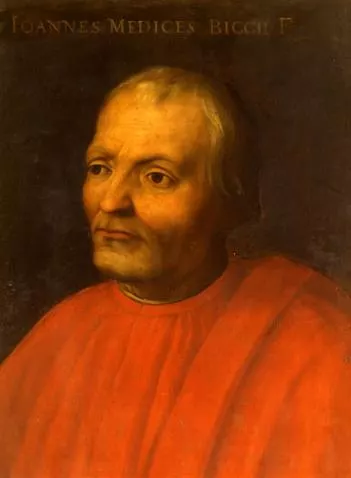
Giovanni di Bicci de' Medici
Giovanni di Bicci de' Medici was the founder of the famous Medici Bank. The wealth produced through his banking and trading operations rose the Medici family members to positions of popes and dukes and helped ti create the Italian Renaissance.
Giovanni was born into a family of a modest means, his father, who died three years after Giovanni's birth, was probably involved in small-scale moneylending.
The figure who was crucial for Giovanni's professional rise and success was actually his distant relative, certain Vieri di Cambio (or Cambiozzo) de' Medici (1325-1395), who had banking interests in Florence and Rome, as well as abroad. Using family connections, Giovanni along with his elder brother Francesco went to their relative to work as apprentice in his banking firm, as was a usual practice in early Renaissance Italy.
Highly capable and ambitious, Giovanni took the maximum advantage of that experience for its further personal and professional development. In 1385, at age of 25 he ascended as a manager as well as a junior partner of the Roman branch of his cousin's firm, investing most likely his wife's dowry to provide the necessary capital. The partnership resulted in “joined enterprise of Vieri e Giovanni de' Medici in Rome”, and lasted till Vieri's retirement when Giovanni took over the whole business. In 1386, Giovanni became a member of the Arte del Cambio, the guild overseeing international bankers. In the year 1397 he relocated the firm's headquarter from Rome to Florence, the principal banking center of Europe. That event marked the foundation of the famous Bank of Medici.
In Florence Giovanni established the firm in partnership with Benedetto di Lippaccio de' Bardi, his most reliable business partner and general manager responsible for all branches. Under Giovanni’s management, the Medici developed other profitable interests. In 1402 he expanded its business affairs to the Venice, the leading maritime and trading republic by opening the branch office which provided the Republic and its traders with a necessary capital for conducting long-distance trade. The same pattern was applied to other key trading Italian cities. The agents in the service of Giovanni operated throughout Europe.
Since the Florence was a European wool trade center in the 14th and 15th century, Giovanni expanded into wool production becoming a member of the Arte della Lana. In 1402 he opened a workshop (bottega) for the production of woolen cloth, and according to an old Florentine tradition, named it by his elder, and in that time minor son Cosimo. In 1408 the second manufacture was established that bore the name of Giovanni's younger son, Lorenzo. Although the wool shops were a considerable source of incomes for the Medici family, they were actually negligible in comparison with profits made in banking. Also, he invested profits in land and acts of patronage.
The greatest source of income for the Medici family lay in their appointment on the post of Pope's banker, the most prestigious and lucrative office in the Christian world. Although Giovanni developed ties with the Papal Curia while working for his cousin Vieri, yet the acquaintance and business arrangements with Cardinal Baldassare Cosa, who later became Pope John XXIII, were crucial for obtaining the position of “God’s bankers”. Acting as a Pope's personal bank, the Medici family gathered immense fortune. Furthermore, papal connections also gave to the Medici immense political power and paved the way for their conquest of political power.
Accordingly, during his lifetime, Giovanni de Bicci, also surnamed “Friend of the People”, became one of the richest men in Italy – his fortune upon his death was worth around 180,000 gold florins, which was an enormous sum in that time. After 1420, Giovanni had gradually given more and more authority to Cosimo, informing him about all business secrets and preparing him to assume supreme command. Last years of his life, Giovanni spent as patron of arts and engaged in rebuilding he was of the Church of San Lorenzo whose sacristy was destined to be his burial place.
The old Florentine chronicle reports that even while he was lying on his deathbed, he gave to his sons and the members of his family oration full of homely advice about the conduct of business and political affairs.