No. 255
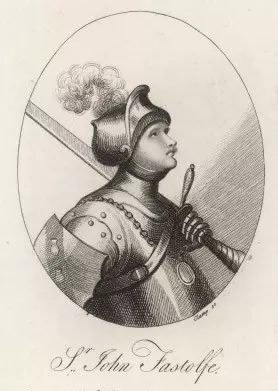
Sir John Fastolf
Fastolf was one of the first English knights who made a fortune as a professional soldier in the second phase of the Hundred Years’ War.
Little is known about his youth besides that he grew up at his family's estates in Norfolk during the early reign of Richard II (r. 1377-1399). Fastolf started his military service under the duke of Clarence, the younger brother of the future King Henry V (r. 1413-1422), accompanying him in Ireland in 1405-1406 and later on expedition in Aquitaine in 1412-1413.
His opportunity to enhance his position came with war engagement of the King Henry V with the aim to recover England’s lost possessions in France. He participated in the battle of Agincourt (1415) and Verneuil (1424), as well as in the “Battle of the Herrings” at Rouvay (1429). In 1426 he was created a Knight of the Garter. After the death of the duke of Clarence in 1421 and the King Henry V in 1422, their younger brother John, Duke of Bedford became the virtual ruler of England since the new King Henry VI (r.1422-1461, 1470-1471) was in infancy. Fastolf would become one of the Bedford’s most trusted military commanders and advisers.
Thanks to his military competence, Fastolf was able to increase his fortune through different appointments, seized land and ransoms for influential war captives. He also started to acquire land in England, mostly around Caister in Norfolk with the money earned in France. According to some estimates, he invested around £14,000 buying property in England and an additional £9,500 improving it. In 1445, his English holdings brought him an annual income of £1,061 while the remaining land in France that he managed to preserve brought him £401.
When Bedford died in 1435, the English campaign in France was also near its end and Fastolf returned to England permanently and soon retired from the military service. He died in 1459, worth at least £35,000, which would be about £11.3bn in 2010.