No. 1307
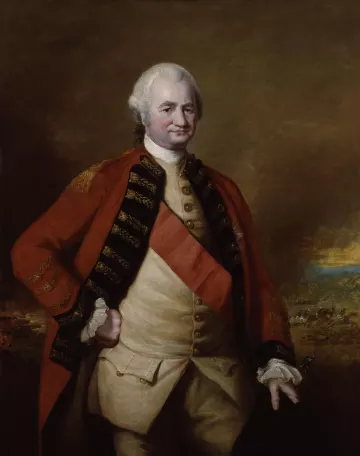
Robert Clive
Born as a son of a minor landowner and lawyer, Robert was known from an early age as a bad student, troublemaker and prankster. We should also add that he suffered from bouts of depression. His father arranged for him a clerkship in the British East India Company and in 1743 he went to India to serve as a clerk at Fort St. George in Madras.
At Madras he allegedly tried to commit suicide during one of his depression attacks, but fortunately his gun failed to fire. In the following two years his fortune started to change as a result of the British-French rivalry in India. After the French conquered Madras, Clive fled to Fort St. David and entered the military. In 1749 he became a lieutenant and soon became known for his military skills and boldness. When the war ended, Madras was returned to the British and Clive was appointed steward of Fort St. George. He received a commission on every supply for the facility and his stewardship made him a wealthy man. He returned to England in 1753 as a wealthy man, but three years later he turned back to India as a deputy governor of Fort St. David.
After Siraj al-Dawla, the nawab of Bengal captured British fort at Calcutta and killed its captives, Clive was appointed commander of the punitive expedition. He reconquered Calcutta in 1757 and at the Battle of Plassey he defeated nawab's forces. Due to this victory, Clive became considered as the founder of the British Empire’s control of India.
Following the battle, the British became the dominant power in Bengal, which was the richest province in India. Clive’s ally Mir Jafar was appointed the new nawab of Bengal. In return, he received £234,000 and the title of mansabdar (officeholder), and he was entitled to a rent of £30,000. That made him one of the wealthiest people in England. He returned to England in 1760 and purchased two hundred shares of the British East India Company at £500 each and several houses.
After five years in England, he returned to Bengal again to serve as governor for two years. In 1765 he was given the grant by the Mughal Emperor to collect the revenue of Bengal, Bihar, and Orissa. In reality, that meant the governorship in mentioned areas and led to the creation of “British India”.
Clive returned to England in 1767, now with even greater wealth. He spent the rest of his life investing in landed properties, serving in Parliament, traveling, and acquiring art objects. In one of his depression episodes he succeeded to commit suicide. He was buried in 1774 in an unknown grave. At the time of his death his wealth was at least £500,000, or the equivalent of £4.5bn in 2010.