No. 1959
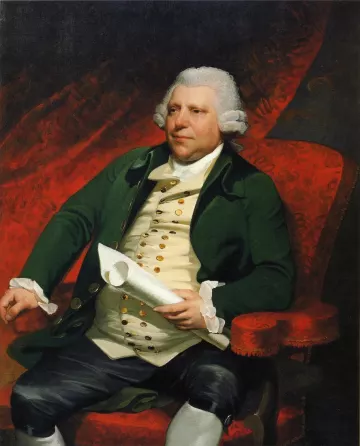
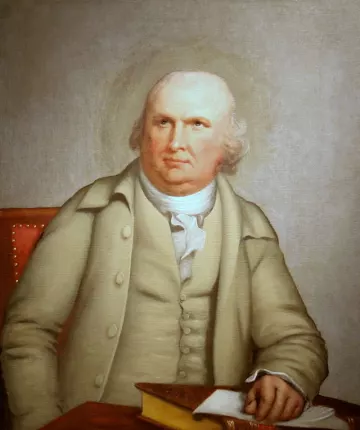
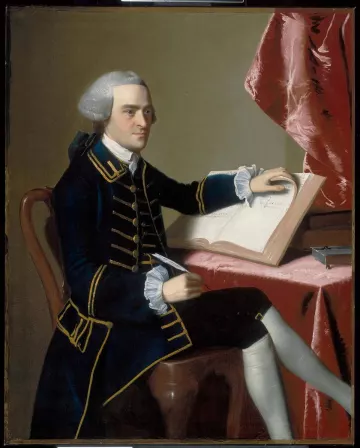
Sir Richard Arkwright
A famous inventor, Arkwright is considered the father of the modern industrial factory system whose inventions served as initiator of the Industrial Revolution.
He was born in Preston as the youngest of 13 children in a family of a tailor. Since he was the last of the large family, there was no money for his formal education. He started his career as an apprentice barber and subsequently started to work as a wig maker. He found out a secret method for dyeing hair, and traveled around England to purchase hair for use in the manufacture of wigs. As most 18th century barbers, he also performed a surgical practice of bleeding and tooth extraction.
However, when fashion changed and the wig making business starts to decline, Arkwright started to explore the new mechanical inventions in the textiles industry in order to make his fortune. By 1767 a machine for carding cotton already existed and James Hargreaves had invented the spinning jenny. In association with a clockmaker, John Kay, who worked on a mechanical spinning machine, Arkwright made improvements that produced a stronger yarn and required less physical labor. His new carding machine was patented in 1775.
The first models were powered by waterwheels so the device came to be known as the water frame. The whole process of yarn production was carried on by one machine and trough a system in which labor was divided, improving efficiency and increasing profits. His first textile mill was built in Cromford, England in 1774.
During his lifetime he had established factories in Derbyshire, Staffordshire, Lancashire and Scotland. He was a hard worker, and it is known that he insisted on working from 5:00 a.m. to 9:00 p.m. every day. By 1782 he had a capital of £200,000 and employed 5,000 people.
For his life’s work, he was knighted in 1786. He was also appointed High Sheriff of Derbyshire. At his death, he was one of the richest people in England, leaving an estate valued around £500,000.