No. 8533
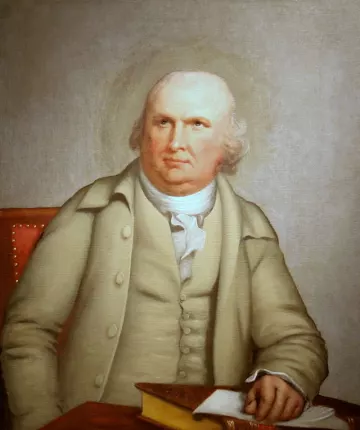
Robert Morris
Accompanying his father, a tobacco merchant, Robert left his native England in 1748 and settled at Oxford, Maryland. There he learned a trade working as an apprentice to Charles Wiling, a leading merchant in Philadelphia. Since he in the meantime inherited an estate valued about £2,500, he was able to form a partnership with Willing’s son, following his death in 1754.
The business grew, and in 1756 Morris was able to purchase a one-fourth interest in another firm that was named “Willing and Morris” and dealt mainly in imports and exports, supplemented by foreign exchange. In a decade, the company became the leading merchant firm in Philadelphia and owned ten ships. With the outbreak of the American Revolution, they expanded to privateering and investing in land and plantation.
Being an importer, his business was struck by the restrictive trade and tax measures of the British government, and he joined the anti-British movement. Elected to the Continental Congress in 1775, he participated on many of the committees involved in raising capital and provisions for the Continental Army. His activities primarily involved borrowing money at home and abroad to finance war against the British. From 1781 to 1784 he held the post of the superintendent of finance.
Morris formed numerous trading partnerships – by 1780 he was involved in nine major and numerous lesser ones that were active in the field of privateering, commodity transactions, shipping, lands, securities, and foreign exchange.
However, during the war (1775-1783) his wealth was significantly reduced and in order to renew his fortune he went into land speculation. By the mid-1790’s, he accumulated millions of acres of land in seven states, and more than seven thousand building lots in the District of Columbia. Since he had to borrow money for these investments, he ended in the debtors prison in 1798 when he proved unable to repay his debts. He stayed there until 1801.