No. 4005
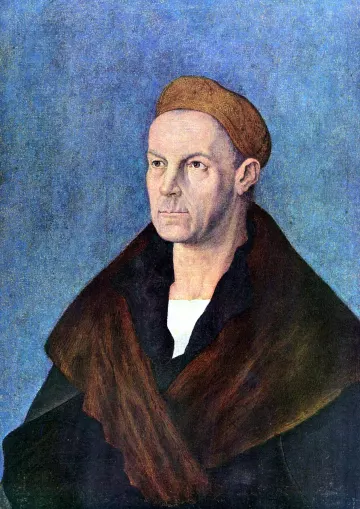
Jakob Fugger
Jakob Fugger was a German banker and mining magnate whose business activities made the Fugger's firm the most famous and wealthy enterprise in the early 16th century Europe.
He was born in 1459 in Augsburg, Germany as the youngest son of Jakob Fugger the Elder and Barbara Basinger. The family was involved in lucrative textile business which was the main source of the wealth in the 15th century Augsburg.
In 1469, Jakob the Elder who founded textile business died as the seventh-richest man in Augsburg, leaving the management of family business to his sons. Jakob, as the youngest of seven children, was predestined for the ecclesiastical career. However, in 1478 he was recalled from monastery to join the family business since only two elder brothers were still alive. First they sent him on apprenticeship in Venice and Rome, and upon his return to Augsburg he was put in charge of the firm’s Italian trade.
Although trade in woven goods, silks, and velvets continued to be significant source of their incomes, involvement in credit, and especially mining operations was crucial for the creation of the Fugger fortune. Jakob had a main role in building of a business strategy. Involvement in the incredibly profitable exploitation of the copper and silver production and trade in central and Eastern Europe was his initiative. Tyrol and Hungary had the largest silver and copper mining production facilities in Europe until the mid-16th century when the Spanish mines in America produced significant amounts of silver.
The Fuggers already had mining interests in Salzburg since 1480, but in 1485 Jakob succeeded to expand the business to Tyrol. That was possible through the financial arrangements with Count Sigmund of Tyrol who was deeply in debt because of his war with Venice, and after 1490 with his successor, the Habsburg Emperor Maximilian I. A mutually beneficial relationship between the Fuggers and the Habsburg rulers was crucial for the welfare of the Fugger family over the next four decades, as well as for the Habsburgs’ political ambitions. In 1519, Jakob even bribed the German electors to ensure the election of the Habsburg ruler Charles I of Spain as Charles V, Holy Roman Emperor.
Although the Fuggers earned more than 400,000 gulden from the silver trade in Tyrol between 1487 and 1497, their business ventures in Hungary proved to be even more profitable, earning a total of 1.5 million gold gulden. In 1495, Jakob organized a Fugger-Thurzo consortium to mine and trade the Hungarian copper and silver entering into business and family relations with Johann Thurzo, a Hungarian mining specialist. When the Imperial Diet of Germany attempted to charge the Fuggers with illegal monopoly practices, the Habsburg rulers Maximilian I and Charles V provided them with protection. In addition to mining operations, the Fuggers also profited from the transfer of church funds from Germany to Rome.
Part of the acquired wealth, Jakob used for purchase of vast landholdings and in 1511, and 1514 he was granted titles of nobility from the Habsburg emperor.
In 1494, Ulrich, Georg, and Jakob joined their capital and formed a family trading partnership, granting equal rights to all of the brothers. In honor of the oldest brother, the firm was named Ulrich Fugger and Brothers of Augsburg. When Jakob’s brothers died, he signed a contract with his nephews and renamed the firm Jakob Fugger and Brothers’ Sons.
Since his marriage with Sybille Artzt was childless, Jakob named his nephew Anton as his successor at the helm of the Fugger family firm.