No. 10579
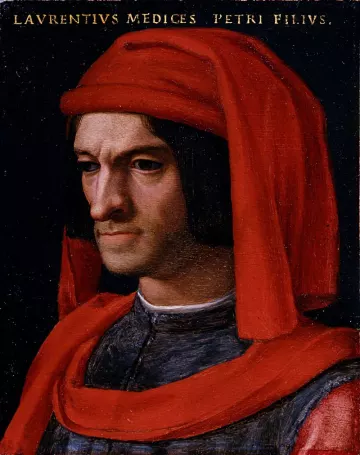
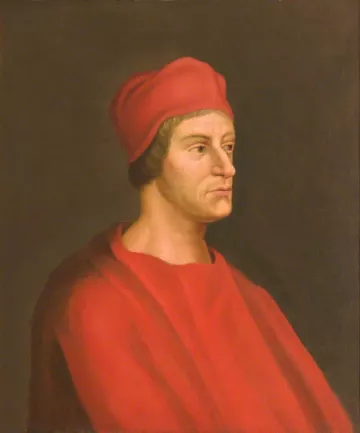
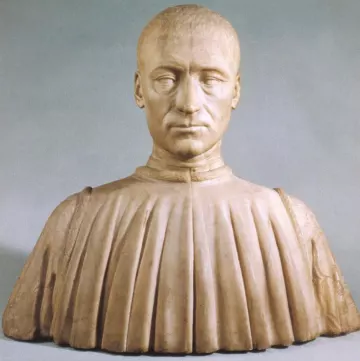
Lorenzo de’ Medici
Lorenzo de’ Medici, also known as Lorenzo the Magnificent, was a wealthy banker and politician born in the richest banking family in Italy who become one of the leading Renaissance patrons of arts and letters. He represented the embodiment of the Renaissance prince, and Niccolo Machiavelli dedicated his famous book “Il Principe” to him.
The fortune of the Medici family was established by his great grandfather Giovanni de’ Medici, and under his successor the Medici bank expanded all over Europe becoming the most profitable bank in Europe. Lorenzo's father, Piero I, although suffering from severe illnesses, succeeded for a while to maintain the power of the Medici family.
As the eldest son of Piero, Lorenzo was foreseen to take over leadership of the family. Leading humanists were involved in his education since he was five, and in the following period he further developed his interests in music, art and poetry through contacts with artists and writers who used to gather in the Medici palace. Although he suffered from asthma, eczema and poor eyesight, that didn't stop him in performing his duties and ordinary activities.
Already as a teenager, Lorenzo was sent by his father on delicate missions to Medici's political allies, ceremonial events and government meetings. When Piero became gravely ill, Lorenzo replaced him in negotiations regarding family business with important dignitaries such as the Pope, and the King of Naples. At age of 19, he was married with Clarice Orisini, a member of one of the wealthiest and most powerful family of Rome that provided family with additional power and prestige.
Following his father's death, Lorenzo became master of Florence at age of 20 with his brother Giuliano as his closest associate. Family interests had to be defended from the Pazzi family, a powerful rival banking family who plotted against the Medici, as well as against four rival Italian states. Through wise business moves, Lorenzo succeeded to maintain the material position of his family. Namely, he established strong financial relations with the Ottoman Turks, as well as a network of many thousands clients in Florence and other Italian states who in return for favors provided loyalty.
As a great supporter of culture, Lorenzo became patron of the leading 15th-century artists including Leonardo da Vinci, Sandro Botticelli, and of young Michelangelo, and humanist writers such as Giovanni Pico della Mirandola and Marsilio Ficino. His agents were tasked for collecting classical manuscripts for the Medici library.
In 1478 in Pazzi Conspiracy his brother Giuliano was murdered, while Lorenzo was stabbed in the neck saving his life by disappearing in the confusion. After he returned, the Pazzi family was wiped out from Florence. In such a delicate moment for survival of family, Lorenzo succeeded to neutralize the plans for invasion of Florence by forces of the Pope Sixtus IV and King of Naples. However, he became aware of the fact that the only guarantee of safety was domination of the papacy post. Therefore, Lorenzo used his wealth to make his son Giovanni a cardinal at age 16, who eventually became Pope Leo X, the first Florentine pope. Giulio de’ Medici, his brother’s son was also made the archbishop of Florence, then cardinal, and finally Pope Clement VII.
Later in his life, preacher named Girolamo Savonarola who came to Florence in 1490 and become Lorenzo’s protégé, started to preach against the paganism in Renaissance art and against the Medici rule of Florence. He gained many supporters. During these events, Lorenzo, who suffered from gout and increasing depression, was unable to counter the unfavorable development of the situation.
Lorenzo died in 1492 and was buried next to his brother Giuliano at the church of San Lorenzo. He was succeeded by his eldest son, Piero (1471-1503), who didn’t possess his spirit and was driven out of power.