No. 10659
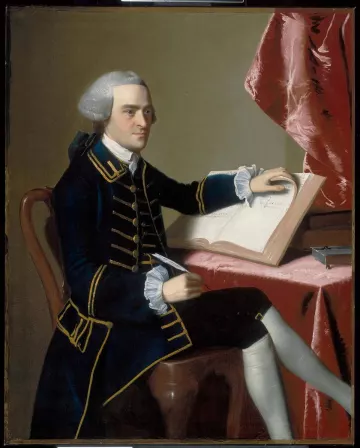
John Hancock
John Hancock was one of the wealthiest entrepreneurs in colonial America who had a prominent role during the American Revolutionary War which had its origins in the resistance of many Americans to taxes imposed by the British parliament.
Born in North Braintree, Massachusetts John lost his father in the boy’s age and went to live with his uncle, Thomas Hancock, one of the richest men in Boston at the time. Since his uncle had no children, John received the best education at Harvard University and started to work for him in a highly successful importing business. After his uncle’s death in 1764, he became the sole owner of the House of Hancock and inherited a large business empire.
Although in the initial turmoil between England and its American colonies, John approved the Sugar Act (1764) issued by the English government in order to obtain tax revenues from the colonies, later with the imposition of the Stamp Act (1765) and Townshend Acts (1767) he changed his mind. He joined the boycott of British merchandise and gained popularity among Bostonians. Since he was one of the wealthiest colonial merchants, the English government tried to neutralize him. He was accused for smuggling and one of his ships - Liberty - was confiscated.
Although he didn’t participate in the famous Boston Tea Party, he supported the boycott. In the following political events, Hancock was elected president of the Continental Congress (1775) and was one of the most significant participants in the American Revolution. He is known as the sole signer of the original copy of the famous Declaration of Independence before it was sent to the printing. In the postwar period he served as the governor of Massachusetts.
He died in 1793.