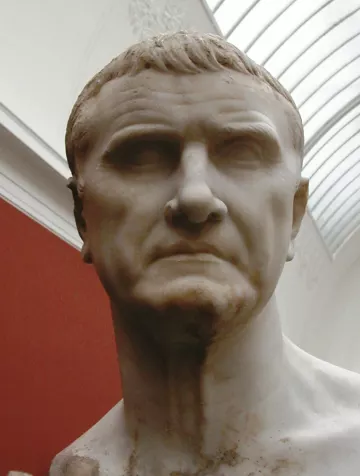
No. 6297
Pasion
Pasion was an Athenian slave, most likely of Phoenician origins, who belonged to two prominent Athenian bankers, Antisthenes and Archestratos. His employment at his master’s bank started when he was 20 years old and he performed various business transactions in the busy commercial port of Piraeus, five miles from Athens where the headquarters were situated. Business skills as well his honesty and reliability enabled him to achieve the highest position in the bank – that of the chief clerk charged for managing the money table at the Piraeus harbor. Because of his valuable services, his owners emancipated him and he gained freedom.
Eventually Pasion accumulated sufficient money to first lease the bank and then to buy it around the year 394. His bank was equipped with slave personnel – with Kittos and later Phormion as his manager and chief cashier. Interest rates in Athens were high amounting to about 12 per cent. Bankers paid no interest on deposits and collected large commissions on money changing. Pasion’s annual income was some 100 minae, equivalent to about $1 million in 21st century. That provided him the status of the wealthiest banker in Athens who cooperated with the leading merchants, generals and elders of Athens and Piraeus. His success was recorded in speeches of the celebrated orators Demosthenes and Isocrates. Later he diversified his business activities by buying a shield factory which was a leading industry in warring Athens, blocks of apartments to rent, and an assemblage of slave employees and servants.
In history of Athens Pasion was also recorded as generous benefactor – he donated one thousand shields and five triremes (warships), for which he also supplied crews. Consequently, as sign of gratitude, he was granted Athenian citizenship.
As Pasion started losing sight, he entrusted the operation of his bank and shield workshop to his confident slave Phormion who conducted his business affairs after his death and married his widow. He left a substantial dowry to his wife, while the remainder of his estate was divided equally between his two sons.
According to calculations, the estate included about 50 talents (some in the form of outstanding loans), the bank, the shield factory, real estate worth 20 talents, cups, and a golden crown. As it is estimated that the Athenian talent at that time was worth the equivalent of as much as $600,000 in 2010 dollars, Pasion’s estate can be said to have been worth approximately $55 million.