No. 4223
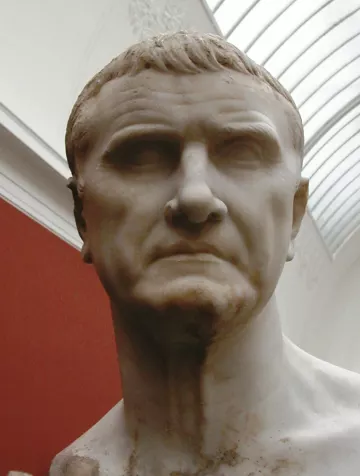
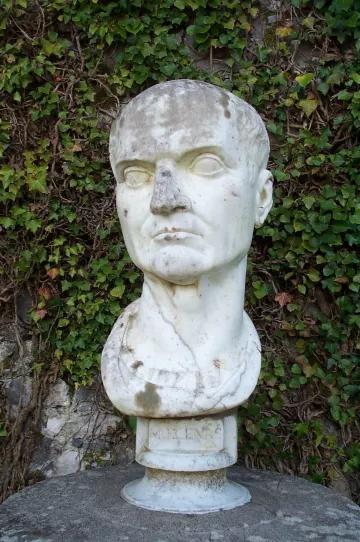
Marcus Licinius Crassus
Crassus was a Roman politician, landowner and military leader engaged in various business activities. He is regarded as one of the most influential personalities of the late Roman Republic and one of the wealthiest men in ancient Rome.
Although he belonged to patrician class, he was raised in modest circumstances in comparison with other Roman nobility. After his father and older brother were killed in the Civil War caused by the rise to power of Gaius Marius, he was forced to leave Rome and to join the forces of Lucius Cornelius Sulla, the political rival of Marius. With the defeat of Marius, Sulla and Crassus got the political power but also the access to material wealth.
Sulla and Crassus enriched themselves plundering Rome and appropriating the property of their defeated rivals. Furthermore, Crassus evolved the strategy that included accumulation of large amounts of land, buying at low cost the confiscated property owned by Sulla's political foes and then selling it at a premium. Although these methods of profiteering were common practice to Sulla and his followers, Crassus went one step further and started to manipulate the proscription lists which contained the names of those whose property was to be confiscated.
Crassus was very well aware of the great potential that lay in real estate. Since the newly enrolled Roman senators needed houses in the capital, Crassus offered his talents for finding them a suitable home, of course, for a high price. It was an extremely profitable enterprise as it was demonstrated by the fact that Crassus sold a house in Rome to his sometime rival Cicero for the tidy sum of 3.5 million sesterces, or $17.5 million in twenty-first century American currency. The properties in poorer sections of Rome were also a part of his business plans and he often cheaply bought houses damages or destroyed by fire. There are some indications that he actually ordered arson.
In addition to assets derived from the sale of land, Crassus possessed silver mines, a share in tax collection companies, and numerous slave. He was also an owner of the small army of highly skilled and educated slaves which were used for his real estate ventures, while those trained as administrators, clerks, and readers were also employed by Crassus or hired out for their services.
Using his great wealth he was finally able to realize his political aspirations. In 70 BC he became consul, in 65 BC censor, and in 55 BC he won a second consulship. Throughout his career, Crassus used his wealth to establish the network of allies which made him one of the leading political persons in the ancient Rome. Ultimately, his great ambitions caused his downfall. Inspired by Alexander the Great, Crassus led and financed a military expedition against the Parthians, Rome’s enemy in the East. In the battle near the city of Carrahe, Crassus and his son lost their lives. According to a legend, the Parthians poured molten gold down the throat of the decapitated head of Crassus to mock his greed.
Crassus increased his sizable inheritance of 7 million sesterces to a fortune of about 170 million--a sum nearly equal to the entire annual income of the Roman treasury--at the time of his death.