Museum / Rooms / Banking in Ancient Greece
Room · 6 chapters · 6 lives
Banking in Ancient Greece
Banking is considered as one of the oldest activities known to humankind, even preceding the invention of coinage by several thousand years.
Coinage – invention which created the need for professionals
By inventing coins in the 7th century BC Lydia the ancient Greeks gave a new impetus to the development of banking. It was not long after that almost every Greek city-state (“poleis”) began to forge its own coins as a mark of political independence. The result was that the markets of the ancient world soon became overwhelmed with a multitude of coins of different systems of weights and denominations, many of which were impure and counterfeit.
The first professional bankers in history
In order to introduce order in this turmoil and facilitate trade, in the 6th century BC Greece were born the first professional bankers in history. They were called a “trapezites” (pl. “trapezitai”) after the table (“trapeza”) on which they handled money. The duty of these bankers in the beginning was to test validity of the coins and to exchange currencies of different Greek poleis. As time went on and their reputation grew the trapezitai began to cover other activities. With practice of receiving money on deposits and safekeeping they stopped to be ordinary moneychangers and paved the way to become bankers in the full sense of the word.
Perhaps the crucial precondition for the ascent of the banking profession was a mutual dependence between business and ethics. In these times the banker had to be known as a man of high standards and strict integrity if he wanted to gain confidence of the people to entrust him with their assets.
Trapeza
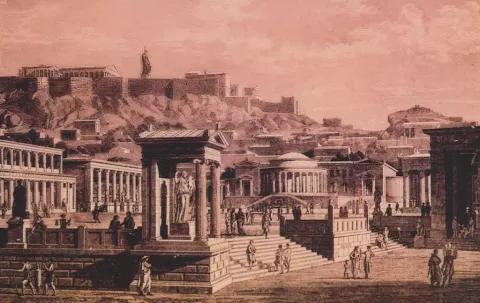
The ancient Greek bank or “trapeza” was placed in close proximity to the agora, the economic and cultural center of Greek poleis, to be within reach to the clients. The most impressive banks were strong and reliable structures with facilities for conducting banking operations and for storage of valuable goods.
Touchstone
Both individuals and governments knew to reduce purity of precious metals by alloying them with cheaper metals. Thus the bankers relied on touchstones – a small black siliceous stone convenient for holding in one hand ─ to test the purity of gold and silver coins. The degree of purity was checked by comparing the color of streaks left on the touchstone by a metal of unknown purity with that made by a metal of known purity.
Banking personnel
In running a business the trapeza was operated by an owner, who had to be a free citizen, and by auxiliary personnel made of well-trained slaves and freed-men whose number and charge greatly depended of the business scope and its needs.
Functions of the first bankers
Along with the testing of coins, exchanging money, and taking deposits, banking business of the ancient Greeks soon extended to more complex transactions. Lending money at interest emerged as the core occupation of the ancient bankers. The interest rate of 12 percent per year was the prevailing rate of interest on ordinary loans. Maritime loans involved greater risks and belonged to completely different category of lending for which interest rates ranged between 12 and 100 percent, depending upon the destination and season of travel. Loans were usually collateralized by mortgages on valuable property depending on the social statues of the clientele − such as real properties, merchant vessels, mining plants and slaves and etc. Although the financial activities of the ancient Greek bankers were considerable and covered various functions, the invention of more demanding clearing systems was postponed for the future times.
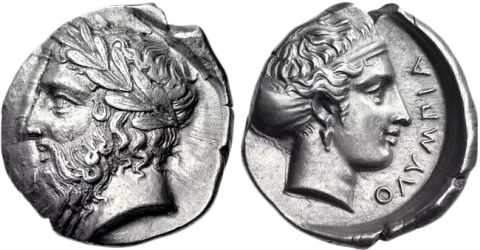
Silver Tetradrachm from Olympia, 360 BC. Obverse Head of Zeus wearing laurel wreath. Reverse Head of the nymph Olympia wearing sphendone. OΛYMΠIA to right
Touchstones were also called “Lydian stones” after Lydia which invented the first coins and had first used the touchstone.
In order to fully meet the customers’ needs in the 3rd century BC Alexandria was opened, perhaps, the first “all-night bank” in history and was owned by the banker Caicus.
Contrary to common belief, slaves who worked for the banks could enjoy great authority and importance in business circles. Moreover, due to their opportunities for manumission and inheritance they represented the most socially mobile businessmen in ancient Greece.
Chapters
- Introduction to Greek Banking
- Moneychanger - the Proto Banker
- Banks
- Banking Personnel and Business Practice
- Functions - Banking in Ancient Greece
- Legacy
Introduction to Greek Banking
Banking is considered as one of the oldest institutions in business history. The first banks in the world history were religious temples of the ancient Mesopotamia whose oldest preserved records of loans date back to the 18th century BC. Temples were a natural choice for storage of both valuable and ordinary goods in antiquity since they were solidly built and their sacred role provided additional spiritual protection of violation.
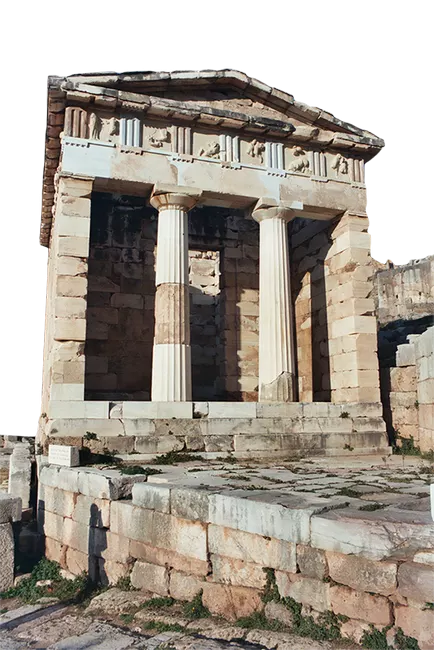
Banking practices of the ancient Greece had developed on similar foundations, but in more advanced and sophisticated form. The temples in Delphi and Olympia were particularly wealthy and renowned in the ancient Greek world. However, protagonists of Greek banking business weren't temples and its priest, yet the private entrepreneurs.
The ascendancy of the Greek banking concept was fostered by the greatest achievement of antiquity – invention of money. Following the discovery of coined money that occurred in the 7th century Lydia, its use has been spread all over the Greek world. Its usage brought a significant alleviation of business transactions because it was easily stored, transported and counted. The city-states of the Greek world scattered all over the Greek mainland and the Aegean Sea, regardless of their greater or smaller relevance, soon started to coin its own version of money. Ultimately more than 11 hundred Greek cities and several hundred minor monarchs was issuing their own coins. In such circumstances impurities and counterfeits abounded in business life.
In the confusion that this economic invention initially created, one vocation paved the way to creation of the sophisticate banking service – it was the money-changer. Thus, we can safely say that monetary transactions, that is, the use of coined money as universal medium of exchange, created a uniqueness of Greek banking and its legacy is still alive today.
Moneychanger - the Proto Banker
Introduction and existence of various coinages imposed a necessity for creation of expert who would in professional manner facilitate the business life. He supposed to be well acquainted with coins that differed among themselves by used metal, weights, and different degrees of purity, all of which in turn, affected its gradations in value.
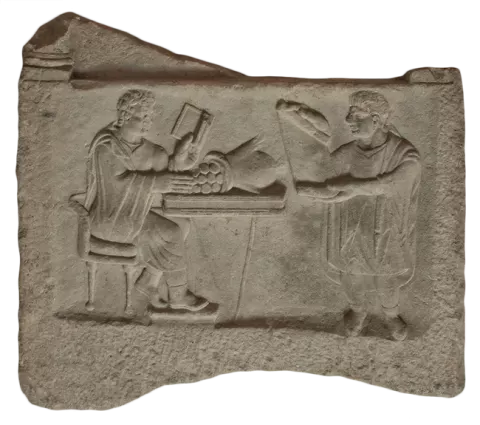
So the first bankers were actually the 6th century BC money-changers, persons who had a table in some public place near the market, and whose business was to change the coinage of one city for that of another. The earliest mentioned banker in Greece for whom we have reliable evidence is Philostephanus of Corinth who lived in the 5th century BC. According to the procedure, the moneychanger first needed to measure all items using a small balance scale called “stathmos before he changed coins. For an exchange of certain sum he used to charge commission of 6 percent of the total amount of exchange.
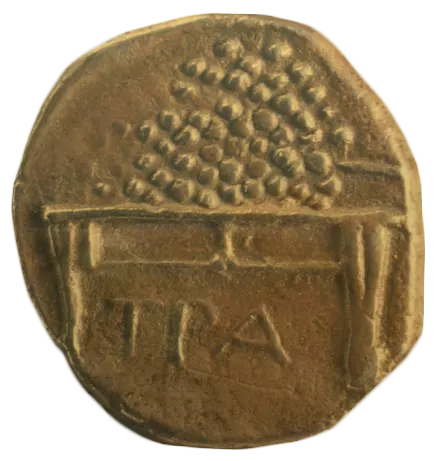
From the Greek word “trapeza” meaning the “table” or “counter” on which the money-changer performed his job, derived the word “trapezites” (pl. “trapezitai”), the usual appellation of the banker, which means originally “the man at the table”. The medieval Italians, who were experts on the issue of finance, used the word “banca” for denoting the “table” or “bench” where the moneychanger held a job. Hence the modern word “bank” derives.
Banks
Money changer who ran a business on a large-scale must have had some kind of facilities in order to keep money and valuables necessary for daily business transactions safe. In times when life was uncertain and legal protection rather disputable, people who kept large sums of money with them, both travelers and people who stayed at home, risked of losing them.
The credibility of banker, that is, his reputation of a man with strict integrity and honesty was of crucial importance in getting a client to entrust him assets. In other words, the business ethic was inseparably bound to professional success in the ancient world.
The banks which kept their old name “trapeza” were usually situated in close proximity to the commercial square, the center of public life. The most impressive ones evolved in impressive structures which contained a considerable staff, as well as facilities for business meetings, keeping of books, receipts, weighing, and storage of valuable goods in order to meet the whole of customer’s needs.
Banking Personnel and Business Practice
Generally speaking, the bank's staff have consisted of its owner and employees.
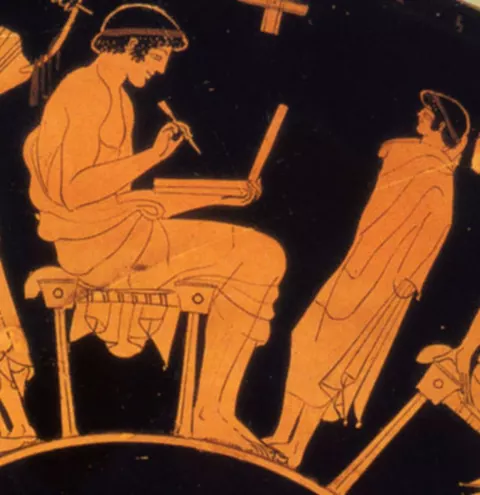
Only the free citizens could be the owners or lessors of the bank, while the employees were usually unfree individuals. Besides the owner, banking personnel consisted of cashier and bookkeepers. These duties were performed by one or two confident employee who was well trained slave or eventually freed-men. The bank was additionally supported by many ordinary slaves, their number and charge greatly depended of the business scope and its needs. However, it was not impossible that a slave who was an ordinary worker becomes the owner of the bank. This was the case of Passion who is known as the wealthiest banker in the ancient Greece.
Most of the banks used daybooks and ledgers in conducting their business operations. In daybooks were recorded all transactions as they were completed, while ledgers were kept to show how the account of each individual client stood.
Demosthenes provide us with information on bookkeeping of the Athenian banks: “It is the custom with bankers“, says Demosthenes, “to make memoranda of the sums which they advanced and the purposes for which these are wanted, and of the sums which their customers deposit, so that they may be able, by knowing what has been received and what deposited, to balance their accounts”. These precise accounts, which were a testimony of a high business standards and professional efficiency of the ancient bankers, were accepted as evidence on courts of ancient Greece.
Functions - Banking in Ancient Greece
Functions
The original moneychangers were experts on coins. As skilled assessors they verified if the coins that circulating market were genuine and of good quality, and exchanged one currency to another.
The process of transforming the moneychanger into a private banker was gradual. In the beginnings, the merchants had a practice to make payments in the presence of “trapezai” who would confirm the quality of the coins. Next, it became usual for merchants to deposit their money with a moneychanger for safekeeping, or for several payments in future. However, accepting money on deposits, the moneychanger stopped to be an ordinary money-changer and pawed the way to become a true banker.
Silver Tetradrachm from Olympia, 360 BC. Obverse Head of Zeus wearing laurel wreath. Reverse Head of the nymph Olympia wearing sphendone. OΛYMΠIA to right
Since the moneychanger sought the way to charge his service, it did not take long before he perceived the possibility to make profits by lending a portion of his deposits to responsible borrowers of interest. Lending money at interest eventually became the principal business of the bank. For ordinary customers the interest rate for loans ranged between 12 and 18 percent.
A “trapeza” ran account for each customer, posting to it each deposit and withdrawal. When two customers (payer and payee) held an accounts with the same banks, which was usual among people of same trade, it was possible to carry out a non-cash payment by simply debiting the depositor’s account and crediting that of the payee on the books of “trapeza”. For an actor that did not had an account with the same bank in which payment was deposited it required a different procedure. Payment orders by depositors to banker were given usually orally and in person.
But, since the banks risked their own capital they were inclined to conservative business strategy. Loans were usually collateralized by liens on valuable property, depending on the social statues of the clientele. Loans were usually secured by mortgages on real property, for example, farms, dwellings, and apartment houses. Also, money could be lent on a merchant vessel and the slaves who constitute its crew, on a mining plant and slaves, on the endorsement of another patron of the bank, in pledge and so on. However, there have been instances of unsecured loans as well, but very rare, and they were protected merely by the personal credit of the borrower. The early bankers also avoided to extend loans to government because this was a large and risky lending. Therefore the government raised funds through either sale or leasing of valuable assets, such as the right to farm particular taxes, monopolizing particular trades or controlling foreign commerce.
As the financial operations of bankers developed and individual banks became richer and more powerful with the expansion of trade and industry, their activities were extended to public finance as well. Rulers, who had previously in critical situations such as wars or social crises sought relief in temples, now realized the advantage of securing the co-operation of the financiers who possessed vast resources in money or credit. During the 4th and following centuries a large loans were advanced by banks to their own and neighboring governments.
In addition to usual services, some bankers occasionally served as surety or bail for clients, usually to foreigners or resident aliens who probably had substantial sums on deposit. As a personal favor, besides the money, they received any valuables of their clients among which written contracts had a special place. In order to fully meet the customers’ needs, in the third century Alexandria was opened, perhaps, the first “all-night bank” in history by the banker named Caicus.
In addition to temples and individuals, some Greek city-states, such as Miletus, known for its financial strength, created a state bank for its money transactions.
Although the financial activities of Greek bankers covered various functions, the ancient Greek banking did not recognize intra city or intercity interbank clearing systems.
Legacy
After Greece was subjugated to the Roman Empire in the 2nd century BC, numerous achievements in the field of culture, science and economy were assumed by the Romans. Under the Roman bankers, “argentarius”, banking practice as well as banking laws were further developed and expended throughout the ancient world.Thus, the Greek perfection of Mesopotamian financial innovations had a lasting and relevant impact on Western economic development.
6 lives in this room
More lives in this room
- Demosthenes 5th-4th century BC
- Eubulus 5th-4th century BC
- Hermias 5th-4th century BC
- Pasion c. 430 BC -370 BC
- Archestratus of Athens 4th century BC
- Phormion 4th century BC