No. 8999
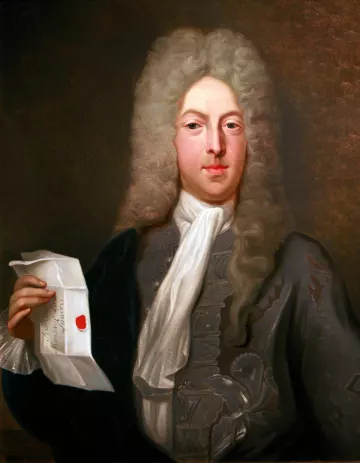
John Law
A banker, gambler and economic theorist, Law amassed a large fortune through gambling and devising of economic theories known as the Law’s System, which form the basis of the modern banking system.
Law was born in Edinburgh, Scotland, in an affluent family of goldsmith and moneylender, and he started his career in the family enterprise. In 1688 he went to London to study mathematics, business and economics. There he entered the circle of wealthy people and was a regular guest of the gaming house. Eventually he built a reputation as a successful gambler and speculator in government paper, but killing a man in duel forced him to flee to Amsterdam.
In Amsterdam he studied banking practices and began to develop his famous economic theories which are known as Law’s System. He observed how the bank serves as a trade intermediary and was particularly interested in the secret transactions, in which the bank issued credit without any coins being deposited. He was convinced that an increase in money would increase trade, and advocated the creation of money by permitting banks to make loans, records deposits, but not receive cash for the loans. He visited Scotland in 1700 and 1705 with the aim of ameliorating its economy, but his plans were rejected, and he went to a decade long travelling throughout Europe.
He lived from gambling with the wealthy in which he was extremely successful. In 1708 while he was trying his good luck in Paris, he became a friend with Philippe II, duc d’Orléans. His large winnings eventually became suspicious, although he claimed that his wins were result of ordinary mathematical system. Nevertheless, he was forced to leave France and to continue his travels during which he amassed a fortune of 1,600,000 livres by gambling.
After in 1715 the duc d’Orléans became regent of France, Law decided to return in France where he succeeded to obtain a patent for a private bank and financed the Banque Générale. Successful operations enabled him to purchase trading companies, including the Mississippi Company which had a monopoly on trade in North America and West Indies, and he also controlled Compagnie des Indes, which included all the major French trading companies. By 1720 his system was applied to the French economy, and he was appointed comptroller-general of France, and had monopolies on tobacco, salt and money coining.
However, during 1720 his manipulations of market caused financial panic and collapse of his system. He was dismissed from his office and forced to flee to Venice. He died there in 1729 in great poverty.