No. 10618
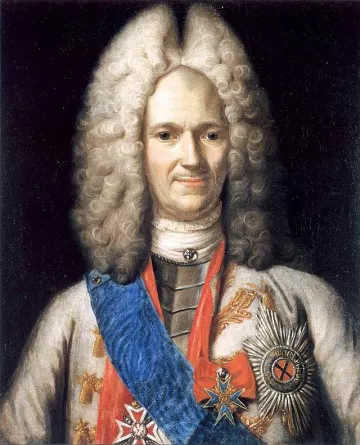
Aleksandr Danilovich Menshikov
Aleksandr Menshikov was born in 1673 to a Lithuanian living in Moscow. He came from a very humble background, and as a boy he worked as a stable boy at the imperial state and seller of meat pies on the streets in Moscow. Although he was illiterate until adulthood, he was characterized by wit and outgoing personality.
His destiny began to change after he met François Lefort, a young Swiss mercenary in the Russian army and close friend of Czar Peter the Great, who was impressed with Menshikov and took him into his service. So he got the chance to get close to Peter, who was only a year and a half older, and two of them became close friends. Menshikov entered in his service. He participated in the creation of the Toy Army – a regiment of noblemen’s sons who dressed up as soldiers and fought practice battles - which would eventually evolve in emperor's personal guard and the foundation of new, westernized military. He also joined Peter during his journey to Europe which had diplomatic and educational purpose, and two of them learned shipbuilding in Amsterdam.
Upon returning to Russia, he helped Peter to crush a revolt that broke among officers who were dissatisfied with plans of westernization. In the meantime, he became czar’s primary adviser. When the lengthy Great Northern War (1700-1721) broke out with Sweden, he proved to be bold and capable commander. In return for his services, Peter granted him numerous honors, titles, command positions, and land grants. He was made governor of Karelia, Ingria and Estonia, and after a while, the prince of Izhora with large estates. It was followed by the position of the governor general of St. Petersburg which was destined for the new Russian capital. For his role in the famous and decisive Battle of Poltava (1709), he was promoted and became a field marshal and was granted lands at Oranienbad, near the Gulf of Finland.
His numerous positions provided him with numerous opportunities for different embezzlement and extortions. After 1714 he was under almost continuous investigation for corrupt practices, and fell into disgrace toward the end of Peter’s reign who was thoroughly disgusted and disappointed with his closest friend. The death of Tsar Peter in 1725 proved to be salvation for his career. He succeeded to make a widow Catherina, his ally and former mistress, Russian empress and through her he became virtual ruler of Russia since she had no knowledge of the state matters. He was named head of the Privy Council, the first senator, and Russia’s only grand duke. When Catherine became mortally ill two years later, he worked to make Peter’s grandson, Pyotr Alexeyevich, the new czar and arranged the marriage between young emperor and his daughter. However, his numerous enemies managed to turn Peter II against him, whereupon he was arrested, stripped of his rank and property, and sent to Siberia, where he died.