No. 215
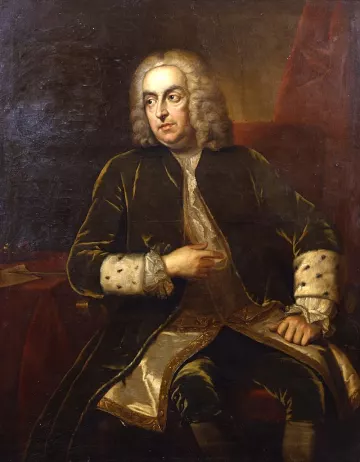
William Pulteney
William Pulteney, first earl of Bath, was born in 1684 in a family of wealthy landed gentry with property in London. According to his status, he was educated at Westminister School and Christ Church College at Oxford. After he completed his studies, he went on a long journey through Europe as was the practice among wealthy and young British aristocrats.
His political career began in 1705 when he entered House of Commons as a member of the Whig Party. Henry Guy, secretary to Treasury, became his political patron, and since he was childless he left his estate, including land in Middlesex and a large sum of money to Pulteney in 1711. In 1714 Pulteney married Anna Maria Gumley, the daughter of a rich cabinetmaker that provided him with additional social contacts. When in 1715 his father, Colonel William Pulteney died, he inherited family estates in London, primarily in Soho and Piccadilly. At Piccadilly he built a splendid mansion that later became known as Bath House. In 1742 he was raised to peerage as the earl of Bath. His political career was mainly marked by his conflict with Robert Walpole, a Whig politician.
His immense wealth, Pulteney spent on development of his London real estates, and different hobbies, such as collection of plates and pictures. He was also a director of the Royal Academy of Music and a patron of theater. His greatest legacy was, however, development of a considerable portion of the West End of London.
Since he had no living children, he left his properties to his brother, General Harry Pulteney. In addition to land, according to some estimates, his personal estate was worth between £600,000 and £1,2 million. All in all, he was easily worth £2m, a equivalent of £14.9bn in 2010.