No. 194
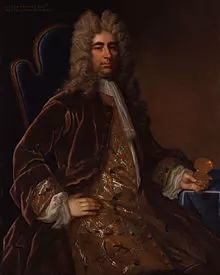
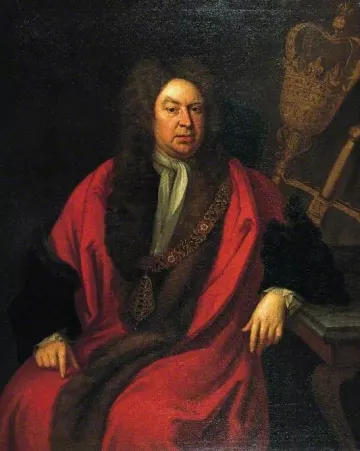
James Craggs
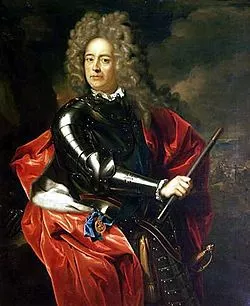
Craggs was born in 1657, in County Durham, England, and was educated at the local free grammar school. At the age of 21 he went to London to make his fortune. He served the Duke of York, the Earl of Peterborough, and was steward to the latter's son-in-law, the Duke of Norfolk. In 1684, he married Elizabeth Richards, the daughter of a corn merchant. Craggs' wife was a domestic servant to Sarah Churchill, who later became the duchess of Marlborough. Through this connection Craggs became acquainted with John Churchill, who later became the first duke of Marlborough.
Craggs served Churchill as a private secretary, and Churchill was his mentor in the matter of politics. In the 1690's Craggs was branching out into army clothing contracts and financial brokerage, paying particular attention to the East India Company. On 7 March 1695, he was imprisoned in the Tower of London for failure to supply the Parliamentary commissioners of public accounts with information regarding alleged improprieties in his administration of the clothing contracts. It was also discovered that he was bribed by the governor of the East India Company, Sir Thomas Cooke, in order to help the company to maintain its monopoly. Craggs was soon released and had maintained his connection with the English East India Company into the eighteenth century, even serving as a director from 1700 to 1705.
Craggs' fortune was interlinked with his mentors', and both of them benefited from the War of the Spanish Succession (1701-1714). Craggs was appointed secretary to the master-general of the ordnance, Churchill, and the clerk of the deliveries of the ordnance. He also entered the House of Commons in 1702 and retained his seat until 1713. In 1715 he received the lucrative position of joint postmaster-general.
He and his son, also named James Craggs, were deeply involved in the activities of the South Sea Company, a firm established to trade (mainly in slaves) with Spanish America and to help manage Great Britain’s national debt after the War of the Spanish Succession (1701-1714). When the price of the company's stock began to fall dramatically in the autumn of 1720, he was at the center of attempts to remedy the situation. However, an inquiry into the company's finances reported that he had received £30,000 worth of stock for which he had not paid. The inquiry happened in January 1721, his son died in February of the same year, and stuck by this tragedy Craggs died a month later.
At the time of his death Craggs was worth £1.5m, the equivalent of £20.8bn in 2010.