No. 222
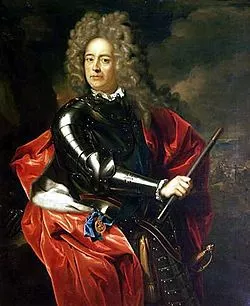
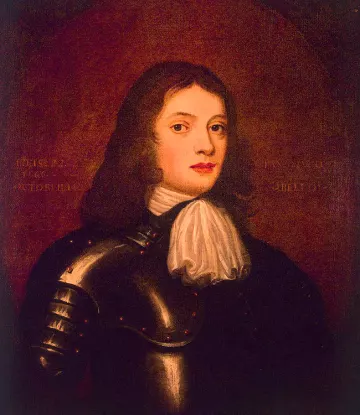
John Churchill, First Duke of Marlborough
John Churchill was born as the son of Sir Winston Churchill, a Member of Parliament and adviser to King Charles II of England, and his wife Elizabeth Drake. Through various government offices he became one of the richest men of his time.
Churchill started his career as a courtier in 1666 as a page to James, duke of York, who was the brother of King Charles II (r. 1660-1685) and the future King James II (r. 1685-1688). The following year, he received a commission in the Foot Guards and was sent to Tangier (now Algeria) in northern Africa to fight the Moors. At the time, he was only 17 years old. After he returned to England, he began to made incomes through his positions as a gentleman of the bedchamber and master of the robes, as well as through military service on the Continent during the Third Anglo-Dutch War (1672-1674).
In 1685, James II ascended to the English throne and employed Churchill on a special mission to France. As a reward for this service, Churchill was promoted to major general and a baronet. In a meantime, he married in 1678 the beautiful and vigorous Sarah Jennings who was a confidant of Princess Anne, the future Queen of England (r. 1702-1714). Therefore, the couple became quite wealthy because of the income from their positions, annuities, and investments.
In the period between 1685 and 1714, Churchill was one of the most influential men in England. He was made the earl of Marlborough and commander of a regiment in Europe during the Wars of the League of Augsburg (1689-1697). In 1692 after the letters that he wrote to the expelled king James I were uncovered, he was stripped of his titles and temporarily imprisoned in the Tower of London by the by the current King William III (r. 1689-1702). However, he was soon released and his title and rank in the army were restored. Churchill won the king’s confidence once again and was appointed commander of the British forces at a salary £10,000 per year at the beginning of the War of the Spanish Succession (1701-1714). During the war, he won several major victories and became the greatest general of England and duke of Marlborough.
In 1711 he was accused of favoring the war in order to improve his material position and relieved of his commanding duty. The following year he went in exile on the continent. With the new King George I (r. 1714-1727) he returned to England and was restored to his position as captain general. However, due to declining health, he could not accept the service and after a series of strokes he died at Blenheim in 1722. At the time of his death his fortune was reckoned to have been at least £1m. In 2010's money that would be £13.6bn.