No. 7544
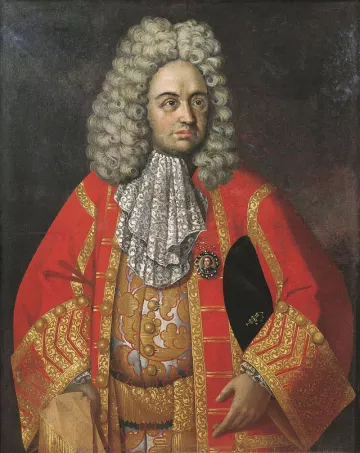
Samuel Bernard
Samuel Bernard was born in a protestant family of Dutch origin in the predominantly Catholic France.
Since he belonged to bourgeois class, he received a standard bourgeois education that enabled him to engage in business. He started his career as a merchant of gold brocade and jewelry, and eventually expanded to banking, receiving support by the Protestant refugees living abroad. In order to improve his business, he renounced publicly his protestant faith in 1676, although he remained loyal to protestant faith privately. When the King Louis XIV in 1685 founded the Compagnie de Guinee, a trading company engaged in the gold and slave trade, Bernard was one of its founding members. His wealth was additionally augmented by a policy of minister of marine who allowed the sale of goods acquired through pirate activities.
By 1695, Bernard was known as the wealthiest banker in Europe and as the most successful of the protestant bankers. In the subsequent period he became the financier of the King Louis XIV’s major wars, and in exchange for his services he was elevated to the rank of nobility, but under the condition that he would not abandon his financial activities which were useful to the kingdom. During the reign of his successor Louis XV, he continued to enjoy his prestigious position as royal financier. In addition, the king made him the hereditary comte de Courbet in 1725 and in 1730 he appointed him the counselor of state.
The acquired wealth, Bernard began to invest in land property, first in Seine-et-Marne and later in Normandy. At the time of his death, he left an estate valued at 33 million francs.