No. 1396
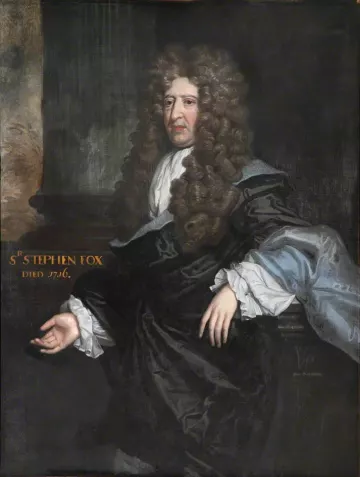
Stephen Fox
Although he was raised in relative poverty, young Fox received a gentleman’s upbringing, and education in bookkeeping and financial management. He entered the court with the help of his brother who already served there. His first appointment was that of a page to Lady Stafford, then the countess of Sutherland; and then to Henry, Lord Percy, a favorite of Queen Henrietta Maria.
Accompanying Charles II in his exile to the continent, Fox was appointed manager of the royal household, on the recommendation of Edward Hyde, 1st Earl of Clarendon. Fox was described as "a young man bred under the severe discipline of Lord Percy ... very well qualified with languages, and all other parts of clerkship, honesty and discretion". With the restoration of the Charles II to the English throne in 1660, began Fox's ascent in society although not as fast as he hoped. He had to obey the court protocol and accept a lower office until the deaths of older officers. Therefore he initially served as the chief clerk comptroller and then as the second clerk of the Green Cloth, and received an estate for his loyal service.
His career ascendancy and personal fortune finally began when he gained the position of an informal financial agent. He was in charge for raising and dispensing money that went directly to the royal household, instead of being disbursed by the Exchequer (government treasury). That allowed the royalty to have more flexibility in its expenditures. With the post of paymaster of the king’s guards he was involved in the financial transactions of the realm on the larger scale. To ensure prompt payments of the troops he created an efficient financial system.
During his financial career in the service of government, Fox accumulated a substantial wealth from arranging loans to the government or loaning the government money from his capital. He continued to rise to other positions in the government and eventually became First Lord of the Treasury. He also served in Parliament. He was known for his generosity and used his wealth to help other people by investing money for other and by helping them to gain the posts in the government. Although he made a fortune during his career, he is remembered as an honest and reliable official who served in the politically unstable times such as Restoration and the Glorious Revolution (1688- 1689).
One of Fox’s most enduring legacies was establishment of the Royal Hospital Chelsea, one of many charitable institutions that he established or influenced.
In the last years of his life he retired to Chiswick where he died in 1716 as one of the richest men of his time.