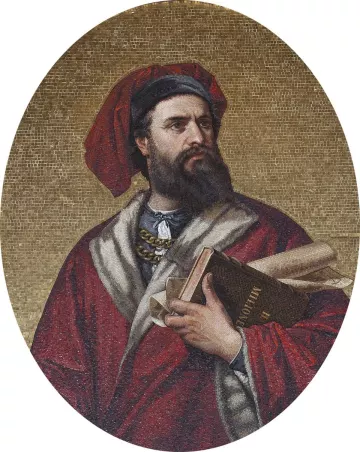
No. 10802
Marco Polo
Merchant and explorer
Marco Polo was the most famous of travelers and merchants journeying the Silk Road. His journey to Asia started in 1271 and his return to Venice was in 1295. Description of cultures and his adventures were written in his book that came to be known as “Il Milione” (“The Million Lies”), since it was to fascinating to be believed as a record of true events.
Marco Polo was born in 1254 to a wealthy Venetian merchant family. Much of his childhood was spent parentless, since Polo's mother died when he was young, and his father and uncle, successful jewel merchants Niccolo and Maffeo Polo, were in Asia for much of Polo's youth. They returned from Asia in 1269 with the request from Kublai Khan to visit again with 100 priests and a collection of holy water.
In 1271, Niccolo, Maffeo and Marco Polo set out for Asia. The Polo’s were unable to recruit the 100 priests that Khan had requested, they left with only two, who, after getting a taste of the hard journey ahead of them, soon turned back for home. They traveled by land and Marco’s later memory for the places and cultures he witnessed was remarkable and exceptionally accurate. After four years of travel, the Polos reached China and Kublai Khan, who was staying at his summer palace known as Xanadu, a grand marble architectural wonder that dazzled young Marco. Polo’s were granted important positions in the Khan’s Court and had stayed in the Mongol Empire for 17 years. Among other duties in service for Kublai Khan, Marco served as a special envoy. In that capacity he was sent into far-flung areas of Asia never before explored by Europeans. The experience provided Marco with the knowledge of the cultures under the great Khan as no European could possibly dream of.
After 17 years in Khan’s court the Polo’s decided to return to Venice. The decision displeased the Khan, but he accepted it with the request thet Polo’s escort a Mongol princess to Persia, where she was to marry a Persian prince. This time they journeyed by sea. The journey was filled with perils and by the time the group reached Persia's Port of Hormuz, just 18 people, including the princess and the Polos, were still alive. In Turkey, Genoese officials appropriated three-quarters of the Polo’s wealth.
Few years after his return Marco commanded a ship in a war against the rival city of Genoa. Eventually, he was captured and sentenced to a Genoese prison. During his imprisonment Marco told the story of his adventures to a fellow prisoner and writer named Rustichello. Marco’s stories were committed to paper and published as a book called The Description of the World, later known as The Travels of Marco Polo. The book also came to be known as “Il Milione” (“The Million Lies”), since few readers allowed themselves to believe Marco's tale.
Marco was released from prison in 1299 and spent the rest of his life in Venice where he married, raised three daughters and, for some 25 years, carried on the family business. Marco died at his home in Venice on January 8, 1324.