Museum / Rooms / The Venetian Republic
Room · 6 chapters · 30 lives
The Venetian Republic
Emerging from a fishing villages in the 5th century Venice became a commercial hub for luxury trade between the wealthy Byzantine and Islamic states of the East and Western Europe
The Queen of Adriatic
The Republic of Venice is known as one of the greatest maritime and trading powers during the Medieval and Renaissance period. Ruled by the oligarchic class of wealthy merchants the Venetian Republic represents one of the rare historical examples of successful alliance between interventionist government and individuals united in acquiring of wealth.
Staple city
The fastidiously built status of a staple city was the foundation of the large Venetian fortune. Merchants from all around the world – like the Italians, Germans, Jews, Arabs and Persians ─ were welcomed to Venice where the state provided them with lodgings and warehouses to conduct business. The only requests which foreigners were obliged to respect were to conduct all their transactions in Venice, pay taxes, and not to ship their goods overseas.
Colonial empire built through trade
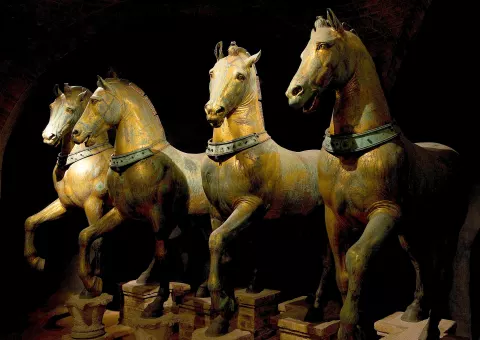
Economic privileges and monopolies that the Venetian merchants enjoyed in the Western Europe, Byzantine Empire and Islamic states were the basis of Venetian commercial supremacy. It witnessed not only about the masterful Venetian diplomacy which was at the world level, but also that when it comes to business there were no moral constraints. In fact, the culmination of Venetian economic and political power was enabled by a quite violent act ─ the 1204 Conquest of Constantinople, a splendid capital of Byzantine Emperors. In the aftermath of this scandalous sack, Venice obtained not only rich plunder which was shipped to Venice and still adorns the city, but also founded colonial empire in the Aegean, eastern Mediterranean and Black Seas and established control over the most important ports and islands on the way from Venice to Constantinople.
By the mid-13th century around 70,000 Venetian merchants moved to colonies in pursuit of profit.
Manufacture
Except of merchandise Venice also transferred technology from East to West. The Venetians were renowned experts in shipbuilding, glassmaking, salt and silk industries, and in book production. They were also the first to establish sugar plantations which relied on slave labor on its possessions at Crete and Cyprus which would be later copied by the Portuguese and other colonialists.
International trade
International trade was under direct surveillance of the state which determined sailing schedule, cargoes, routes, and ensured safe navigation for its ships. The transport of precious cargo (spices, bullion, and cloth) was conducted in escorted convoys (“mude”) and comprised of galleys contracted by state to private entrepreneurs. Other commodities were transported unaccompanied on sailing ships (“coche”) which belonged to private companies and usually bore the name of the family holding the most shares in business.
Financial instruments for financing international trade
Only the richest Venetian families could afford to internally finance ship and cargo in long distance trade. Other businessmen of various financial strength used limited liability partnerships called “colleganzia” both to pool capital and spread risks. To lease the galleys which were auctioned by the state in times of peace the merchants used to form temporary companies. Each voyage could be financed through dividing up investment into 24 shares or “carati” whose owners were called “parcenevoli”. Other way of funding was a more complex “maona” partnership in which all the shareholders in the ships of a whole fleet joined forces to purchase cargo and to negotiate the best terms in the venture.
In order to ensure that all merchant ships within its waters operate in accordance with Venetian navigation laws and treaties the government organized naval patrols that controlled traffic in northern Adriatic.
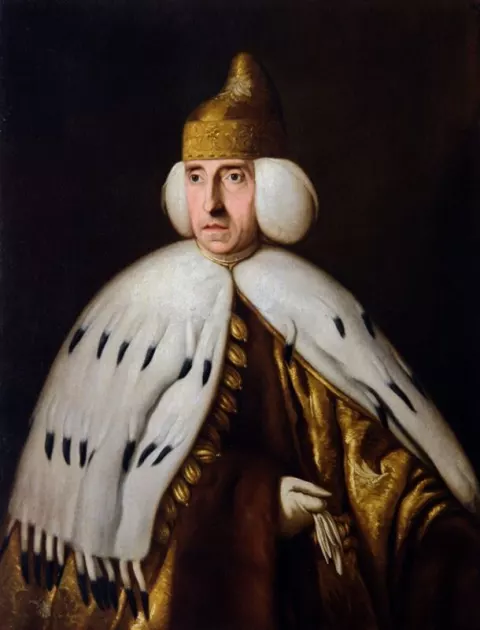
By diverting the crusade attack on Constantinople the doge Enrico Dandolo became the founder of the Venetian colonial dominance in the East and the maritime supremacy in the Mediterranean. It is said that this ninety years old and blind doge participated in the assault on Byzantine capital and personally scaled a ship's ladder up the city walls.
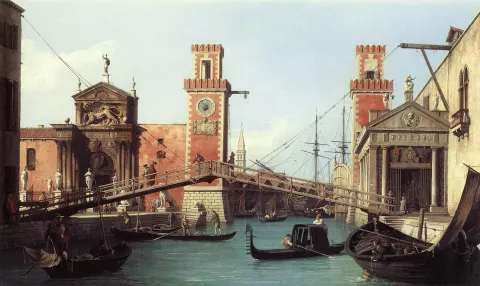
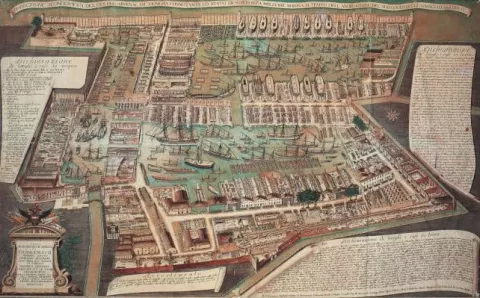
The Venetian Arsenal founded in 1104 represented the leading industrial complex in the Mediterranean and base of its commercial and maritime supremacy. In the 16th century it extended on 263,000 square meters and employed 16,000 workers.
Sailing between Byzantine Empire and the crusader state of Acre was conducted with two convoys which usually consisted of 10 to 20 ships. One caravan left in the spring and returned in the fall, while other left in the fall, wintered outseas and returned in the spring.
Chapters
- Establishment of the city in the lagoon
- Political and economic expansion
- The Venetian Republic - Government
- The Venetian Republic - Economy
- The Venetian Republic - Decline
- Financial instruments
Establishment of the city in the lagoon
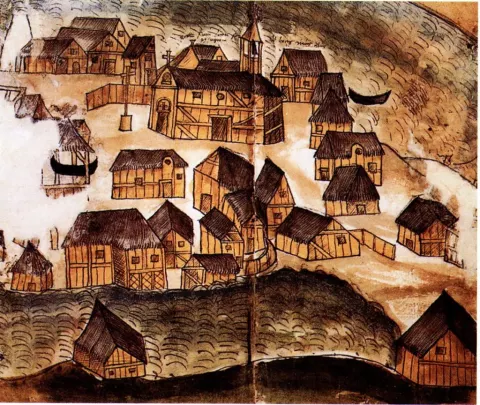
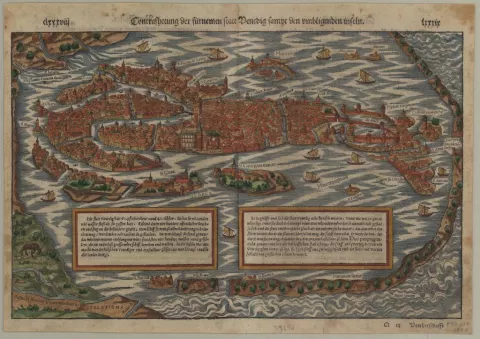
Already inhabited in the pre-Roman and Roman times by the scarce fishing communities and salt workers, Laguna Venete with its islands and sandbags proved to be the perfect place for defense, as well as for trade, due to its easy access to the Adriatic Sea and to inland waterways. By taking advantage of a favorable position, in the following century the small island settlements evolved in city-state which became the greatest seaport, as well as commercial and cultural link between Europe and Asia. According to legend, the city was founded on Friday, 25 March 421, exactly at noon.
From its beginnings, Venice was under the influence of the Byzantine Empire, the legal successor of the Roman state and its lost territories in the West. Eventually the dispersed settlements in lagoon became united in political entity. Among them, Rivo Alto, better known as Rialto was the most central and represented the core of Venice, linking together 118 separate islands with bridges and canals, and subordinating all other settlements. In the 9th century, the city was for the first time mentioned as civitas Venetiarum, which was a sign of its increasing autonomy. After the relics of St. Mark the Evangelist, who became the city's patron-saint, was stolen from Alexandria in 828 and brought to Venice, the city gained necessary status and was founded officially.

Political and economic expansion
in building up..
In building up its trade the Republic of Venice managed to create a political empire. During the entire existence of Venetian Republic its economic history has been closely intertwined and inextricably linked to the political. By combining naval aid and skillful diplomacy Venice managed to gain trading privileges which made the basis of its economic welfare.
In the beginning, the Venetian sailors and traders were limited to the local routes and north Adriatic area, but from the 7th century on the Venetian trade began to expand partly due to the role of Byzantine stronghold in northern Italy. Stronger economic rise started in the 9th and 10th centuries thanks to favorable geographical position and overall economic recovery of other Italian coastal towns. Over the Alpine passes, Italian cities penetrated the Danube region, Rhineland and southern Gaul, and by the sea routes to Byzantine and
Islamic cities on the Mediterranean which were the focal point of trade with the East. From the second half of the 10th century the connections with Sicily, Tunis, Egypt and Syria became more powerful. Some especially curious and courageous Venetian traders tried to follow the caravan paths. Marco Polo, the famous traveler could serve as a representative of this type of merchants.
Great wealth accumulated through the trade and territorial acquisitions which included maritime as well as land possessions, settled the Venetian Republic in the place of a leading trading power of the Middle Ages and Renaissance.
interests in the east
Political and economic expansion
Interests in the East
As early as the 9th and 10th centuries Venetian merchants had established successful trade links with the Byzantine Empire in the eastern Mediterranean. To ensure safe navigation to the East it was important to establish and maintain the political control of the eastern Adriatic coast which, with the numerous coves, bays and islands provided shelter from sudden sea storms and ports for ship supplying, represented a far safer solution then the Italian coast.
Two events from that time had an enormous influence on Venetian growth to position of a leading maritime power. The beginning of large scale Venetian activity on the East marked the privilege granted by the Byzantine Emperor Alexius I Comnenus for providing military help in the war against the Normans. In the Golden Bull (1082) Venice gained the right to conduct trade throughout the Byzantine Empire and was completely exempted from paying all tariffs. The native Greeks themselves paid 10 percent for example.
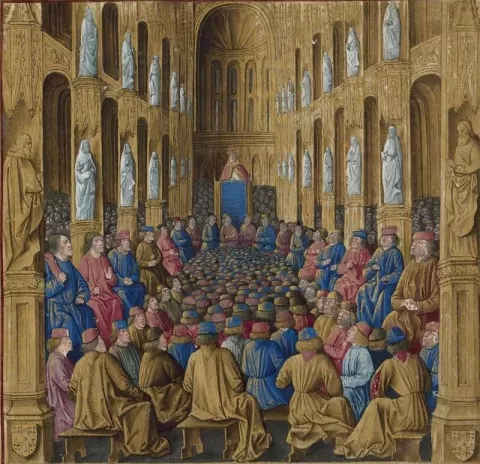
Secondly, when the First Crusade War (1095-1099) was launched in the late 11th century with the aim of re-conquest the Holy Land, the Venetian Republic that already enjoyed trading concessions and conditions for providing of transport, was now able to draw huge profits from the subsequent increase of trade, travel and pilgrimage. After the Crusades founded small Christian states in Antioch, Acre and Jerusalem, the Venice, together with Pisa and Genoa was granted commercial privileges in lucrative commodity exchange between the East and West.
Pope Urban II at the Council of Clermont, the starting point of the First Crusade. Depiction from c 1474.
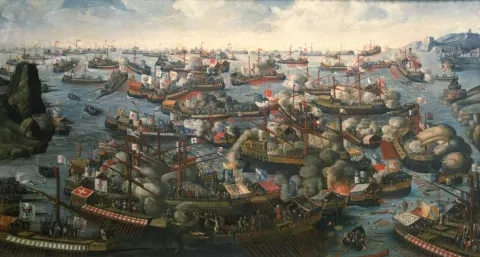
The pragmatic and opportunistic politics of the Venetian Republic reached its finest expression during the Fourth Crusade (1202-1204) when doge Enrico Dandolo, who provided transportation for Crusaders managed to divert the crusader attack on the city of Zara/Zadar (1202) and Constantinople (1204), instead on the Muslims.
Following the fall of Constantinople in 1204 and the newly established Latin Empire, the Venetians were rewarded with extensive trade privileges and the right to 3/8 of the old Byzantine Empire. Venice occupied nearly half of Constantinople and acquired bases in Dalmatia and an Empire in the Aegean. They have also received the right to control the most important ports and islands on the way from Venice to Constantinople – Durrës, Kefalonia, Zakynthos, Modon and Coron in the Peloponnese, Crete, Dodecanese, Rhodes, Euboea, Lemnos and Gallipoli. Venice also gained the access to trade in the Black Sea and Sea of Azov where economy was booming due to the Mongol reopening of the silk route through Central Asia. They were active not only as middlemen between the East and West but also in moving merchandise from one part of the Byzantine Empire to another.
After the Muslims recaptured Syria and Palestine from the Crusaders at the end of the 13th century and held Egypt until 1517, Venice anyway managed to establish a privileged trading relationship there. From the Karimi merchants of Alexandria it obtained Asian spices brought to Egypt from Asia via the Red Sea. In return for spices, the Venetians sold metals, armour, woolens and slaved obtained from the Balkans and Russia. Of course, selling armies to enemies was illegal, but the Venetians found the way to avoid this prohibition by selling raw materials and plain planks which were not strictly speaking considered munition of war.
The Venetian colonies spread in the Byzantine and Islamic cities along the Mediterranean were headed by an official representative, called “bailo” or consul, whose function was to represent the Venetian merchants and entrepreneurs in front of the local ruler, and to protect their persons and business.
The Venetian role in the spice trade was greatly reduced in the 15th century following the establishment of the Ottoman Empire with its capital in Constantinople in 1453. The Ottoman authorities restricted Venetian trade with Syria and Egypt once they have conquered that area, and the role of Venice is further reduced because of Portuguese shipments from Asia.
Political and economic expansion
Interests in the North
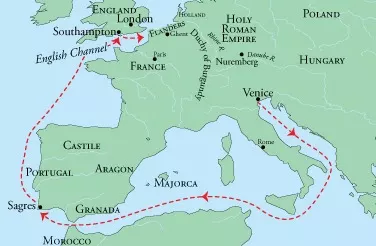
Besides the expansion eastwards, the Venetian Republic was also engaged in trade with Northern Europe. Venice served for centuries as an emporium for goods that derived from the East intended for the western and central European markets. The so called Venice land route (Venezianerstrasse) stretching north across the Alps through the Brenner Pass connected Venice with important European cities such as Vienna, Augsburg, Nuremberg, and Prague. Trade with the northern Europe was mainly conducted at the Champagne fairs where Italian merchants bought woolen goods and sold silk, spices, alum and lacquer. When the sea route was opened in the 14th century between the Western Europe and Atlantic, the Venetian galleys established a profitable business relations with Flanders and south England, namely London and Southampton, and the Western Europe in general.

The Venetian Republic - Government
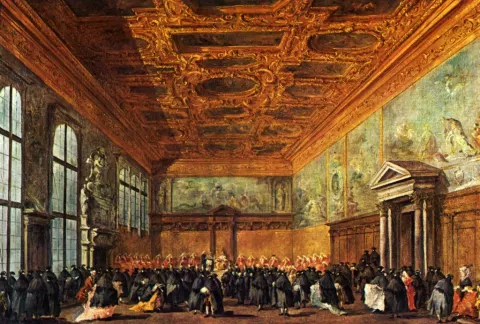
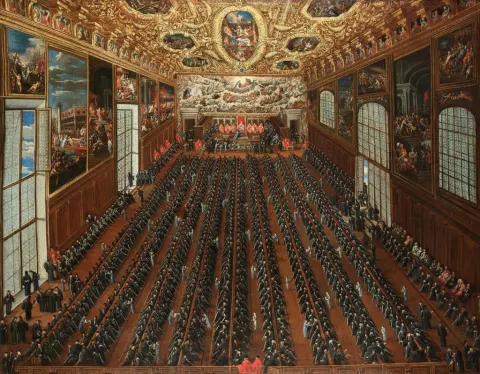
The Venetian Republic was one of the rare examples of successful and long lasting oligarchic republic ruled by merchant capitalist elite in history. A factor that contributed significantly to the economic prosperity of the Venetian Republic was a pragmatic alliance between the state and its subjects.
During its entire history, the Venetian government had a crucial role in designing of economic policy and commercial activities. It supervised development of types of ships suitable for Venetian commerce, the conditions of trade in the Mediterranean, arranged the organization and timing of convoys, controlled the storage and classification of goods in the overseas stock and even leased state-owned galleys to private enterprise.
The Senate had a special task to keep and foster profitability of Venetian merchants through issuing of regulations, sending deputies to a foreign country and launching military and trade fleets. The nature of these measures was twofold – to reduce costs for private traders by making commerce more secure from enemy attack, and to allow smaller traders, with limited capital to participate in international trade.
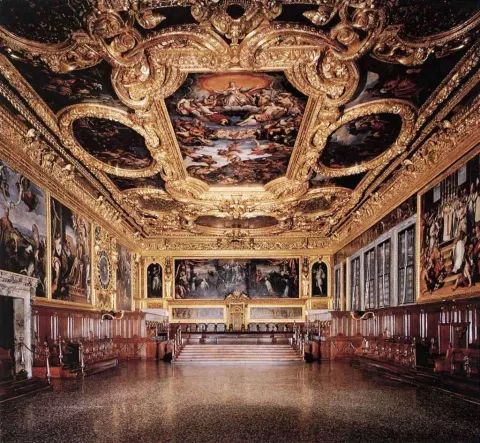
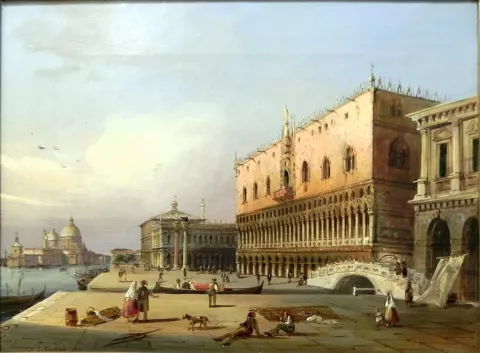
An exceptional concentration of capital and wealth of the Venetian nobles led to the construction of magnificent monuments and works of art for which the city is known today.
The Venetian Republic - Economy
economy
A scarcity of land in the Venetian lagoon naturally turned its inhabitants to seafaring and trade as a means of survival. In the centuries that followed the international trade, banking, shipbuilding and manufacturing activities represented a firm and solid base of Venetian economic power.
A liberal life and business environment attracted travelers and entrepreneurs from all around Europe and from the East. Along with the inhabitants from other Italian cities, in Venice were particularly active Greeks, Jews, Germans, Ottomans, Persians, Armenians, Albanians and others who have contributed to Venice to become known as the European cosmopolitan center.
The Venetian Republic - Economy
Salt industry
salt
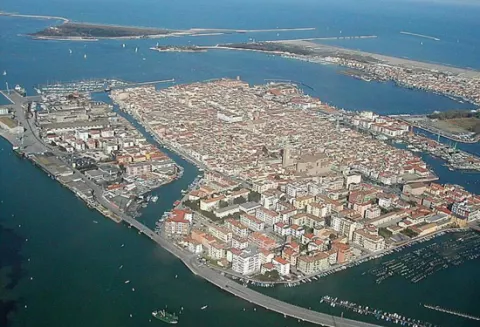
The leading industry in the early Venetian history was extraction of salt centered on the island of Chioggia. Over time, salt became the main commercial product. Surplus of salt was exchanged and sold to their neighbors on the land and further. From these activities, the original Venetian fishermen and producers of salt gradually became known as skilled traders and sailors. Much of the government’s own revenue came from the salt sale. Thus, all Venetian producers of salt were required to place their product at the disposal of the Salt Office (Camera del Sal) which issued licenses to exporters with instructions where, how much and at what price they could sell salt.
The Venetian Republic - Economy
Glass industry
glass
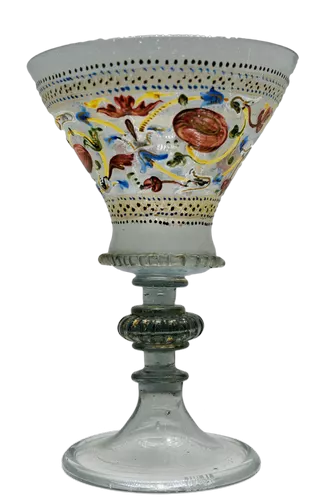
The glass industry was another industry from the early Venetian history whose origins can be traced back to the 10th century. Venice is regarded a pioneer in glassblowing technology in Europe producing items of very high quality. The Venetians were particularly notorious for production of the sand-glasses used by mariners as a time-keeping device and for making spectacles which was an Italian invention. In order to keep secret the technological process, the government shifted the glassblowing industry to the island of Murano.
The Venetian Republic - Economy
Trade in luxuries
luxuries
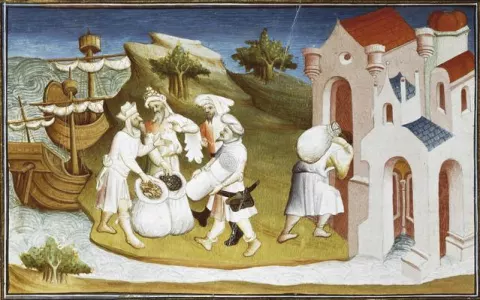
The Venetian merchants acted as middlemen in luxury commerce and transferred on their ships spices and textiles from the East to the markets in northern Italy and above the Alps, for the lands of western and central Europe and its feudal elite. Various goods such as hides, minerals, salt, wax, sugar, borax, wool, silk, spices, drugs, guns, ivory, ostrich feathers, parrots, gold dust and many others were imported from Africa, Levant and Black Sea and brought to Venice. Apart from material exchange, Venice was an important factor in the transfer of cultural goods such as Arabic numbers, compass, Latin sail and so on from the more advanced East to Europe.
In trade with East, they primarily operated with other people’s products with exception of salt, fish and glass. Iron was imported from eastern Alps, timber from Istria and Dalmatia, wool from Italy, Flanders and England. Important part of Venetian trade made trade in slaves procured from Slavic and Germanic countries, and resold through Italy, ports of France, and those more distant in North Africa, Egypt and Syria.
The Venetian Republic - Economy
Silk production
silk
Lucrative trade in raw silk and silk products from Asia inspired the Europeans to introduce its substitution. The Venetians began to produce silk as early as the 13th century. The government regulated production to guarantee quality, keep out competition and reduce the risks of industrial espionage. As a consequence, Venetian silk, satin and velvet products were of the highest quality combining indigenous and oriental designs, and made a substantial portion of Venetian exports.
The Venetian Republic - Economy
Sugar production
sugar
Using techniques borrowed from Muslims, Venice ventured into the production of sugar. On the islands of Crete and Cyprus, the Venetians have built the sugar plantations and processing facilities worked out by slave labor. Interestingly, the Portuguese only copied this practice from Venetians in founding their plantations in Madeira and Brazil.
The Venetian Republic - Economy
Chemicals
chemicals
Special industries of Venice were the manufacture of chemicals – cream of tartar, cinnabar (vermilion), shellac, white lead, and triaca (the “universal medicine”).
books
The Venetian Republic - Economy
Book production
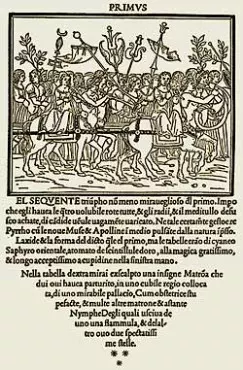
Another important field of Venetian expertise represented book production and Venice enjoyed the reputation of the principal typographical center and one of the biggest in Europe. Only 15 years after the invention of Guttenberg press, Venetians were acquainted with the technique, thanks to a German immigrant. Their contribution was the improvement of the printing productivity. Venetian publishing fostered the intellectual and cultural blooming of Europe at the time.
The Venetian Republic - Economy
Shipbuilding
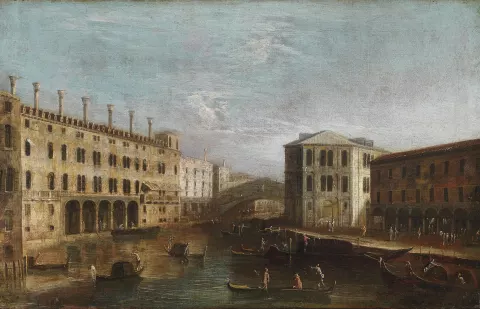
Prominent place in Venetian economy was held by the Venetian Arsenal, a public shipyard founded in 1104 as a result of government policy of stimulating trade and seafaring. During its entire history, the main tasks of the Arsenal were production of ships for trade and war, production of arms, rope and entire marine equipment. Therefore, it is not surprising that during the entire history of the Venetian Republic, very important place among imported goods held timber which was initially imported from the area under the rule of the Langobards and the Franks in northern Italy, and later from Istria and North Adriatic. Stimulus to development and expansion of Arsenal was given by the Crusades that increased needs of transport and trade.
At its height in the last decades of the 16th century the Arsenal extended on 263,000 square meters and had 16,000 employees. At the height of production, from February to mid-March 1570, one hundred galleys were built. The government forbade any Venetian to sell his ship to a foreigner unless he was old or inferior.
The Venetian fleet had two types of ships – galleys and cogs. The galley sailed using sails and oars, it was able to pass great distances in short periods and was used for high value cargo. They could also be used for war purposes. The cogs were general cargo ships and they navigated only by using sails. One of the biggest Venetian ships was called Roccaforte (Fortress) and could carry 500 tons. Although it is not impressive by today's terms, in a period preceding the 19th century it meant a very big ship. During the Middle Ages, only several ports such as Venice and its main rival Genoa, had ships as big as 200 tons.
Therefore, the Arsenal not only represented a leading industrial complex in the Mediterranean, but also the seat of naval, commercial and political expansion of the Venetian Republic in the Mediterranean.


The Venetian Republic - Decline
Although the Venetian Republic throughout its history has shown a great ingenuity, however, it failed in attempt to stop the changes which were inevitable. In the period that followed, various newly formed political and economic factors weakened its position. Fading of the Venetian power has been gradually but steadily.
On the East, the Byzantine Empire was in the second half of the 15th century substituted with the Ottoman Empire, one of the best organized and most powerful expansionist states of the time, while on the European soil, European powers became alarmed by its expansion and extremely hostile towards it. In the following conflicts, the Venetian Republic eventually has lost a great part of its territories and source of incomes. For example, the Venetian spice imports fell from 1600 tons a year towards the end of the 15th century to less than 500 tons by the first decade of the 16th century.
In addition, the maritime discoveries marked the turning point in the history and left far-reaching consequences on the economic and cultural life of Europe. As a result of discoveries, the old Mediterranean trade was suppressed by the newly established global trade which was linked to the Atlantic Ocean. The new maritime forces thus became the nations on the Atlantic coast, while the previous trade powers, such as Venice and Dubrovnik, began to decline rapidly.
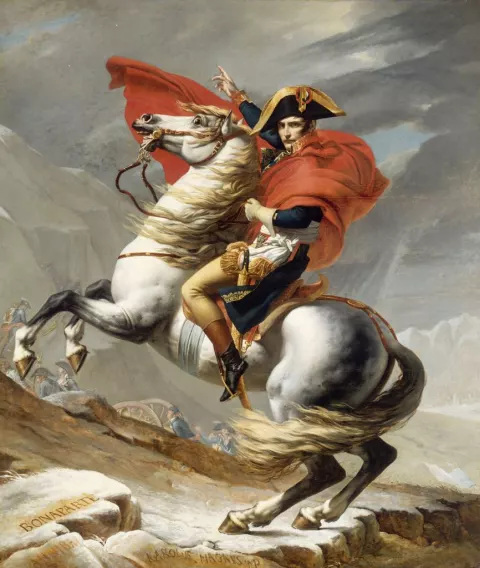
Despite these unfavorable conditions, the Venetian Republic survived far away in the 18th century adapting its economy to other conditions. However, in 1797 after more than a thousand years of existence Napoleon's conquests in northern Italy marked the end of the Venetian Republic.
Financial instruments
The Venetian commercial expeditions involved different instruments used for organizing and financing overseas trade. For centuries, overseas voyages of the Venetian merchants were treated as community enterprises subject to government approval in terms of dimension of ships, the number of crewmen, routes, cargoes, and sailing dates.
Financial instruments
Organization of trading voyages
The Venetian government determined the sailing schedule and ensured the safe navigation of the trading fleet. The ships going on the dangerous and distant routes were ordered to sail in convoy, under an admiral appointed by the Doge.
Sailing between Venice and Byzantine Empire and the Crusades state of Acre was conducted through two caravan of ships consisting typically of 10 to 20 ships with a few galleys for protection. One caravan left in the spring and returned in the fall, while other left in fall, wintered outseas and returned in the spring. Acre was the center of all the business of crusading, the assembly point for convoys, and the meeting place of trade routes tapping the wealth of Asia and the Spice Islands.
Financial instruments
Financing of trading voyages
Trade expeditions of the Venetian merchants could be funded through loans. Traditional Venetian rate was 20 percent, although it could be much higher for the risky maritime voyages.
From the second half of the 12th century as the basic instrument for the pooling of capital and the spreading of risks, the Venetians used the quasi partnership called “colleganzia” which was called “commenda” in the rest of Europe. The “colleganzia” lasted only for the duration of a particular voyage. The investor provided the full capital and remained in the home port, while the travelling partner contributed only his time and energy to transporting and selling the wares overseas. According to contract, the investor (commendator) at the end of the voyage received ¾ of any profit and bore all liability for loss, while the travelling partner (tractator) received ¼ of any profit and bore no liability for loss of capital, and in the case of failure only lost the value of his labor. Although giving to the travelling partner who did all the work only ¼ of profit may seem exploitative, it is deceptive because the travelling partner often received funds from several friends, relations and business associates and if the voyage ended successfully he made a good profit. “Colleganzia” was the closest medieval antecedent of modern joint-stock companies by attracting investments of any size from all kinds of people. Members of the wealthy and old Venetian families collected a large fortunes from diversified investments in a large number of colleganzia. They also invested part of their capital in ship-ownership or to outfit the ships. Eventually, in the 15th century “colleganza” partnership used in Venice was gradually replaced by the commission agencies, although it was not off course completely abandoned.
Venice also developed new financing for commercial sea voyages. In time of peace, the government farmed out the ships for the use by private enterprise in an auction. The ownership of the ship remained with the state and the successful bidder actually only won the right to operate the ship for a specific voyage. Since it was very expensive undertaking, merchants formed temporary company that bid for the lease of galley. Therefore, a voyage could be financed through the issuance of twenty-four shares called “carati”. The owner of the share was called “parcenevoli”. The “parcenevoli” also appointed a “padrone” responsible for outfitting and managing the voyage.
There was, however, much larger and complex partnerships known as “maone” in which all the shareholders in the ships of a whole fleet joined forces and purchased cargo jointly. Through the “maona” system the investors were able to exercise maximum power in negotiating favorable terms for basic supplies such as food, wine and ballasting materials. “Maona” principle was also effective in maintaining uniform prices for the common wares that the “parcenevoli” sold in foreign markets.
30 lives in this room
 Marco Polo1254-1324
 Bartolomeo Gradenigoc. 1259 – 1342
 Bertolome Zorzidied c. 1300
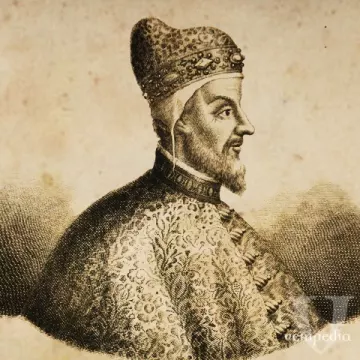 Michele Morosini1308-1382
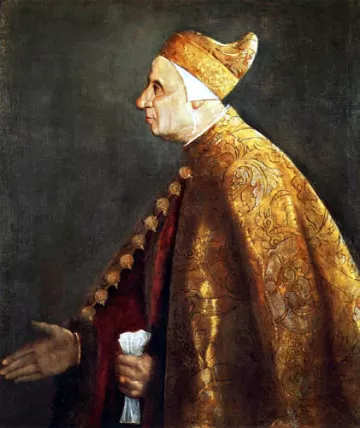 Nicolò Marcelloc. 1399 – 1474
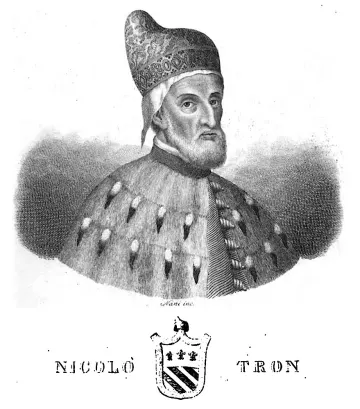 Nicolò Tron1399-1473
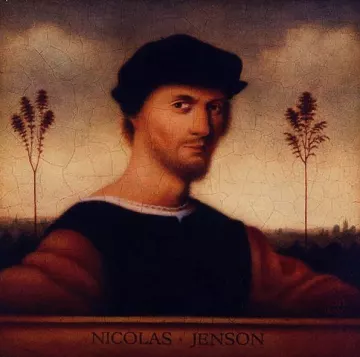 Nicholas Jenson1420-1480
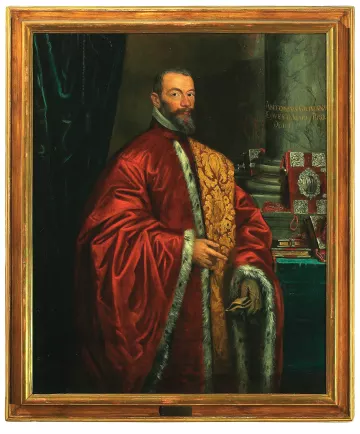 Antonio Grimani1434-1523
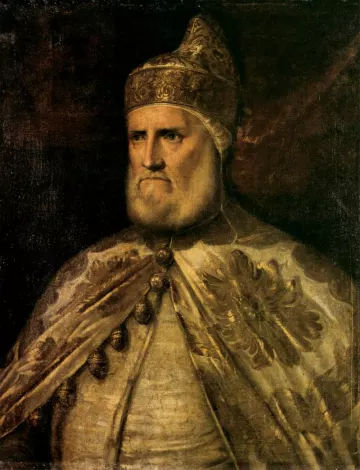 Andrea Gritti1455-1538
 Girolamo Priuli1486–1567
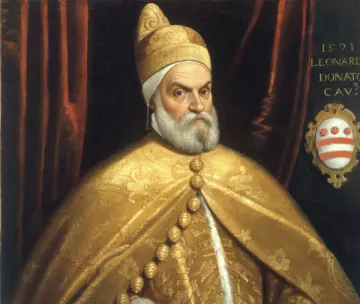 Leonardo Donato1536-1612
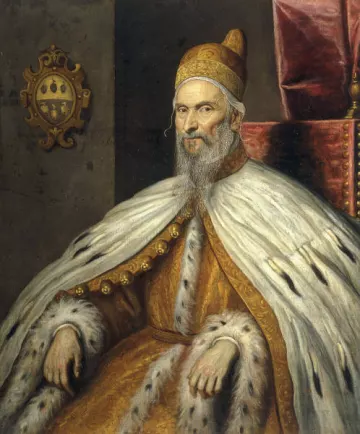 Marcantonio Memmo1536-1615
 Daniel Bombergdied c. 1549
More lives in this room
- Zaccaria Stagnario 12th-13th century
- Domenico Gradenigo c 1185- c 1266
- Niccolò and Maffeo Polo 13th century
- Federico Cornaro c. 1335 - 1382
- Niccolò dei Conti c. 1395-1469
- Giosofat Barbaro 1413–1494
- Pietro Bicarani died 1414
- Ambrogio Contarini 1429-1499
- Alvise Cadamosto 1432-1488
- Guillaume LeRoy c. 1450–c. 1529
- Giovanni Maria Angiolello 1451-1525
- Cesare Federici c. 1530 - c. 1603
- Anselmo del Banco died 1532
- Nicolò Donato 1539-1618
- Gasparo Balbi born c. mid-16th century
- Marco Antonio Giustiniani fl. 16th century
- Joseph Pardo d. 1619