No. 9365
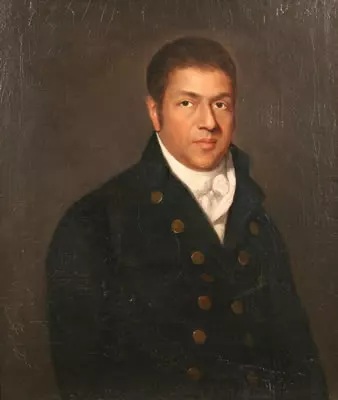
Paul Cuffe
Paul Cuffe was born in colonial Massachusetts in the family of a freed African slave and a Native American of the Wampanoag tribe.
At age 16, Cuffe became a sailor on whaling and cargo ships simultaneously gaining knowledge of arithmetic and navigation. During the American Revolution he profited as privateer and was involved in running American supplies through British blockades. Eventually, he achieved the rank of captain, and in a partnership with his brother-in-law Michael Wainer started working on creating of his own fleet. Interestingly, their ships were staffed exclusively with African American sailors. His fleet was engaged in long whaling expeditions and trading voyages to Europe and other parts of the Americas from Newfoundland to the Caribbean. Besides whaling and cod fishing, Cuffe traded timber, livestock, food, corn, apples, cotton, and flour. He was also the owner of a grist mill and a farm.
Subsequently, Cuffe became highly successful businessman, and perhaps the wealthiest African American of his time. He was described by his contemporaries as a man of quiet dignity, pious, and unselfish. With revenues from his numerous affairs, he was able to donate his time and money to humanistic aspirations. In 1783 he married Alice Pequit, also of the Wampanoag tribe with whom he had seven children.
As a supporter of education, he used his wealth to establish a school in the town of Westport, Massachusetts, and to end the slave trade. His most significant venture was his effort to create overseas colonies for freed American slaves in the Sierra Leone colony in West Africa.
He wrote Memoir of Captain Paul Cuffee (1811).