No. 3336
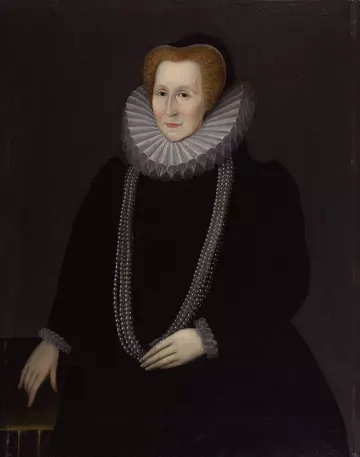
Bess of Hardwick
Elisabeth, countess of Shrewsbury, better known as Bess of Hardwick, was born into a family of an impoverished Derbyshire nobleman and through shrewd marriage policy eventually became the second wealthiest and most powerful woman in England, after Queen Elizabeth I.
In 1543 Bess married Robert Barlow, but the marriage didn’t last long and she became a widow with a relatively small part of inherited estate. Then she entered in the service of Lady Francesca Grey, and started to progress in society using her charm and intelligence. Around that time she met Sir William Cavendish, a wealthy treasurer of the king’s chamber and married him in 1547 although he was more than twenty years older. The marriage which was happy provided her with additional financial security and social advancement. However, nor this marriage was long-lived and in 1557 she remained a widow for the second time with six children of her own and two daughters of Cavendish to care for. Two years later she entered in marriage for the third time which made her a wealthy woman. Sir William St. Loe was the captain of the guard and chief butler of England in the service of Queen Elisabeth I. In his ownership were large estates in Gloucestershire and Somerset. Her third marriage also ended with her husband’s death who was most likely poisoned by his brother in 1564. Since they didn’t have male heirs, Bess became the sole heir of his fortune. That made her very desirable for marriage at English court. At the time, she was also a lady of the bed chamber of the Queen Elisabeth.
Her fourth marriage in 1568 to George Talbot, sixth earl of Shrewsburry made her one of the highest-ranking women at court, and certainly one of the wealthiest. In 1568 her husband became the custodian of Mary, Queen of Scotland, on behalf of the Queen Elisabeth. Mary would stay with the Talbots for the following 16 years. In 1583 she left her husband, and after his death in 1590 she regained the ownership of her assets. Among the properties that she controlled were Bolsover Castle and its coal mines, lead mines, glassworks and forge of Wingfield Manor.
When she died in 1608, she left a fortune worth of thousands of pounds. She was the ancestor of several prominent aristocratic families.