No. 8059
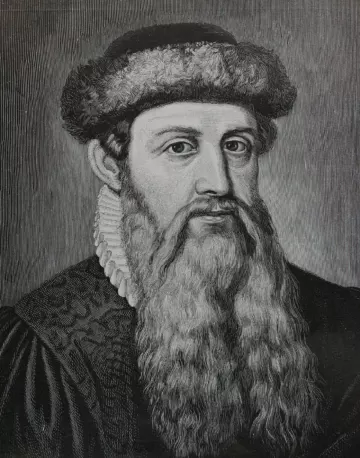
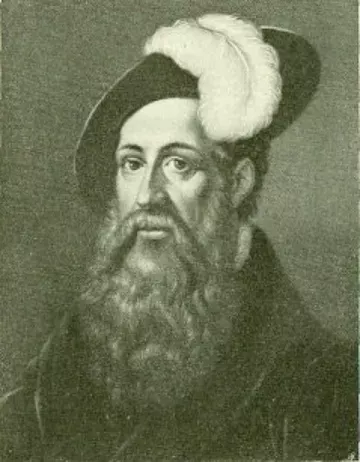
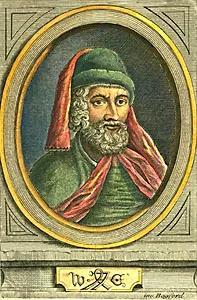
Johann Gutenberg
Printer and inventor
Johann Gutenberg is credited with the invention of printing with movable metal type, an invention that is regarded as one of the most important in history. His invention laid the foundation for the commercial mass production of books and made books affordable to a wide audience.
Gutenberg was born into a patrician family in Mainz, which he left because of a revolt against the patricians and settled in Strasbourg. By the time he left Mainz he was a skilled goldsmith, a skill he probably learned from his father. During his stay in Strasbourg between 1428 and 1448 when he returned to Mainz, Gutenberg had worked as a goldsmith and had also started to work on his invention of the printing press. In 1450, when Gutenberg’s experiments had apparently reached a considerable degree of refinement, he persuaded Johann Fust, a wealthy financier, to lend him 800 guilders—a very substantial capital investment. Two years later Fust was made his partner for additional 800 guilders.
By 1455 Gutenberg’s masterpiece, the Forty-two-Line Bible, was finished. It was also the year in which Johann Fust sued him for the return of a large sum of loaned money. Gutenberg lost the case and had to turn over his printing equipment to Fust, who later formed an important printing partnership with Peter Schoeffer, Gutenberg's assistant. Little is known about Gutenberg’s later life, except that he was financially supported by the Archbishop of Mainz and may have lived comfortably until his death in 1468.