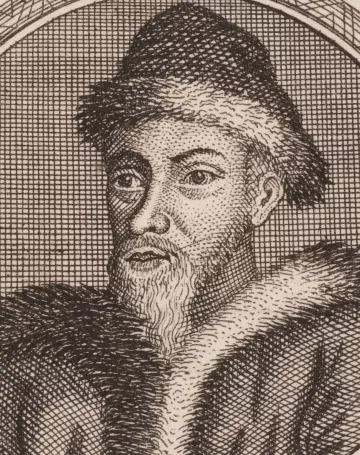
No. 4372
William Caxton
Printer and merchant
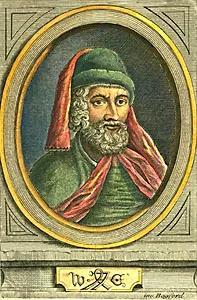
William Caxton was a successful mercer turned printer who printed the first book in English and who established the first printing press in England.
Caxton was born in Kent into a merchant family. In 1438 he was apprenticed to a rich mercer Robert Large, and lived in his house in the Old Jewry in London. After Large’s death in 1441, Caxton moved to Bruges, the capital of Flanders, seat of the Burgundian government there and a center of culture, manufacturing, and trade where English wool was imported and woven into fine Flemish cloth.
In 1463 Caxton became governor of the English Nation of Merchant Adventurers in Bruges, negotiating trade treaties and supervising textile quality control. In 1470 he ceased to be governor and entered the service of Margaret, duchess of Burgundy, and the sister of England’s King Edward IV (1442 – 1483), possibly as her financial adviser. He was also hired by her to procure and translate books, beginning with the Recueil des histoires de Troyes.
From 1470 till 1472 Caxton was in Cologne on a diplomatic mission, but more importantly it was there that he learned the art of printing. He set up a press in Bruges about 1474, and soon printed the first book in English The History of Troy. In 1476 Caxton returned to England and set up a printing press at Westminster. It was there that the first dated book printed in English, Dictes and Sayenges of the Phylosophers, appeared on 18 November 1477. From then on Caxton printed more than one hundred books, most notably Geoffrey Chaucer’s Canterbury Tales and Troilus and Criseyde, John Gower’s Confessio Amantis, John of Trevisa’s Polychronicon, Jacobus de Voragine’s Golden Legend, and Thomas Malory’s Morte d’Arthur.