No. 4367
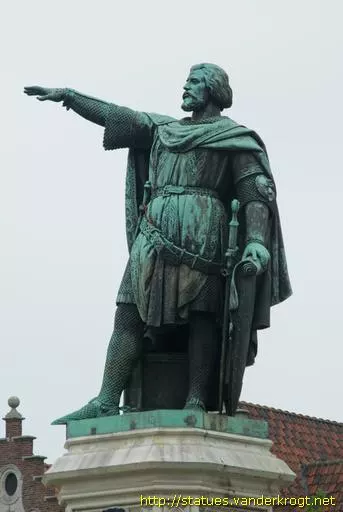
Jacob van Artevelde
Jacob van Artevelde was a prominent merchant with business interests in brewing and in the wool trade with England. He played an important role in the early conflicts of the Hundred Years’ War (1337–1453), and became virtual ruler of Flanders for seven years.
At the beginning of the Hundred Years’ War, Flanders was under the suzerainty of Louis I (r. 1322–1346) Count of Flanders, and Louis I was a vassal of the French king. As relations between England and France worsened in the 1330s, tension arose between the count and the Flemish towns because in 1336 Edward III placed an embargo on wool sales to Flanders, hoping to pressure Louis I into an English alliance. The count remained loyal to the French king, but the Flemish cities, whose economy was driven by English wool, were soon suffering from the wool shortage and the loss of and important foreign market. At that point, van Artevelde emerged as a leader in Ghent, an important centre of the weaving industry. In 1338, the people of Ghent, under his leadership, declared their neutrality, and the major towns of Bruges and Ypres followed suit, joining together in a league for that purpose. At first the league maintained neutral, but it soon sided with England after in December 1339 van Artevelde became a hero to his subjects by negotiating with Edward III a very favorable treaty for Flanders.
Van Artevelde ruled Flanders with an iron hand, and in fact was little more than an autocratic dictator. At first he enjoyed the support of the people, but his open display of his wealth and success displeased the common people, and he was no longer on good terms with many of the guilds that had supported his rise to power in the first place. Finally, in 1345 a popular insurrection broke out in Ghent, and van Artevelde fell into the hands of the crowd and was murdered.