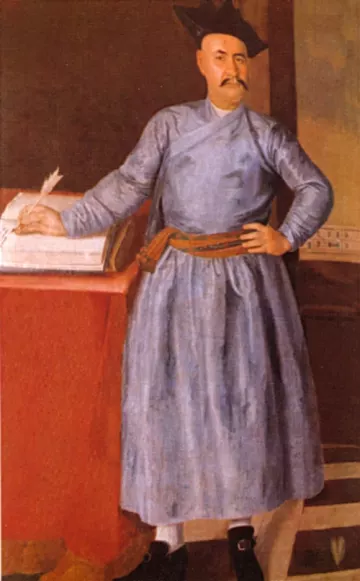
No. 451
Beri Pedda Venkatadri
During the second half of 17th century Beri Pedda Venkatadri was one of the chief merchants in Madras. At the time the English were dealing with 26 chief merchants under whom were many lesser merchants employed by them. Pedda Venkatadri, as seniormost among the Company’s merchants, was appointed to the post in 1680.
The English East India Company (EIC) at Madras wanted to gather local merchants into a joint-stock company for procurement of cloth. The merchants of the joint-stock company would thus supply cloth to Fort St. George (English fort in Madras) which would greatly facilitate the commercial operations of the EIC in Madras. However, the big players such as Beri Pedda Venkatadri that had enough of their own capital and network of agents working for them were against such structure. In spite of resistance from Pedda Venkatadri, the joint stock was constituted with a share capital of 100 shares of 500 pagodas each. Pedda Venkatadri and his group held 25 shares; the other 7 chief merchants had two and three-fourth shares each, and the rest of the merchants held the remaining shares.
The merchants outside the Venkatadri’s group soon started to complain about him, and the EIC sided with them. Venkatadri’s answered by leaving Madras and using his influence to obstruct the Madras trade. After a few months Venkatadri and his group was called back and the EIC restored their 25 per cent share in the join-stock and as a further affirmation of their triumphant reinstatement, three “turbulent” merchants, presumably the most vocal against Venkatadri, were discharged. After Pedda Venkatadri died in 1783 he was succeeded by his brother, Chinna Venkatadri, as the chief merchant.