No. 10815
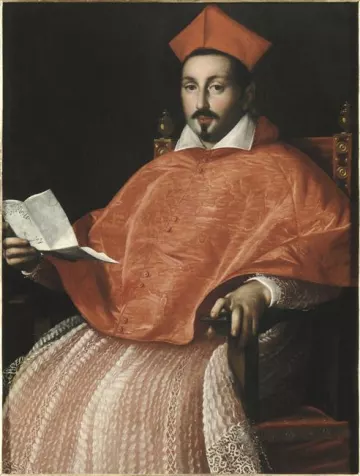
Scipione Borghese
As a nephew of the Renaissance pope, Borghese benefited from his uncle’s nepotism gaining many prominent positions in the Church hierarchy. He is known for the extraordinary art collection he left behind.
Scipione was born in a family of Marcantonio Caffarelli and Ortensia Borghese, sister of Pope Paul V. He studied law and philosophy at Collegio Romano in Rome and the University of Perugia. At age of 29 he became a cardinal, and was allowed by his uncle, the Pope, to use the Borghese name and coat of arms. Owing to family relations, he held many prominent and lucrative positions in the Roman Catholic Church. He was appointed archbishop of Bologna, superintendent negotiorum sanctae sedis, prefect of the Tribunal of the Apostolic Signature of Grace, librarian of the Holy Roman Church, protector of Loreto, archpriest of the Lateran Basilica, and camerlengo (chamberlain) of the Sacred College of Cardinals.
Each office brought him substantial revenues in the form of salaries, papal taxes and fees, and various gifts. His annual income in 1616 was about 160,000 scudi, which was quite sum if we consider that a single scudo was equivalent to about 3.5 grams of gold at the time.
Part of his wealth he invested in valuable land properties around Rome, restoration of the religious objects and collection of antiquities as well as contemporary art. In pursuit of artworks he was sometimes ruthless - it is known that he even imprisoned the painter Domenichino for refusing to sell him a painting already promised to another cardinal. Despite that, he had a reputation of a generous supporter of many talented artists. After the death of his uncle in 1621, Borghese moved to the Palazzo Borghese, where he relocated most of his paintings, creating the Galleria Terrena.
He died in Rome in 1633.