No. 9140
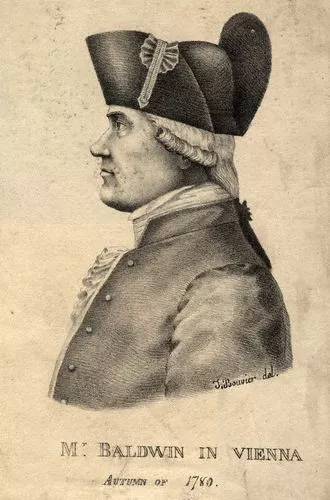
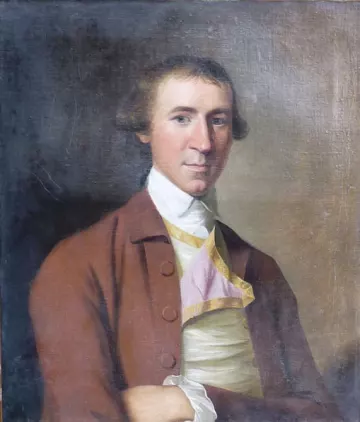
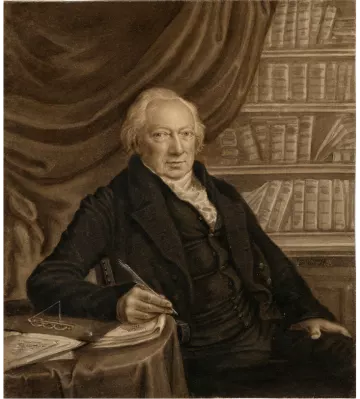
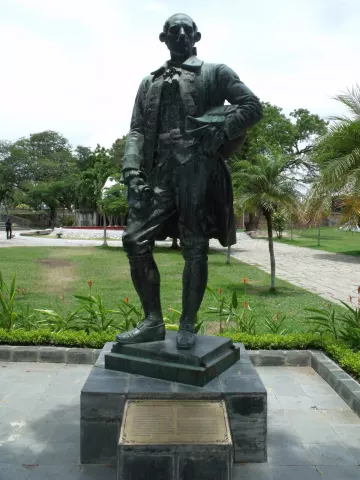
George Baldwin
Baldwin was born in 1744 as the son of hop merchant William Baldwin of Borough, London. At the age of 16 he was sent to join his brother at Cyprus, where he served as consul-general and three years later he headed for Acre where he became involved in silk trade.
While staying in the Eastern Mediterranean, Baldwin had noticed the commercial potential of the area as a possible link with the lucrative Indian market. Thus, he went to England to investigate the possibilities of trade running from British India across Egypt via the Red Sea. Although this route was blocked off to non-Muslims, development of trade could be possible if it brought profit to the rulers of Egypt.
The ruler of Egypt encoured Baldwin in these efforts allegedly telling him: “If you bring the India ships to Suez, I will lay an aqueduct from the Nile to Suez, and you shall drink of the Nile water”. When Baldwin arrived in Cairo in 1775 he was the only English merchant there. However, with his knowledge of domestic affairs and of Arabic, he was able to monopolize British trade caravans passing from Suez to the Nile, and ensured a fast, safe and efficient service.
By 1779 his trade was so successful that it started to disrupt that of the Ottoman sultan causing restrictions on his activities. In one incident, his caravans were attacked and looted and some merchants imprisoned. His efforts to set up in India also failed after he was assaulted and robbed on route. Together with his wife, Jane Maltass, the daughter of his agent and the famous beauty, Baldwing packed his things and returned to England.
However, he didn’t give up and he wrote memoranda for the India Board of merchant emphasizing the importance of Egyptian trade and stressed the risk for English interests if France was allowed to dominate that trade. Measures were taken in 1786 after French merchants obtained permission to make use of the Red Sea, when Baldwin was sent to Egypt to negotiate the similar conditions for English merchants.
In 1793 the French Revolutionary War broke out between England and France. He left the country when the French forces invaded Egypt. He participated in the planning of the British counter-invasion of Egypt as a logistical officer in the army.
In 1801 he settled in London and devoted himself to his studies of magnetic theory.