No. 7624
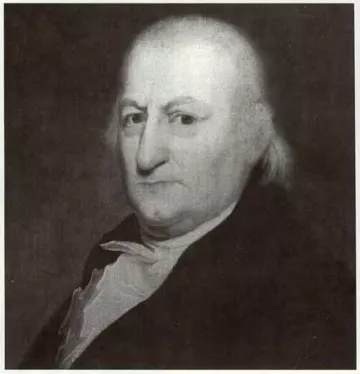
David Salisbury Franks
David Salisbury Franks was a U.S. merchant, a Revolutionary War officer, and patriot. He started his career as a merchant, joined the Continental Army, and after the War continued to serve the government as a diplomat.
David Salisbury Franks was born in Philadelphia around 1740 into a large and highly respected Jewish merchant family. His father family to Quebec, and in 1775, on the eve of the Revolution, Franks was living in Montreal, serving in the distinguished position of parnas (president) of the Spanish and Portuguese synagogue in that city, though he was of German Jewish descent.
When the Continental Army invaded Quebec, Franks joined the revolutionaries, and was appointed paymaster of the Continental Army in Quebec and apparently expended his own funds to pay the salaries of the American volunteers. Franks retreated with the Continental Army to Philadelphia in 1776, and remained in active service until October 1777. He gained the rank of major, served as liaison officer to the Comte d’Estaing, commander of the French naval forces fighting on the American side, and as a aide-de-camp to Benedict Arnold, the military governor of Philadelphia.
Franks retreated to Philadelphia, reaching it in July 1776. He joined the Continental Army and served actively until October 1777. Because he spoke French, Franks was then assigned as liaison officer to the Comte d’Estaing, commander of the French naval forces fighting on the American side. Franks attained the rank of major and was assigned as aide-de-camp to Benedict Arnold, the military governor of Philadelphia. However, Arnold committed treason, and Franks was suspected of involvement. He was exonerated of complicity in the Arnold treason in 1780, and was promoted to the rank of lieutenant colonel. Subsequently he served as a U.S. diplomat with figures such as John Jay, Benjamin Franklin, Thomas Jefferson, Robert R. Livingston, and John Adams. However, his political enemies continued to attack him for his association with Benedict Arnold. In 1786, the attacks succeeded and Franks was dismissed from the diplomatic services. In 1789, after years spent clearing his name, Congress granted Franks 400 acres of land in recognition of his service during the Revolutionary war.