Museum / Rooms / Trade in Ancient Greece
Room · 7 chapters · 10 lives
Trade in Ancient Greece
The ancient Greeks were, alongside with the Phoenicians, the greatest traders and seafarers of the ancient Mediterranean world
The birthplace of Western civilization
As the first sophisticated civilization on European soil the ancient Greece was named “the birthplace of Western civilization”. The homeland of Greeks was made of many autonomous city-states (“poleis”) that shared a common language, religion and sense of belonging, but during its history they never formed a centralized state. Geographical factors and the scarcity of Greek soil naturally directed the business interests of the Helens to the sea and maritime activities.
Commercial network
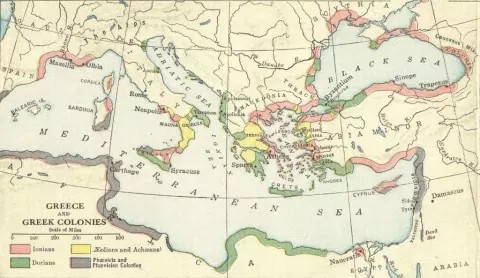
Between 800 BC and 300 BC the Greeks founded a vast colonial empire that encompassed colonies in the Mediterranean, Black and the Adriatic Seas. Colonization had a dual purpose - to expand the Greek commercial network by finding new sources of raw materials and new markets for Greek products, and to mitigate increasing social problems such as overpopulation and food shortages in parent cities that threatened economic stability. The parent cities had multiple benefits from the establishment of colonies – they won future allies in wars, marketplaces in time of peace and source of spreading of the Greek culture.
Main protagonists of commercial life
The long-distance trade represented, perhaps, the safest and fastest path to wealth. Since the Greek noblemen (“eupatrids”) considered beneath their dignity to participate directly in business affairs, the main actors of the ancient economic miracle were actually foreign entrepreneurs (“metics”), and lowborns, that is, slaves and freedmen who dominated lucrative business in shipping, industry and banking.
Agora
The Greek agora was the first district used specifically as a marketplace in history. It was the commercial center of the city as well as the public center where people encountered. The traders and commodities were controlled by officials, called the “metronomoi” who checked weights and measures, and the “agoranomoi” that evaluated the quality of goods. Trade in ancient societies in general was devoted to two main categories: foodstuffs such as grains, olives and wine, and high value merchandise.
Business inventions
In business environment defined by high risk and poor information the ancient Greek businessmen sought the way to avoid catastrophic losses. Unlike a typical loan in which the borrower is liable for the debt at all times, the Greek entrepreneurs used a “respondentia” (loan on cargo) and “bottomry” (loan on ships) contracts which made the lender liable for the loan. If the venture went well, the investor received the principal and interest that exceeded the legal rate and ranged between 20 and 30 percent. On the other hand, if the venture ended badly the investor irretrievably lost all the money he advanced. Neverthless, for the liquid capitalist who provided money the occasional loss of a ship would not mean financial ruin because the high interest rate in the long time ensured a profit over and above his losses.
The enthusiastic spirit of exploration and trade that led the Greek explorers and merchants to wander the world have been preserved in the famous Homer’s epic poem “Odyssey”.
Among a multitude of colonies, Byzantium founded by the colonist of Megara had the grandest history. It is better known in history under the names Constantinople, the capital of the great Byzantine Empire, and Istanbul, during the reign of the Ottoman Empire.
Since the foreigners and lowborns were not allowed to acquire land, which was a base of political and social power in ancient Greece, they held their assets in various business investments.
To motivate capitalists to continue to fund risky ventures, the government in Athens established special maritime courts and laws to provide the greatest possible security and legal protection for business investors.
Chapters
- The Ancient Greece
- Seafaring in ancient times
- Greek vessels
- Greek trade network
- Rise of the merchant class
- Business practice
- Economy
The Ancient Greece
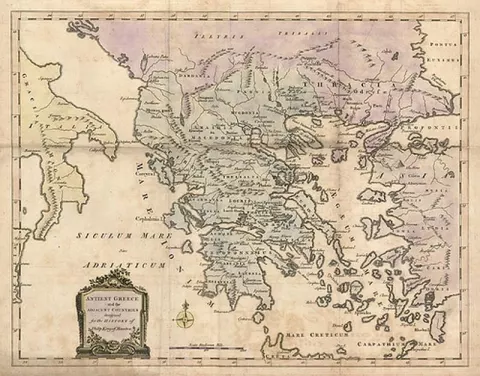
The Helens, how the ancient Greeks called themselves, created the first highly developed civilization on European soil. Their country, Helada, is considered to be the cradle of European civilization, science and culture, because of its rich legacy in the field of art, architecture, drama, historiography, philosophy and political theory.
Although the Greeks, as they were called by the Romans, spoke the same language, had the same letter and worshiped the same gods, they never created unified state. Instead, during all its history the area of Greece was divided between various poleis (city-states), among which neither one has been principal. Besides cultural achievements, the ancient Greek people have also left significant impact in field of economy. The modern term “economy” derives from the Greek word “oikonomia” denoting the management of the household.
Eventually, the Greeks emerged as a one of the greatest seagoing people of ancient history. The words of the Athenian philosopher Socrates: “We live around a sea like frogs around a pond”, in an interesting way reflect dependence as well as connection of the ancient Greek people with the sea.
Seafaring in ancient times
Since Greece is predominantly mountainous country, travelling on land was extremely difficult and hazardous. In comparison with overland transport provided by mules or ox drawn carts, maritime transport although a dangerous endeavor was still much more efficient, lucrative and far faster.
Due to security reasons, navigation was confined to the season from May to mid-September. The winter period because of violent storms, reduced visibility due to natural phenomena as rain and fog, and short daylight, was completely unsuitable and hazardous for navigation.
The main obstacle in ancient seafaring represented its primitive navigation. It was the reason why the Greeks practiced the coastal routing and had a strong resistance of straying too far from shelter. As there was no compass and sextant, the ancient mariners heavily depended on visible reckonings, such as coastal landmarks and position of the starts.
In order to take the full advantage of nearby natural harbors or waterways, cities were raised on such favorable places. Some of them like Aegina, Athens, Chalcis, Corinth, Miletus, Phocaea, Samos, Chios, Lesbos and Rhodes became leading Greek poleis and economic centers.
Greek vessels
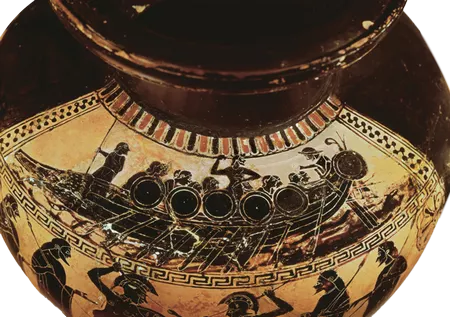
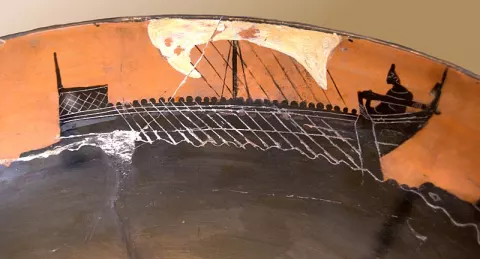
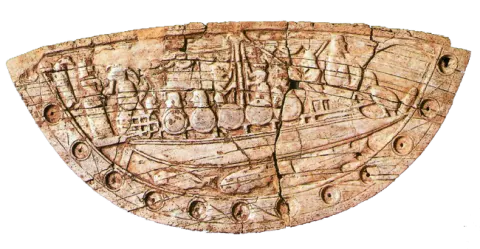
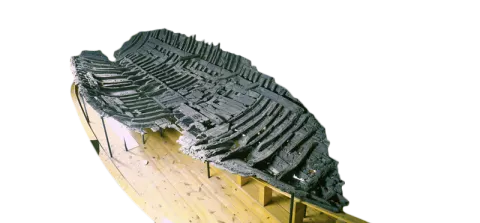
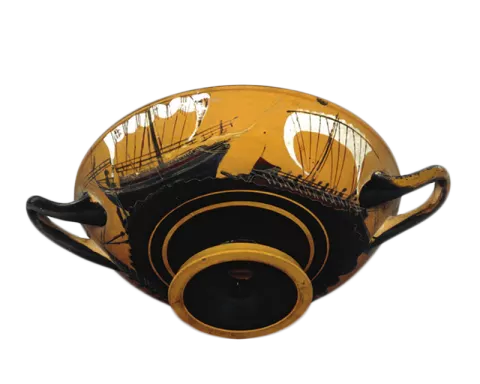
The ancient vessels were made from timber and relied on two forms of power – wind and oars. Usually they had at their disposal a single mast which was able to lift one square sail typically made of patchwork linen (from the flax plant) or canvas (from Egyptian cotton). The ancient square-riggers could make direct progress only if the wind was fully or nearly astern; a wind from the side (abeam) required the ship to sail close-hauled, on a zigzag course of tacking, and a wind forward of the beam tended to be unusable.
There can be distinguished two basic categories of ships in use - merchant vessels and war vessels. The merchant ships were in general larger and designed to carry freight – thus, they had deep drafts, wide beams, and heavy masts, while their hulls were usually closed at top by a deck. They relied mostly on wind power, while smaller craft and warships could also make progress under oars. They carried a small crew that directly influenced its ability to undertake long-range travel without interruptions for rest and food. Under proper conditions, such ship might reach between four and six knots, traveling 100 or more miles in 24 hours.
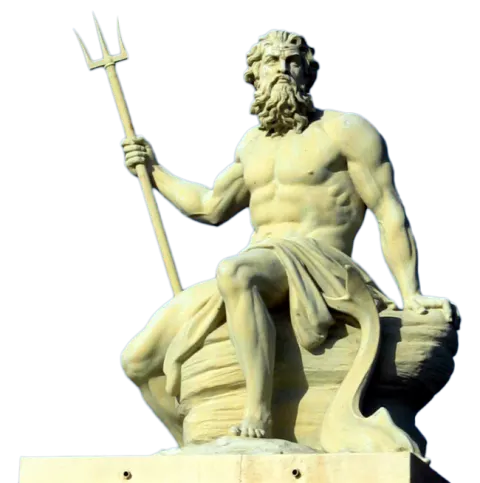
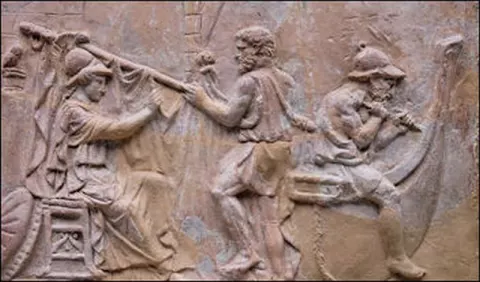
Vase paintings, written sources and modern archeology witnesses the cases when things went wrong. Shipwrecks were a common thing at that time. It was the reason why many harbors had temples where mariners went to pray and offer sacrifice for a safe voyage. The main patron gods of seafaring were Poseidon, Athena, Aphrodite, and Castor and Polydeuces.
Greek trade network
Along with the Phoenicians, the ancient Greeks were regarded as the greatest traders and seafarers of the ancient Mediterranean world.
In the period between 800 BC and 500 BC the Greek city-states carried out the large scale colonization of the Mediterranean. Their presence is evidenced in Southern France, Spain and on the Black Sea. The area of Sicily and southern coastal Italy was so densely populated by the Greeks that the Romans called it “Magna Graecia” or Great Greece. The famous Homer’s poem, the Odyssey reflects the enthusiastic spirit of exploration and trade of that period. However, the colonization had an economic purpose – to expand Greek commercial network, found new markets and sources of raw materials. In the same time, colonization mitigated social problems like overpopulation and food shortages in parent cities.
The colonist’s new cities were entirely independent of the parent polis, although they preserved strong commercial and cultural links in the form of the law, tradition and religious cults. The parent cities had multiple benefits from the establishment of colonies – they won future allies in the war, marketplaces in time of peace and source of spreading of the Greek culture. Among a multitude of establish colonies, one founded by colonist of Megara had the grandest history. It was the Byzantium, the future capital of the great Byzantine Empire, and its successor, the Ottoman Empire.
Through established commercial network the Greeks obtained the necessary goods and exotic luxury items.
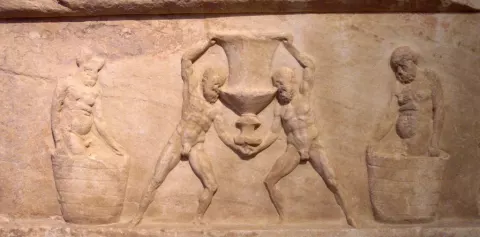
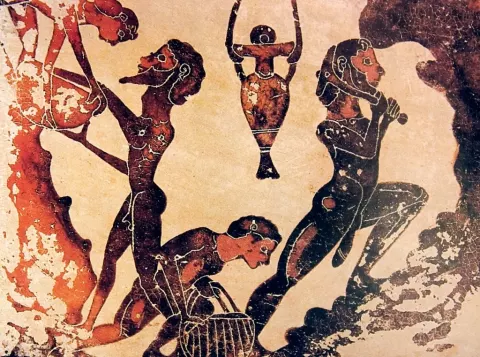
The western Mediterranean was a market for raw tin, silver and lead. Raw tin was a necessary component of the alloy bronze, a metal highly in demand in that times. It was procured through Celtic intermediaries from the British Cornwall, and perhaps, from the northwest Spain. In exchange for these commodities, the Greeks provided metalwork, textiles and wine brought from mainland Greece or from the Greek cities of Asia Minor. Egypt was the source of carved ivory, metalwork, and textiles for which the Greeks offered slaves, silver ore, or other resources that Egypt lacked. But, the most valuable Egyptian good for the Greek world was actually its grain. In Greece, which was short of food, merchants have realized huge profits in this kind of trade. A major source of grain, as well as timber was also Sicily, Italy, Thrace, and the northern Black Sea coast. The Greeks in turn traded in valuable painted pottery of Corinth and Athens, along with woolen textiles made in Miletus and other cities of Ionia.
Rise of the merchant class
In the early, tribal period of the Greek history marked by military democracy social position and wealth of individual were largely determined by proficiency in arms. In the society in which the richest and most powerful members were its bravest and most able military leaders, the trade profession and traders were not esteemed.
Trade of that period was of small scale, and, in lack of coined money, relied on barter. Since the business, in the proper sense of the word didn’t exist, there was no professional ethics. Hesiod formulates the golden rule of his day: “In any and every transaction, thought it be with your own brother, call witnesses – but do it with a pleasant smile”.
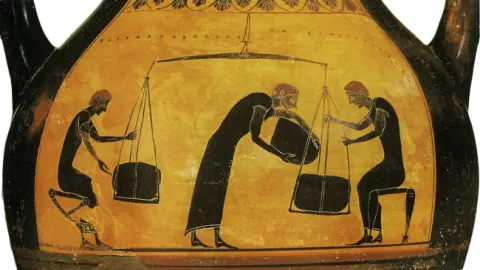
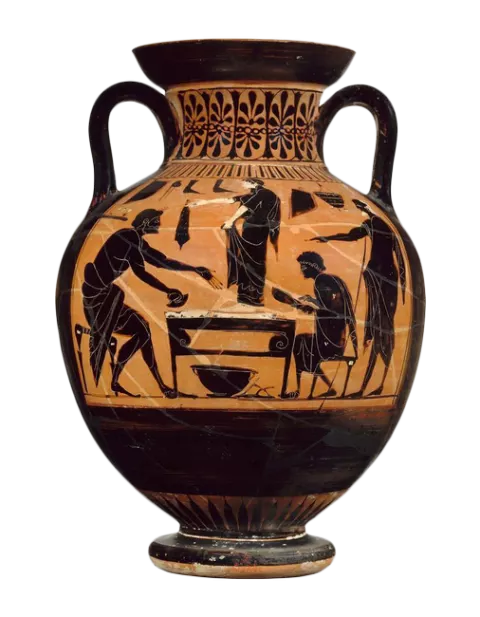
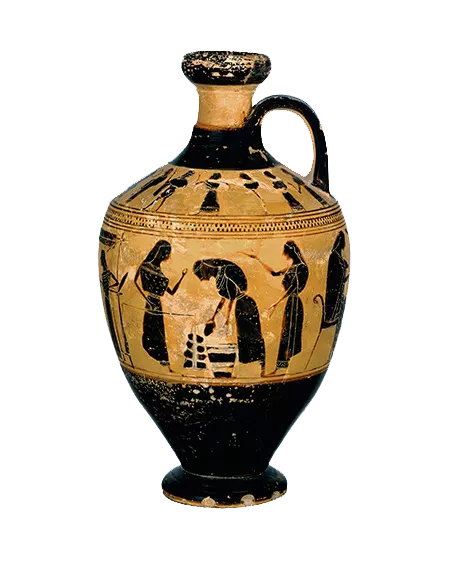
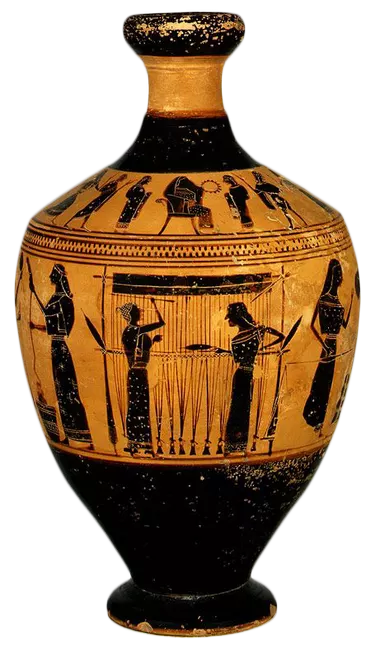
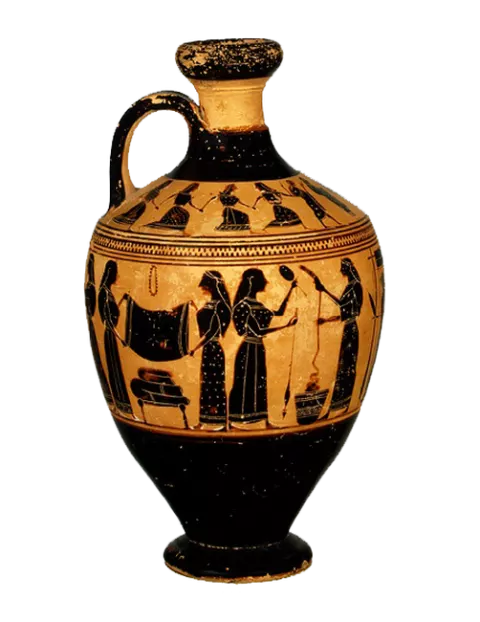
Development of individual ownership, sometimes prior to the 8th century BC, had a far-reaching impact on social and economic development of the Greek society. One of the consequences was the expansion of two main social classes – the “eupatrids” or wealthy hereditary nobility, and “demos” or commoners. With the flourishing of trade and manufacture, eventually a third, middle class was formed comprised of traders and craftsmen. The Greeks recognized various types of merchant: “kapeloi” (retail merchant who sold things as cattle and leather), “palinkapeloi” (entrepreneurs and middlemen) and “emporoi” (long-distance traders).
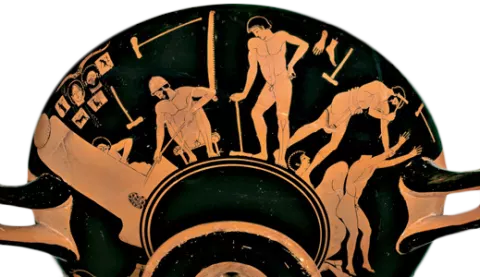
This third class became the main driving force of economic growth. The privileged aristocratic class of Greece based its wealth on land, and considered direct involvement in business ventures as activity beneath their dignity. Thus, they used slaves and freedmen to screen their business activities. As a result, lucrative business in shipping, industry and banking during the antiquity rested almost entirely in the hands of foreigners (metics) and freedmen. Since they could not own land, they held their assets in investments.
However, through institution of liturgies or donations the wealthy citizens of Athens were obliged to share their wealth with the community by construction of bridge, public plays, athletic games, military equipment and extremely expensive warships.
Business practice
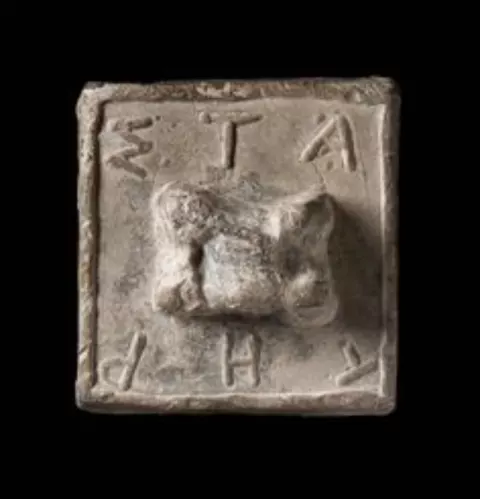
Antiquity was unfamiliar with the concept of insurance on a sophisticated level which protected entrepreneurs from risks caused by storms, pirates or other damages. Although form of joint-stock associations convenient for conducting large-scale business that required a huge capital was used in tax farming, it was not applied to business world in general.
Therefore, for conduct of long-distance trade, merchant was heavily depended on three factors – the capitalist who provided the necessary capital, ship-owner who ensured means of transport and on the special type of contract, called “respondentia”.
Capitalist was a crucial person as he provided money necessary for maritime ventures. Capitalists were persons of different financial strength. First group was made of entrepreneurs whose capital derived from other sources and they were inclined to periodically employ part of their capital in shipping to earn easy money. The second group was made of men permanently engaged in this job – wealthy Athenian citizens and metics. In Athens were established special courts and laws to motivate the capitalists to participate in commercial ventures by providing them the greatest possible security and the legal protection. The most vulnerable party in this scheme was a capitalist.
The merchant’s business guiding idea was to achieve a good profit on a single venture, rather than to conduct a number of ventures simultaneously with a smaller profit from each. He used the borrowed money to purchase a cargo and to contract with a ship owner for all of his cargo space or a portion necessary for transport. In many cases, he embarked and sailed on the ship in person. Following the arrival at the destination, he sold the goods and either repaid the loan to capitalist’s agent or, if the venture was on the round trip, purchased a return cargo.
And finally, the last person in this enterprise was a ship owner who provided transport by hiring his vessels to individuals and firms. As it was the case with capitalists, the ship owners were also persons of different financial strength. There were very wealthy ship-owners who owned ships and slave crews, who made the first class. There was also a man who owned and operated only a single ship, and who made the second class. The third group was comprised by ship captains who were merely the nominal owners of their vessels. In all likelihood, there was also a group of entrepreneurs who acted at the same time as ship owners and merchant adventurers.
Unlike a typical loan in which the borrower is liable for the debt at all times, a “respondentia” (loan on cargo) and “bottomry” (loan on ships) contracts makes the lender liable for the loan. If the venture ended badly, the capitalist irretrievably lost all the money he advanced, but if the venture was successful, he would receive back his principal and also interest agreed, between 20 and 30 percent, exceeding the legal rate of interest.
The typical “respondentia” contract defined the amount of loan, the general route of voyage and the rate of interest that could grew from 22 ½ per cent to 30 per cent if certain deviations from the route, involving added risk, were made by the borrowers. The contract also specified the nature and amount of the cargo to be bought. The borrower was obliged to affirm that there is no prior lien upon the cargo, and agree not to contract any further indebtedness upon the security.
In the case the vessel be lost, the contract provides the termination of the borrowers’ obligation, and in the case of jettison or enforced payment to enemies a proper reduction. On the other side, the borrowers agree to purchase a return cargo, deliver it and put under absolute control of capitalist until the agreed sum is paid. If the loan was not repaid within the stipulated time, the lenders had the right to sell or pledge the security, and in the cases when this was not sufficient, to levy the sum by execution against all other property of the borrowers, whether on land or sea. The contract was signed and sealed in the presence of witnesses and deposited with a third party, while the copies being taken by the contracting parties.
In most cases, the ship-owners were also inclined to operate upon borrowed capital, rather than its own. The reason for such decision was motivated by the great risks that navigation implied for an ordinary entrepreneur. It was much safer for ship-captain to take a “bottomry” loan and pledge his ship as security for repayment, than to risk financial ruin by investing his entire capital. In the other hand, for the liquid capitalist who provided money, the occasional loss of a ship would not mean financial ruin because high interest rate in the long time ensured a profit over and above his losses.
Economy
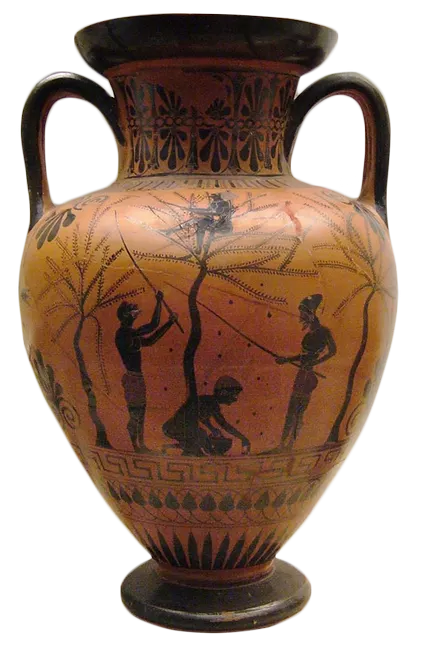
In the ancient Greece the wealth was measured by the amount of land that person owned. Landownership was essential for gaining citizenship as a basis of the political and social position. The most people lived on farms of about five acres in size producing grains for bread, olive trees for oil and grapevines for wine.
The heart of every Greek city was the agora or the market place. It was the commercial center of the city as well as the public center where people encountered. Craftsmen also usually lived and worked near of agora. Shops were usually located in the “stoa” behind the row of columns, and all traders needed to pay a fee to set up a stall. The traders and commodities were controlled by officials, called the “metronomoi” who checked weights and measures, and the “agoranomoi” that evaluated the quality of goods.
The government held an important role in the economy. It often bringing together the private sector with public. Polis leased mining rights on mines and quarries to an individual citizen who used his own equipment, workshops and workers receiving in return a lease fee plus a percentage of the yield. In this way the polis also achieved an easy access to the natural resources and craft products necessary for war purposes. The government also exercised economic control. It banned exports that were especially important for citizens, like grain. Government also raised money by collecting dues and imposing taxes on imports.
Invention of coinage that occurred in the 7th century Lidiya encouraged the other Greek cities to start to coin its own version of money. The use of coins facilitated the conduct of commerce and banking. The silver four drachma pieces of Athens known as “owls” became the Greek monetary standard of the day and the most widely used coins in the Greek world due its purity.
10 lives in this room
More lives in this room
- Colaeus 7th century BC
- Demaratus 7th century BC
- Sostratos of Aegina 6th century BC
- Cephalus 5th century BC
- Demosthenes 5th-4th century BC
- Andocides ca. 440–390 BC
- Pytheas c. 380 – c. 300 BC
- Chrysippus 4th century BC
- Leocrates 4th century BC
- Hippalus 1st century BC