Museum / Rooms / Trade between Han Dynasty and Roman Empire
Room · 6 chapters
Trade between Han Dynasty and Roman Empire
TRADE BETWEEN HAN DYNASTY AND THE ROMAN EMPIRE
Eurasian superpowers which had no official contact but were connected through trade
Superpowers
During the antiquity, both the Roman Empire and the Han dynasty of China were the largest empires on each end of the Eurasia. These empires were well aware of each other, although there was no official contact between them. Since the distance between these two empires was great, nearly all of the interactions between the Roman Empire and China under the Han Dynasty were indirect, brokered by numerous merchants, mostly Parthian and Kushan who traded along the Silk Road.
Commodities
The ancient Roman and Chinese civilizations were still able to know each other indirectly, through various trade goods that they exchanged. Beside the silk, the Romans were interested in Asian perfumes, pepper, incense, cosmetics, and medicines such as rhubarb, storax, and poppy. On the other hand, the Chinese were attracted by precious metals, precious and semi-precious stones, corals from the Mediterranean and Red Seas for jewelry, glass from Alexandria and Syria, amber from Scandinavia, gold threaded and multi-colored embroideries, and even rhinoceroses and fighting cocks.
Great market towns
From the beginning of Octavian’s reign in 27 BC till the late second century CE, the Roman Empire entered the period known as “Pax Romana” (The Roman Peace) characterized by relative peace and economic stability. During this period the cities of Alexandria and Antioch emerged as the primary trading conduits with the East. Alexandria became the principal link to the sea trade with Arabia, East Africa, and India, while Antioch became the principal overland route, linking Rome with Parthia, south-central Asia, India, and China. On the other side of Eurasia this trade brought huge prosperity to the cities of Xi'an and Luoyang, both of which were capitals of the Han Empire.
Role models for the future
Trade connections made between the Roman Empire and the Han Dynasty continued to live long after both of them had fallen and were replaced with new ones. Both of these empires were principal models for successor states, and as in other matters so was in the matter of commerce.
The ancient Chinese referred to the Roman Empire as “Da Qin” which meant “Great China” which was certainly an expression of admiration and appreciation of Roman culture. The Romans named the Chinese “Seres” after the word for silk (“sericum”), the most valuable eastern merchandise affordable only to the wealthiest Roman elite.
Attempt for an official contact between Rome and China was hampered by Parthians because as middlemen in trade between them they had most to lose.
Chapters
- Introduction
- Birth of Eurasian superpowers
- Roman knowledge of China
- In between
- Chinese knowledge about Romans
- Commodities in trade
Introduction
Both the Roman Empire and the Han dynasty China were largest empires on each end of the Eurasia. These empires were well aware of each other, although there was no official contact. Nearly all of the interactions between the Roman Empire and China under the Han Dynasty were indirect, brokered by numerous merchants, mostly Parhian and Kushan. However their knowledge of each other came through the various trade goods, gathered from various parts of their empires and their neighbors, that flowed along the Silk Road.
From the beginning of Octavian’s reign in 27 BC till the late second century CE Rome was in period known as Pax Romana (The Roman Peace), a period of relative peace and stability during which the cities of Alexandria and Antioch emerged as the primary trading conduits with the East. Alexandria became the principal link to the sea trade with Arabia, East Africa, and India, while Antioch became the principal overland route, linking Rome with Parthia, south-central Asia, India, and China.
Trade connections made between the Roman Empire and the Han Dynasty continued to live long after both of them had fallen and were replaced with new ones. Both of these empires were principal models for successor states, and as in other matters so was in the matter of commerce.
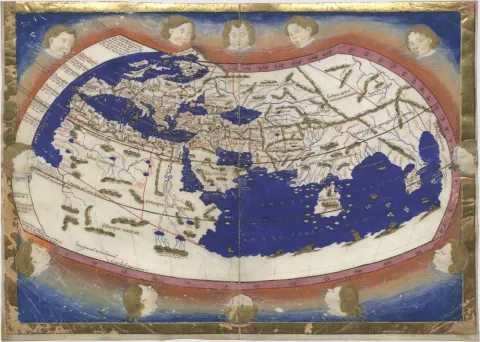
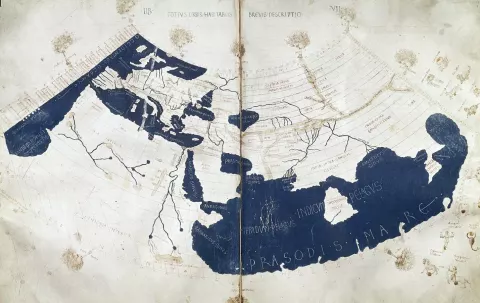
Ptolemy's world map, reconstituted from Ptolemy's Geography (c. 150) in the 3rd quarter of the 15th century, indicating Sinae (China) at the extreme right, and Serica, the Chinese capital
Birth of Eurasian superpowers
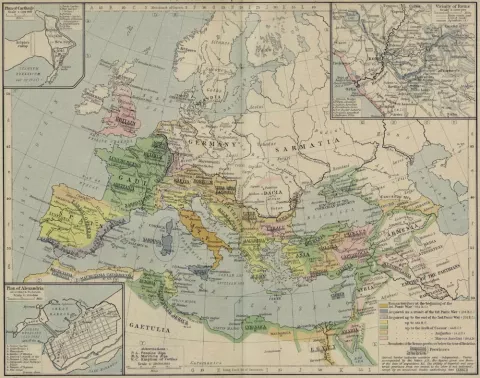
Rome’s relentless expansion made them the greatest power on the west of Eurasia and also provided them with numerous recourses for trade as well as towns at one end of the Silk Road. Roman military machine first secured Italian peninsula, then defeated Carthage, a great military and economic rival, during the Punic Wars (264-146 BC). Their eastward expansion came through victories in the Macedonian Wars (214-148 BC), the Roman-Syrian War (192-188), and conquest of Greece in 146 BC. These wars established Rome as the main power both in western and eastern Mediterranean. Further conquests during the Third Mithridatic War (75-63 BC) secured for Rome nearly all of Asia Minor, Black Sea region and Syria with the eastern coast of Mediterranean Sea. Military and political maneuverings of Julius Caesar and Octavian brought Egypt under Roman control by 30 BC, and thus the great trading centers on the western end of the Silk Road fell under or became accessible to Rome.
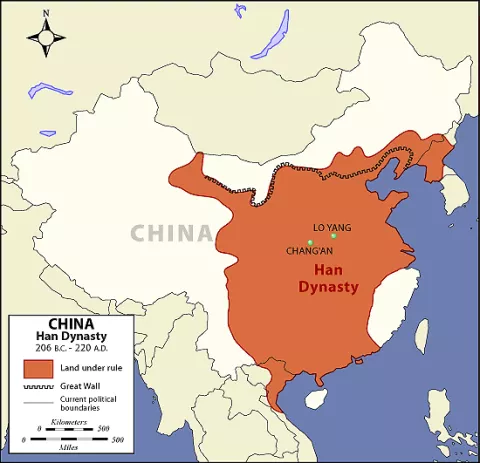
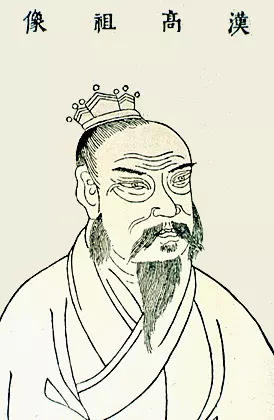
On the other end of Eurasia China was in the Warring States period of its history. Chinese territory was divided among the seven leading states until King Zheng of Qin (c. 259 BC – 210 BC) managed to unify them under his power in 221 BC. Zheng assumed the sacred titles of legendary rulers and proclaimed himself Shihuangdi (First Sovereign Emperor). Once he unified China under his rule he sought to extend its borders to the north and west, where it encountered the nomadic Xiongu who traversed a large zone of the Inner Eurasian steppe. The two people engaged in war, diplomacy, and trade. In order to secure the Xiongu pasturelands for settlement, China built a road and a massive defensive wall along the northern border and settled 30 000 colonists in the steppe lands of Inner Asia. Heavy tax and labor requirements resulted in mutinies from laborers, local military leaders, influential merchants, and others. Qin fell in 207 BC, and during the subsequent civil war one Liu Bang declared himself the prince of his home region of Han and in 202 BC declared himself the first Han emperor.
Chinese came to contact with western lands through voyages of the imperial envoy Zhang Qian. In the 130s BC he was sent on a diplomatic mission to the Yuezhi to make alliance between them and China against the Xiongu, another nomadic people of the steppe. Yuezhi did not agreed to the alliance, but Zhang’s report on foreign lands and markets from his more than a decade long journey greatly interested the Han court. Subsequently Emperor Wu of Han (r. 141 BC – 87 BC) launched several successful campaigns against the Xiongu, extended the Great Wall northwestward all the way to the Gate of Jade (Yumen), and secured China’s access to the routes leading west.
Roman knowledge of China
The majority of trade between Rome and the East passed over land, although it was a complicated enterprise. A mayor point in this trade was Antioch from where land routes led into Parthia by crossing the Euphrates at Zeugma in southeastern Turkey. From there the trade route passed through Parthia to the Stone Tower, probably Tashkurgan in Tajik Autonomous County, Xinjiang, China where Parthian intermediaries met with Chinese merchants. According to Ptolemy’s (c. 100 – 170) Geographia, the distance between the Euphrates and the Stone Tower was 26280 stadia. From there to Sera, the Chinese capital, at the time in the city of Luoyang, was additional 36200 stadia. If we transfer stadia to miles it would be 3100 miles from Zeugma to the Stone Tower and additional 4285 miles to reach the Chinese capital. As the relations between Rome and Parthian Empire were variable, Roman merchants traveling east sometimes were forced to use alternate routes. One such route was northern one that traveled around or across Caspian Sea, across land to the Aral Sea, and down the Oxus River (Amu Darya) to the Stone Tower.
Ptolemy’s calculation shows indication that the Greco-Romans knew of China’s location with relative accuracy considering the indirect nature of the contact between Europe and China. An account from Pliny the Elder (23 - 79) provides further evidence about the geographical knowledge of the Romans.
"Then we come to more Scythians and to more deserts inhabited by wild beasts, until we reach a mountain range called Tabis (probably Tibet) which forms a cliff over the sea; and not until we have covered nearly half of the length of the coast that faces north-east is that region inhabited. The first human occupants are the people called the Chinese, who are famous for the woollen substance obtained from their forests…"
Although the Romans knew China’s location with relative accuracy, they knew very little about China’s main product. Pliny the Elder describes silk like a product growing on trees: "…the woollen substance obtained from their forests; after a soaking in water they comb off the white down of the leaves…" He also describes Chinese as people of mild character who prefer to wait for trade to come to them.
Even three hundred years later Ammianus Marcellinus (330 – 391) wrote that the peacefull and agreeable Seres had “well-lighted woods, the trees of which produce a substance which they work with frequent sprinkling, like a kind of fleece; then from the wool-like material, mixed with water, they draw out very fine threads, spin the yarn, and make sericum.”
In between
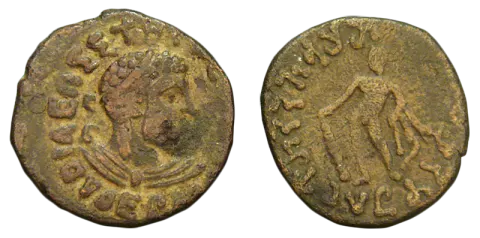
Most of the contacts between Rome and China were through merchant intermediaries. The distance was great and merchants who traveled the whole length between the two great empires were rare. Trade was conducted in stages, from one oasis to another with merchandise changing hands from one to another. Two greatest powers between Rome and China were Parthian Empire and Kushan Empire, and Parthians and Kushans were naturally the ones to control most of the land trade. Parthian Empire stretched from Mesopotamia in the west to the modern Iranian-Afghan and Iranian-Pakistani borders in the east and from Caspian and Aral Seas in the North to the Persian Gulf in the south.
East of the Parthian Empire was the Kushan Empire which controlled lands roughly located over modern Afghanistan, Pakistan, Kashmir, and northern India along the great river valleys. Kushan territory on the east bordered the western extremities of Chinese territory to whom the Kushans were known as the Yueh-chi (Yuezhi).
Chinese knowledge about Romans
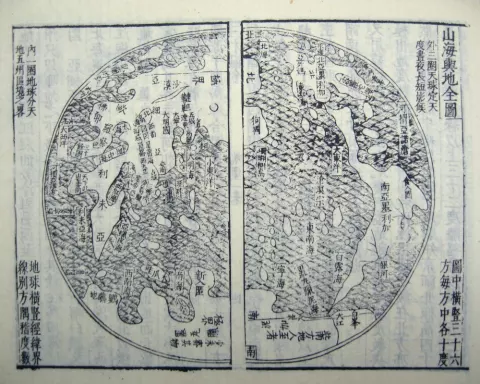
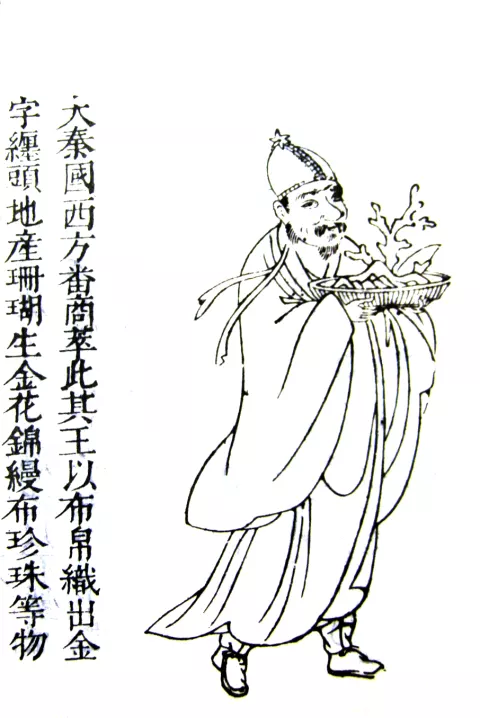
According to Hou Hanshu, a historical account of the Han dynasty from years 25 till 220, compiled in the fifth century, Chinese were by then aware of the Roman Empire or Da Qin as they called it. The name Da Qin, literally Great China, was given to Rome most probably because the Han Chinese came to the realization that China was not necessarily the only civilized country in the world, and that the Roman Empire and its people and civilization were comparable to those of China. In a way, naming the Roman Empire Da Qin was expression of admiration and appreciation of their culture. In 97 CE Chinese general Ban Chao sent his envoy Gan Ying on a mission to Rome to learn about this large and rich empire at the other end of the trade routes. Gan Ying travelled all the way to the West Sea, what is probably the Persian Gulf, but failed to reach Rome. He reached the city Tiaozhi, presumably Characene or Susiana, but the Parthian sailors discouraged him from reaching Roman territory by telling him the trip is too long and too dangerous:
"In the ninth yongyuan year, during the reign of Emperor He, the Protector General Ban Chao sent Gan Ying to Da Qin. He reached Tiaozhi next to a large sea. He wanted to cross it, but the sailors of the western frontier of Anxi (Parthia) said to him:
The ocean is huge. Those making the round trip can do it in three months if the winds are favourable. However, if you encounter winds that delay you, it can take two years. That is why all the men who go by sea take stores for three years. The vast ocean urges men to think of their country, and get homesick, and some of them die.
When Ying heard this, he gave up his plan."
It was the only recorded official attempt of the Han government to establish direct diplomatic relations with the Roman Empire. Presumably the Parthian sailors discouraged Gan Ying from further travel because they had the most to lose from any direct Chinese contact with Rome.
The same book is providing us with information about Rome’s initiative to make direct contact with China: “The king of this country (Rome) always wanted to send envoys to the Han, but Anxi (Parthia), wishing to control the trade in multi-coloured Chinese silks, blocked the route to prevent (the Romans) getting through (to China).” The book also describes what may have been direct contact between Rome and China in modern Vietnam.
“In the ninth yanxi year (166 CE), during the reign of Emperor Huan, the king of Da Qin, Andun (Marcus Aurelius), sent envoys from beyond the frontiers through Rinan (Commandery on the central Vietnamese coast), to offer elephant tusks, rhinoceros horn, and turtle shell. This was the very first time there was (direct) communication (between the two countries). “
Commodities mentioned in the account were all items Rome could easily have gathered from its trading partners and offered as tribute but as the author of the Hou Hanshu states, the tribute was “neither precious nor rare, raising suspicion that the accounts might be exaggerated.”
Commodities in trade
The main commodity in trade between the Roman Empire and Han Empire was silk. The Romans even named the Chinese people "Seres" after the word for silk, "sericum". In the early days of the Sino-Roman silk trade, the "silk people" could have been any of the intermediaries in the trade. However, by the first century the Romans identified the Seres as a people far to the east of Parthia, an area more in line with modern China.
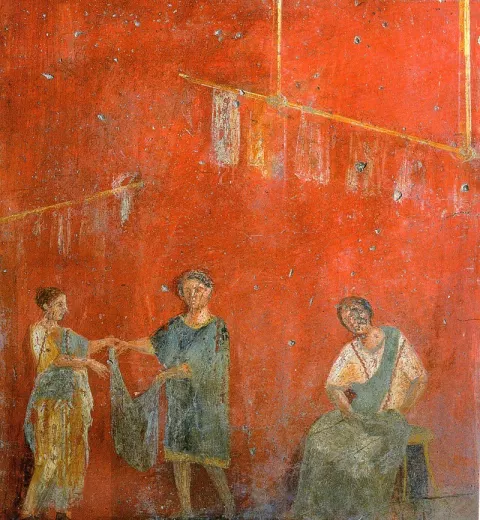
Chinese silk was imported in the Roman Empire as raw material that needed to be unraveled, dyed, and then rewoven to make the product suit Roman tastes. As a consequence of this process the cultural diffusion between China and Rome was limited because Chinese designs and style were not present on the raw imported silk. To make the final product pleasing to Roman customers but also to have the luxurious decadence of the East, linen and wool wee often interwoven with silk. Some of this rewoven and dyed silk was resold to customers in the East. At first only the super wealthy could afford such a luxury as silk but as the volume of silk Chinese silk increased and Rome grew increasingly prosperous under Augustus, a greater portion of the population could afford to purchase silk.
Silk was the main product in Sino-Roman trade but it was not the only one. Romans imported perfumes, pepper, incense, cosmetics, medicines such as rhubarb, storax, and poppy. Even the peach and apricot trees traveled from China to Rome. From Rome to China flowed precious metals, precious and semi-precious stones, corals from the Mediterranean and Red Seas for jewelry, glass from Alexandria and Syria, amber from Scandinavia, gold threaded and multi-colored embroideries, and even rhinoceroses and fighting cocks.