Room · 5 chapters
The Pochteca
POCHTECA
The long-distance Aztec traders whose wealth surpassed those of nobility
The civilization that gave its name to modern Mexico
The Aztecs, who called themselves the Mexica were founders of the last great native Mesoamerican civilization which flourished in the Mexico valley from the beginning of the 14th century to the arrival of conquistadors in the 16th century.
As most of the premodern societies, the Aztec Empire was based on agriculture and trade, and on warfare as an additional source of income. At the heights of power, they ruled over five hundred small tributary states with population that amounted 5 to 6 million people.
The basis of Aztec economic power represented incomes in the form of taxes imposed on domestic and vassal population which were supplemented by tributes paid by the conquered people.
Markets as centers of Aztec economic life
Both daily commodities and luxurious items could be found on markets which were a part of highly regulated system of markets and supply mechanisms. Tenochtitlan and Tlatelolco were known as the largest and most renowned markets in the Empire. The Spanish conquistadors, including the leading conquistador Hernan Cortez, were amazed by its appearance of which they have left written testimonies that survived to the present day.
Chocolate as money
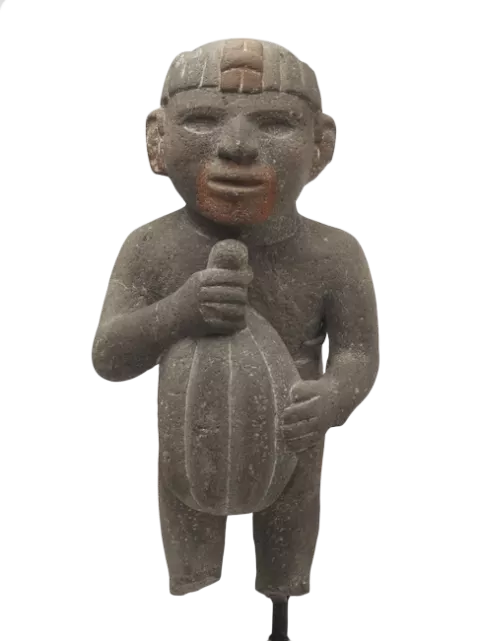
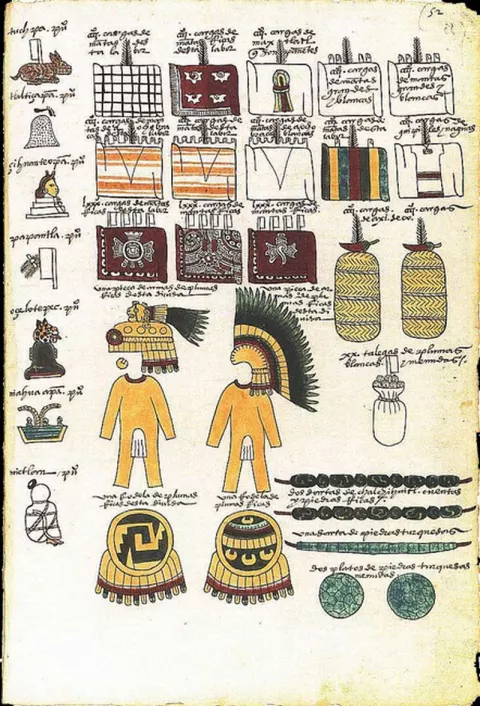
Although they had precious metals, like gold and silver, the Aztec did not known the classical money and they relied on bartering and bargain in their transactions. The Aztec currency represented two quite unusual commodities – the cacao beans and cotton textiles (quachtli). Beans were small and portable and thus convenient for small, daily purchases. Textiles in contrary represented a higher value and were used for more expensive purchases. The hot chocolate beverage was known, but only as a privilege of the noble class and thus unavailable to the commoners.
Professional traders and state spies
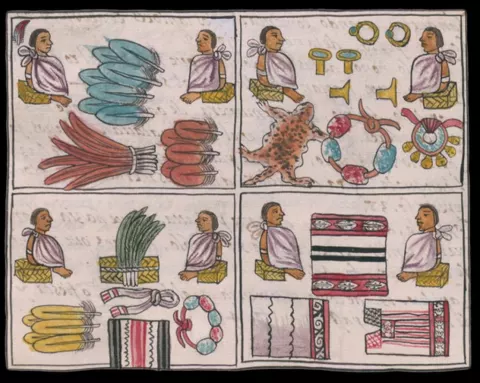
Prominent place in the Aztec economic and social life occupied the “pochteca”, the professional long-distance merchants. They were engaged in obtaining and selling of luxury items highly prized by Aztec nobility such as colored feathers, various gems, and animal hides. In pursuit of profit and lucrative merchandise the Pochteca often frequented the enemy states where they gathered information on resources, armies, and defenses for the Aztec ruler. Because of the great danger to which they were exposed, their profession enjoyed high esteem in society.
Rituals for good luck and gratitude
Before departure on expedition the Pochteca passed through rituals of departure – which consisted of elaborate rituals and speeches before a large gathering. The ceremony included a ritual cleansing and cutting of hair, decoration of their merchant’s stuff and piercing of their ears and tongues at midnight. Those who survived the expedition participated in another ritual in gratitude for successfully completed expedition – they ritually washed their feet and offered a human sacrifice to the gods in ceremony called the “Bathing”.
The Aztec capital Tenochtitlan built in the swamps of Lake Texcoco was one of the largest and prosperous capitals in the world at the time with a population of perhaps 200,000. On its site was developed the modern Mexico City.
The Aztec merchants’ practice of removing the outer skin from cocoa beans and stuffing it with dirt or sawdust, and mixing with the real beans was treated as counterfeiting and punished by law.
In those days on the market for one cacao bean you could get a tomato, for 3 cacao beans a small rabbit, turkey egg or avocado, while turkey, for example, was much more expensive and cost 200 beans. Also, 20 cotton cloaks (quachtli) could allegedly support a commoner for a year in the capital Tenochtitlan.
Although the Aztec civilizations ceased to exist in 1521, the memories on this great people are preserved and still live in the name of Mexico and in symbols of its national flag which recalls the mythical founding of Mexico City by the Aztecs.
Chapters
- The Aztec Civilization
- Markets
- The Pochteca – professional long-distance merchants
- The twilight of civilization
- Money
The Aztec Civilization
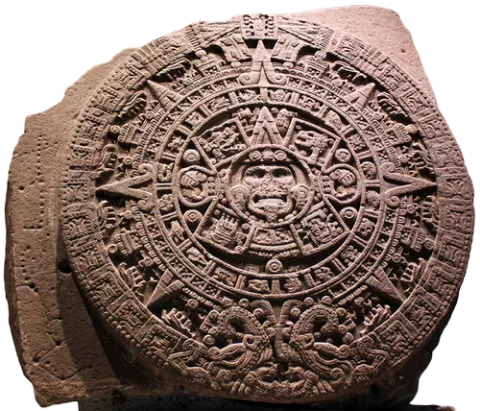
The Aztec calendar stone, Sun Stone, or Stone of the Five Eras is perhaps the most famous work of Aztec sculpture. The stone is 358 centimeters (11.75 ft) in diameter and 98 centimeters (3.22 ft) thick, and it weighs about 24 tons.
At the time when Europe was going through a period of the Middle Age, in yet undiscovered New World flourished one of the most prosperous civilizations on the American soil – the Aztec.
“The people of the sun and earth”, how they called themselves, founded a highly developed culture in the Central America with a complex economic, social and religious system.
Along with the Empire of the Incas in Peru, the Aztecs are considered to be the most powerful and prosperous realm of
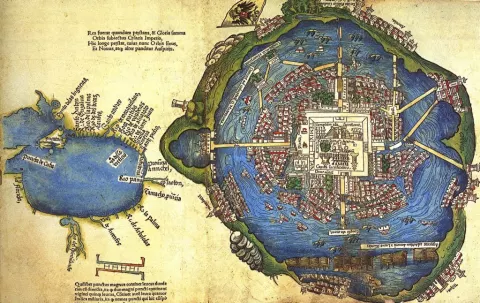
Hernan Cortés’ 1524 Map of Tenochtitlan
the ancient period of American history. Their capital, Tenochtitlan consisted of 200,000 inhabitants and represented one of the largest capitals in the world, overshadowed at that time only by the Paris and Istanbul.
Economically the society was like the all pre-modern societies based on agriculture and in a large extent on warfare as an additional source of income. Other important factor of their economy represented the commerce, long-distance as well as local one.
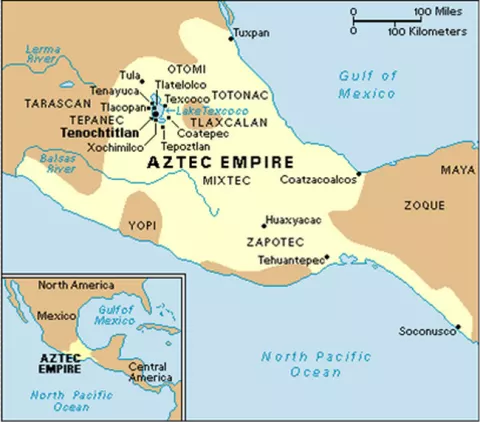
Map of the Aztec Empire. The three major city-states which formed the Aztec Triple Alliance were Tenochtitlan, Texcoco and Tlacopan.
In order to manage the realm, the Aztecs developed a sophisticated control and military apparatus accompanied by the intricate agricultural system indispensable for maintaining a large population, as well as cultural advances in terms of the calendar and letter.
Markets
At the height of its power, the Aztec Empire stretched on an area of over 80,000 square miles (207,200 square km), encompassed 400 to 500 small states with an overall population of some 5.000,000 to 6.000,000 people.
The economic stability of the realm was based on agriculture. Economic prosperity of the Empire was fostered by the conquest of other territories, imposing taxes in nonlocal goods, protecting market towns and trade routes and by sponsoring professional merchants.
In order to supply its increasing population with all necessities it was necessary to develop an elaborate system of markets with adequate supply system. Markets were necessary for securing livelihood commodities for all social classes, as well as luxurious items which were signs of status and prestige of the noble class. Goods could be sold only at market places and at precisely denoted time.
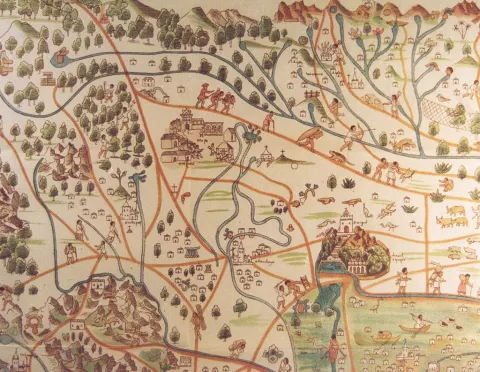
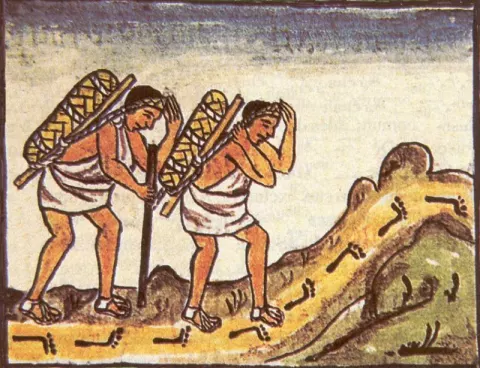
The commodities were transported through the Empire either by well-developed system of roads or, where it was possible, by water. Although the Aztecs were familiar with the concept of the wheel they never used it in practical terms. Most probably it was due to the lack of draft animals. As an alternative, they used “tlamemes”, that is professional carriers, or canoes.
According to some records on the lakes around Tenochtitlan there were around 50,000 and 200,000 canoes of different size used in commercial purposes.
The markets, known as “tianquiztli” were highly diversified and efficient, and comprised of four levels. They differed from each other in the number of people who took part in trade, the quantity and variety of commodities, services that were offered and the frequency with which they were held.
On the bottom of the scale were markets of the smaller towns and villages. They were followed by those which were maintained in the cities Acolman, Otumba and Coyoacan, and by more
prominent which were held in Texcoco and Xochimilco. Some of these have been famous for its specialization in a particular item. Thus, Otompan or Otumba was known as a major market in obsidian; Coyocan in wood products; Cholula in chilies and maguey honey and luxury items as jewels, precious stones and fine feather-work; Acolman in selling dogs; Texcoco in its famous ceramics, while Azcapotzalco and Itzocan were renowned as slave markets.
The top of hierarchy was occupied by Tlatelolco, the most prestige and abundant market in the entire Aztec Empire.
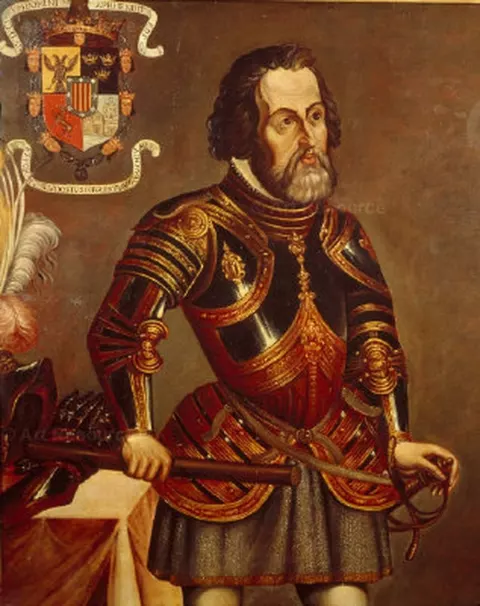
The Spanish observers, including the leading conquistador Hernan Cortez, were amazed by its appearance of which they have left written testimonies that survived to the present day:
“The city has many open squares in which markets are continuously held and the general business of buying and selling proceeds. One square in particular is twice as big as that of Salamanca and completely surrounded by arcades where there are daily more than sixty thousand folk buying and selling. Every kind of merchandise such as may be met with in every land is for sale there, whether of food and victuals, or ornaments of gold and silver, or lead, brass, copper, tin, precious stones, bones, shells, snails and feathers…
There is a street of game where they sell… rabbits, hares, deer and small dogs which they breed especially for eating. There is a street of herb-sellers where there are all manner of roots and medicinal plants that are found in the land… There are barbers’ shops where you may have your hair washed and cut. There are other shops where you may obtain food and drink. There are street porters such as we have in Spain to carry packages…
All kinds of vegetables may be found there. There are many different sorts of fruits… All kinds of cotton thread in various colors may be bought in skeins, very much in the same way as in the great silk exchange of Granada, except that the quantities are far less. They have colors for painting of as good quality as any in Spain, and of as pure shades as may be found anywhere…
A great deal of chinaware is sold of very good quality… Maize is sold both as grain and in the form of bread… Pastries made from game and fish pies may be seen on sale…”.
Beside abundance of the marketplace, the Spanish observers were also impressed by its orderliness:
“There is nothing to be found in all the land which is not sold in these markets, for over and above what I have mentioned there are so many and such various other things that on account of their very number and the fact that I do not know their names, I cannot now detail them. Each kind of merchandise is sold in its own particular street and no other kind may be sold there: this rule is very well enforced. All is sold by number and measure, but up till now no weighing by balance has been observed. Avery fine building in the great square serves as a kind of audience chamber where ten or a dozen persons are always seated, as judges, who deliberate on all cases arising in the market and pass sentence on evildoers. In the square itself there are officials who continually walk amongst the people inspecting goods exposed for sale and the measures by which they are sold, and on certain occasions I have seen them destroy measures which were false”.
The Pochteca – professional long-distance merchants
In order to ensure that markets throughout the empire were well supplied with all types of commodities, a multitude of traders had been active in the Empire.
At least two types of professional merchants existed. The first were regional non-guild merchants called “Tlanecuilo” who traded in a smaller range and utilitarian commodities. They were frequently specialized in specific items such as: seeds of amaranth (the Huauhnamacac traders); salt (The Iztanamacaque); different items, including silver and gold (The Tlacemanqui) and in their own produce (The Tlanamacac producer-sellers).
The second type represented “Pochteca” or guild merchants who were engaged on an international scale and in luxury items. In the caste and class divided Aztec society, professional Pochteca held a prominent position immediately below the noble class. Reasons for such favorable position were due to their successful entrepreneurial skills and material prosperity. In addition to conducting private business, they also operated as trade agents and intelligencers in the service of the state.
The Pochteca – professional long-distance merchants
Guild
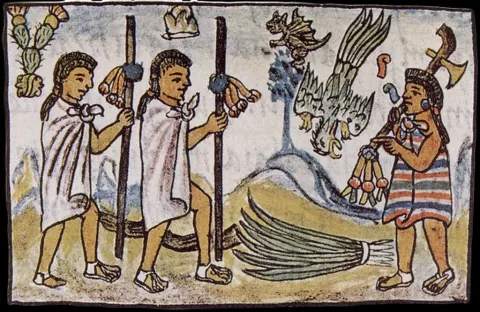
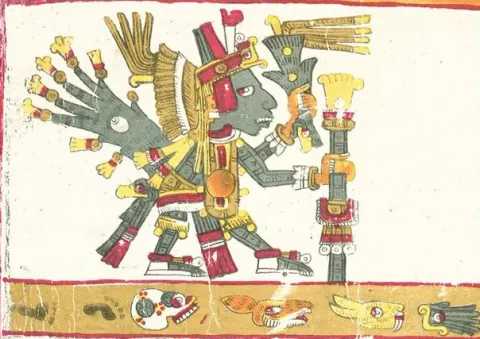
Pochteca were organized in the special guilds characterized by the hereditary membership, separate laws and courts which gave them a certain measure of autonomy. The protector of the guild was the god Yacatecuhtli.
The guild had its own hierarchy with two principal merchants on the head. The highest officials were the “pochtecatlatoque”. They were senior members who acted as administrators, supervisors of young Pochteca and administrators of the marketplace. The second group made up the slave traders or “tlatlani”, often referred to as the richest of merchants due to their role in capturing the slaves predestined for sacrificial victims. The third group of long distance traders, “tencunenenque” worked for the rulers. Only the Pochteca from Tenochtitlan and Tlatelolco, as it seems, enjoyed a privilege to trade goods for and from the emperor. Finally, the last group of Pochteca formed a trader spies, known as the “naualoztomeca” who besides trading used business travels for gathering information for the government. On the bottom of hierarchy were apprentices.
The Pochteca usually began his career by entering the guild at a low level of expenditure, trading in such commodities as salt, chili and other inexpensive commodities selling them in the markets of smaller communities and door to door. Only with time and after they learned the trade, they could rise in the ranks and start trading more exotic goods.
The Pochteca – professional long-distance merchants
Commodities
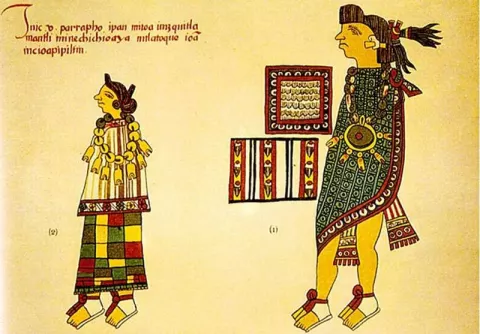
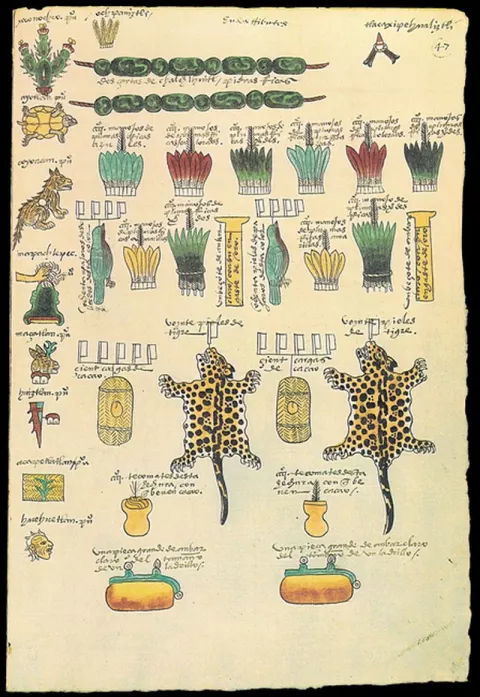
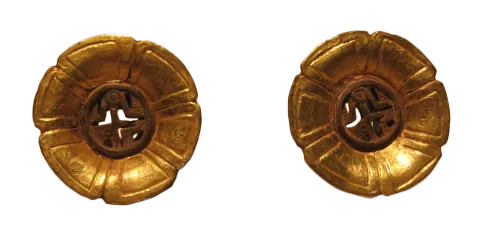
The main subject of their trade were luxury and precious items highly demanded by the noble class which sought every mean to display their wealth and status – elaborately decorated caped and skirt, colorful tropical bird feathers, numerous objects of gold, necklaces, spinning bowls, ears pool, obsidian blades and knives, shells, corals, needles, animal fur and skins, various herbs and dyes, slaves and jewelry of jade, jadeite and turquoise being just some of them.
The main subject of their trade were luxury and precious items highly demanded by the noble class which sought every mean to display their wealth and status – elaborately decorated caped and skirt, colorful tropical bird feathers, numerous objects of gold, necklaces, spinning bowls, ears pool, obsidian blades and knives, shells, corals, needles, animal fur and skins, various herbs and dyes, slaves and jewelry of jade, jadeite and turquoise being just some of them.
Aztec gold necklaces made of small beads in the form of frogs.
In order to obtain these luxurious items which were main source of their personal wealth, the pochteca traded along the Aztec Empire, even outside the realm of the empire on the enemy territories. It was a challenging and highly dangerous enterprise in their world, and exposure to risks provided them additional high esteem.
rituals
The Pochteca – professional long-distance merchants
Rituals
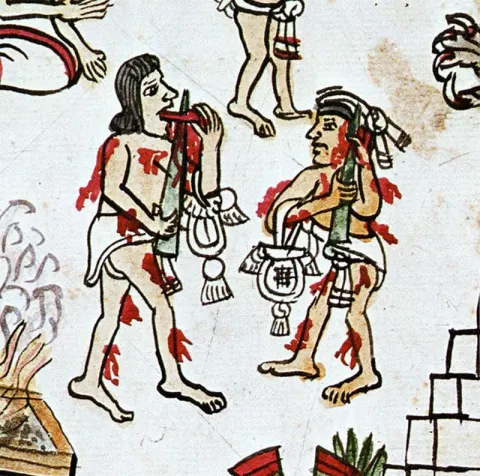
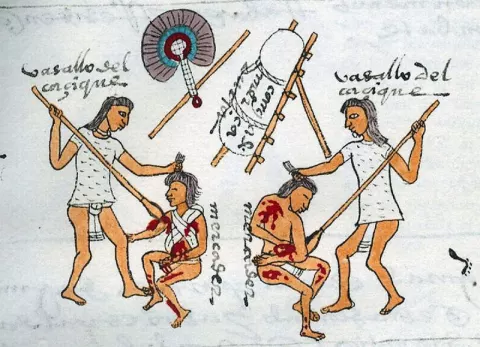
Before departure on the trade expedition, they should pass through the rituals of departure – elaborate rituals and speeches held on a feast before a large gathering. The ceremony began with a ritual cleansing as all the travelers washed their heads with soap and cut their hair. They would not wash their heads or cut their hair until the return. The act of purification was followed by those of decoration of their merchant's staff. Finally, at midnight they pierced their ears and tongues, and flicked their blood into the fire. Then they scattered it toward the sky, the east, the west, the south and the north, for times each and were accompanied by the ceremonial speech.
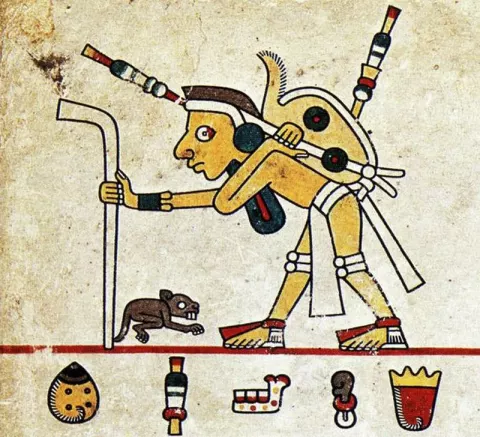
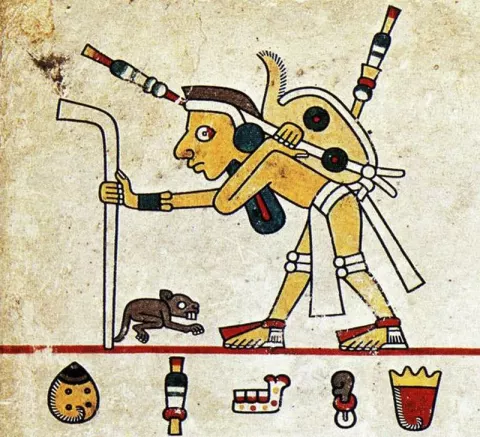
These expeditions were carefully planned. They could last several months and would involve merchants and apprentices as well as a crew of professional carriers or “tlameme” to bear the loads of goods in large backpacks. They were joined by the “nahualoztomeca” who acted as vanguards and spies, gathering information on resources, armies and defenses for the Aztec ruler while staying on the enemy territories.
Upon their return they practiced to enter the city under the cover of darkness:
“Not by day but by night they swiftly entered the by boat. And as to their goods, no one could see how much there was; perhaps they carefully hid – covered up – all the boats... And when he had quickly come to unload what he had acquired, then swiftly he took away his boat. When it dawned, nothin remained...”.
The reason for such a measure was a precaution – to hide the extent of their success. Namely through the expeditions of this kind many pocheteca accumulated personal wealth which surpassed those of the Aztec aristocracy, and the class differences forbade them displaying wealth openly in public.
Upon their return, the pochteca were subjected to interrogation about the honesty of the expedition, the facts of the encounters, ambushes, meetings, exchanges and the intensity of their work.
In gratitude for successfully completed expedition, upon their return the pochteca performed the ritual washing of the feet and offered up a human sacrifice to the gods in ceremony called the “Bathing”.

The twilight of civilization
When the European explorers in search of new routes to India accidentally reached the coast of the American continent, the Aztec civilization was at the height of its social, cultural and economic development.
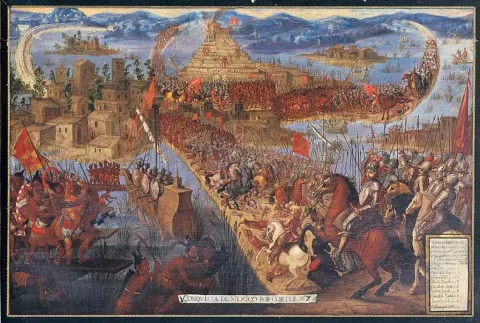
In only few years following the Christopher Columbus first voyage in 1492, and a discovery of the new continent the Spaniards succeeded to colonize the Caribbean islands and set up a base in Cuba. It was not long before they started to launch expeditions for exploring parts of Mexican and Central American Coast. The Aztec Empire, already known to newcomers by its great capital city Tenochtitlan and its incredible riches, stood first on their path.
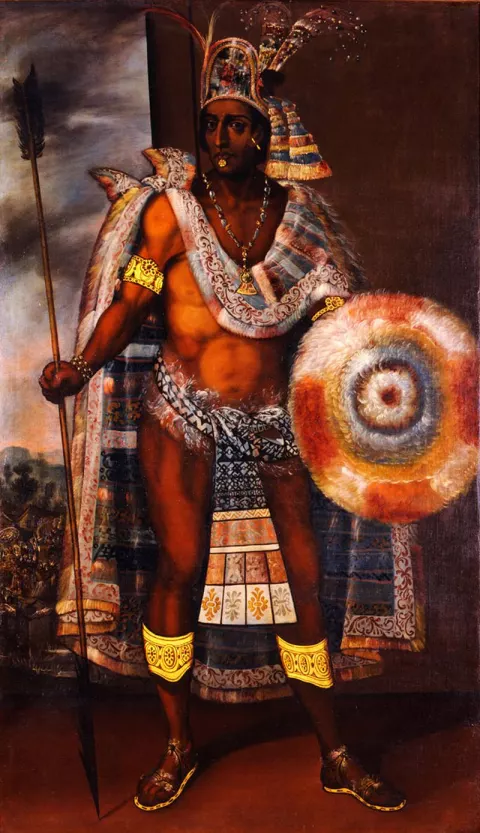
The conquistadors led by Hernan Cortez were more than determined and bold in their intention. Namely, upon landing on the coast of modern-day Mexico, Cortez has ordered all the ships to be burned. Retreat was not an option.
Due to the combination of military inferiority, lack of strong central power and
diseases, the Aztec Empire eventually succumbed to the Spanish conquistadors. In 1521 with the Spanish capture of Tenochtitlán, the Aztec empire officially came to an end. The phase of the Spanish colonization of the Americas is thus started.
This first encounter of the Worlds marked the end of the native civilizations in central and southern America and has opened a new chapter of world history.
Money
The Aztecs were not familiar with the usage of classic money. Therefore, the exchange of commodities in the Empire relied on barter and on usage on Aztec’s kind of currency – the cacao beans and cotton textiles (quachtli).
Cacao beans were medium of small, daily purchases. In those days on the market for one cacao bean you could get a tomato, for 3 cacao beans a small rabbit, turkey egg or avocado, while turkey, for example, was much more expensive and cost 200 beans. The hot chocolate beverage was known, but only as a privilege of the noble class and thus unavailable to the commoners.
Cotton cloaks, the other form of currency referred by economists as „commodity money“, was therefore more reliable. It represented a higher value and was used in more expensive transactions. Allegedly, only 20 of such quachtli could support a commoner for a year in the Aztec capital Tenochtitlan.
Regarding the cacao beans, here should be mentioned the frequent counterfeits and deceptions committed by the merchants. The practice of removing the outer skin from beans, stuffing it with dirt or sawdust and mixing with the real beans was treated as counterfeit and deception, and it was punished by the law.