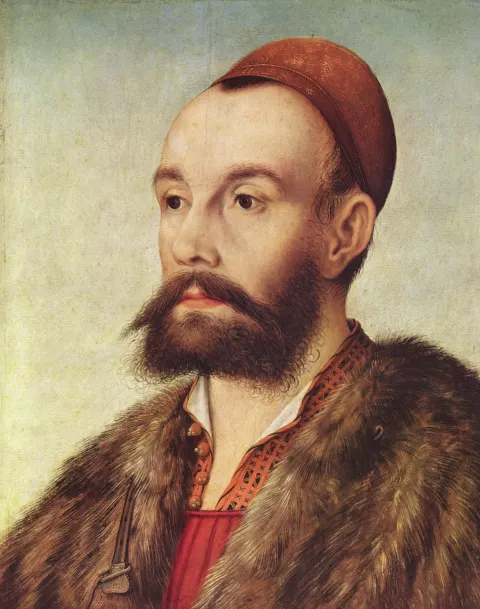
Museum / Rooms / The Fugger family
Room · 5 chapters · 1 lives
The Fugger family
A prominent German mercantile, banking and mining family whose financial success shaped European economic and political history
Fugger has arrived
The family’s rise to prominence began with Hans Fugger who in the second half of the 14th century moved from the village of Graben to Augsburg, one of the leading centers of textile production and long-distance commerce. In the course of three generations, the Fuggers who entered the business trading in woven goods became one of the leading mercantile families of Augsburg.
Deer
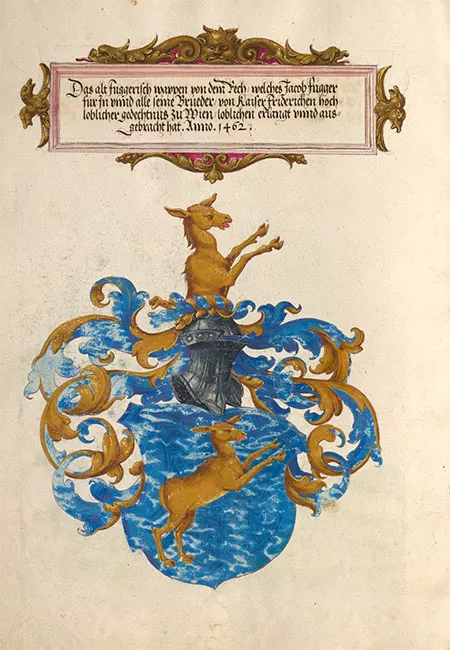
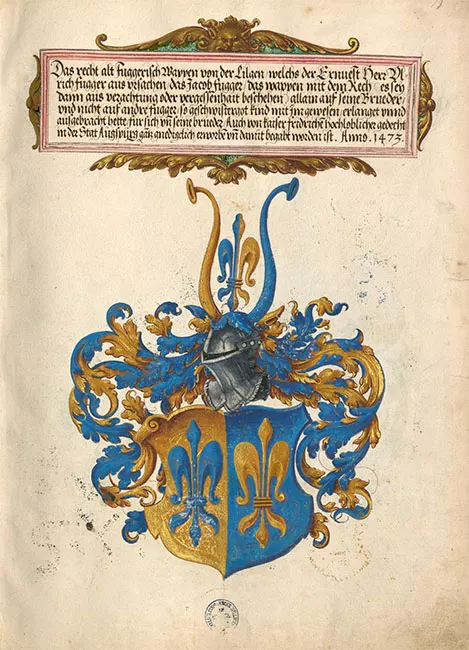
After the death of Hans the family business was inherited by his sons, Andreas and Jakob Fugger the Elder. Their decision to dissolve the partnership in 1455 and start to working independently resulted in foundation of the two family lines - the Fuggers vom Reh named after the deer on their coat of arms, and the Fuggers von der Lilie, named after the lily on their coat of arms.
The Fuggers vom Reh flourished in business during the 15th century and built the name for themselves in the international trade of textiles and luxury items throughout Europe. However, their involvement in the sphere of high finance and lending to monarch proved to be fatal and took them out of the big business.
Lily
Fuggers von der Lillie emerged as the richest and most powerful European banking family of the 16th and 17th centuries. Owing a sharp business sense, the Fuggers created a true international business empire in trading, banking and mining. They controlled Europe’s principal sources of silver and copper, operated an international trading business with interests in India, Africa and South America, and have served as a personal bankers of the greatest powers – the Papacy and the House of Habsburg – whose rise to world power rested on huge and continuous loans provided by the Fuggers. Only Fugger’s mining operations in Slovakia accounted for 37% of total European copper production in the first decade of the 16th century and 40% in the second decade.
Therefore, it is not overly to say that the Fuggers decided on economic prosperity and political destiny of Europe at the time. By the end of the 16th century the family began to intensely invest their fortune in land properties what resulted in gradual transformation from daring businessmen into conventional nobles and patrons of arts. The Fuggers used their wealth responsibly, and in 1516 they built the Fuggerai – the oldest existing social housing complex in the world still in use today.
By the mid-16th century the Fugger’s work capital amounted 5 million guilders. If converted to wheat at prevailing prices, this sum have been sufficient to support 521,477 persons for a year.
Jakob Fugger the Rich (1459-1525) whose personal motto was: “I shall gain while I am able” was not only the most prominent member of the family but also the wealthiest man of his time.
Fuggers financed the recruitment of 150 Swiss soldiers who arrived in Rome in January 1506. This contingent of soldiers marks the origins of the pope’s Swiss Guard, which still exists to this day.
Holy Roman Emperor Charles V got his title because Fugger was willing to lend him astonishing 544,000 of the total 852,000 guilders necessary for bribing the electors.
Chapters
- Beginnings
- Fuggers vom Reh
- Fuggers von der Lilie
- Financial and mining operations
- Gradual decline of Fugger’s business
Beginnings
The Fuggers were a prominent German mercantile, banking and mining family of the late Middle Ages and early Modern Period whose financial success shaped European economic and political history.
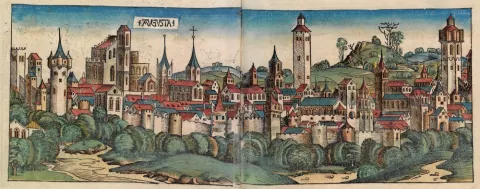
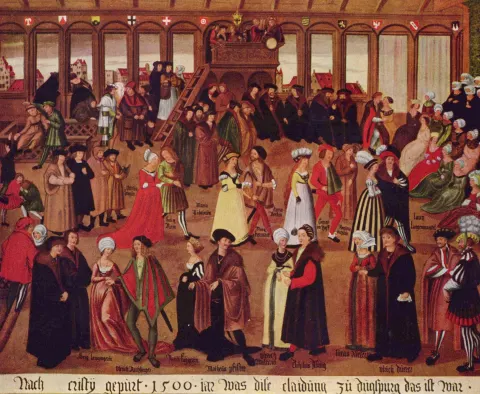
Hans Fugger is considered to be the initiator of the family's rise to fortune. He was a master weaver born in the village of Graben in Swabia who moved to Augsburg in 1367, as it is stated in the Augsburg tax register: »fucker advenit«, »Fugger has arrived«. He acted as a distributor for the weavers finished textiles, and must have acquired some influence as in 1370 he married a daughter of the weavers’ guild master Oswald Widolf, Klara Widolf. The couple had two daughters, and after Klara’s death around 1380, Hans married Elisabeth Gfattermann, also a daughter of the guild master. By 1386 he became a member of the guild’s committee of 12, a member of the city's Grand Council, and was a successful textile trader.
After Hans Fugger’s death around 1408 Elizabeth continued and expanded his business. After Elizabeth’s death in 1440, her two sons, Andreas and Jakob Fugger the Elder, continued the family business together. The business was steadily rising; in 1434 Elizabeth held position 27 in Augsburg’s wealth hierarchy, and in 1448 the brothers owned 10800 florins, the fifth-largest estate in the imperial city at the time. However, by 1455 they dissolved their partnership. The business separation of Andreas and Jakob also marks the beginning of the two family lines: the Fuggers vom Reh, named after a coat of arms showing a roe deer that, according to tradition, was conferred on the line in 1462, and the Fuggers von der Lilie, named after the lily on their coat of arms.
The rise of the Fugger family in the fifteenth century took place in the context of general demographic and economic expansion. Augsburg was decimated by the great plague epidemic of the mid-fourteenth century, but from the early 15th century there was a period of growth. In 1408 the city counted 2957 taxpayers, 4798 in 1461, and 5351 in 1498. During the 15th century the population of Augsburg rose from 12000 inhabitants at the beginning of the century to 19000 around 1500. The textile production, especially of fustian, was the engine behind such rise. From the second half of the 14th century merchants of Nördlingen, Ulm, Ravensburg, Memmingen, Biberach, Constance, and Kaufbeuren used their commercial relations with Venice to import cotton, organize regional textile production by selling raw materials, provide credit, and market the finished product. As early as 1370 Augsburg emerged as one of the leading centers of textile production and long-distance commerce.
Fuggers vom Reh
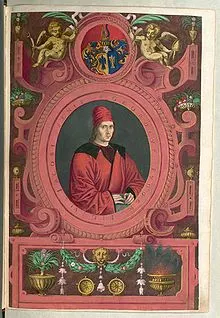
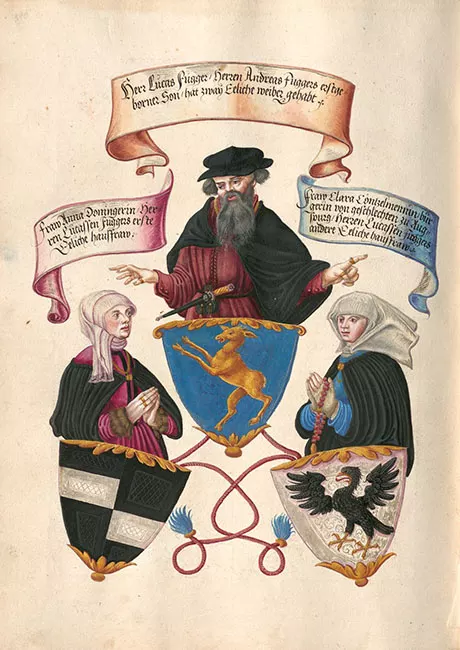
Andreas Fugger died as early as 1457, and his widow, Barbara, preserved the family’s wealth during the following decade. She invested in the trading company of her son-in-law Thomas Grander, whose business was continued by his brother-in-law and Barbara’s son, Lukas, in 1472. Lukas, in cooperation with his brothers steadily increased family’s wealth by trade in spices, silk, and woolen cloth. The textile business, with lucrative trade with Italy, was the mainstay of their business. Lukas was at the helm of the firm in Augsburg while his brothers acted as his representatives in various other towns. Matthäus took charge of relations with Milan, a center for the production of and commerce in high-quality fabrics and luxury items; Markus was in charge of operations in Venice, the most important distribution center for cotton from the eastern Mediterranean, while Hans worked on the axis from Nuremberg to Frankfurt on the Oder. Significant part of the business was in the hands of Lukas Fugger’s son-in-law, Christoph Müller, who was in charge of the business in the Netherlands.
Economic success was a precondition to gaining political influence and reputation within Augsburg’s citizenry. Lukas occupied numerous offices in the imperial city’s government: he sat on the Grand Council in 1474 and held a plethora of civic offices in the 1480s – "Seelhauspfleger", or guardian of a charitable institution; "Findelhauspfleger", or guardian of the foundling home; "Einunger", in charge of settling petty quarrels; "Wollschauer" and "Heringsschauer", commissioned to monitor the quality of wool and herrings; "Barchentungelter" and "Weinungelter", or collector of the taxes on fustians and wine. Between 1484 and 1494 he held the office of tax master, and from 1490 to 1494 he sat on the Council of Thirteen, the center of political power in the 15th century Augsburg. If it were not for his financial troubles which started from 1494, Lukas would probably be elected to the office of burgomaster, the top position in Augsburg’s political hierarchy.
During the 1480s Fuggers supplemented their commerce in goods with financial operations. However, their financial operations will also ruin them. Lukas financially aided German king Maximilian (1459 – 1519) in his fight for the Burgundian inheritance, and his loan of 9600 gold florins was guaranteed by the city of Leuven and the province of Brabant. When the city, which had pawned its income as security, refused to pay it back it turned out to be Fugger’s undoing. Soon he was pressed by his creditors for repayment of loans, and even the close relatives of his filed claims in court. By 1504 Lukas was bankrupt, and the Fuggers vom Reh were out of the big business. They went on to work as goldsmiths, artisans, or commercial agents of their rich cousins.
Fuggers von der Lilie
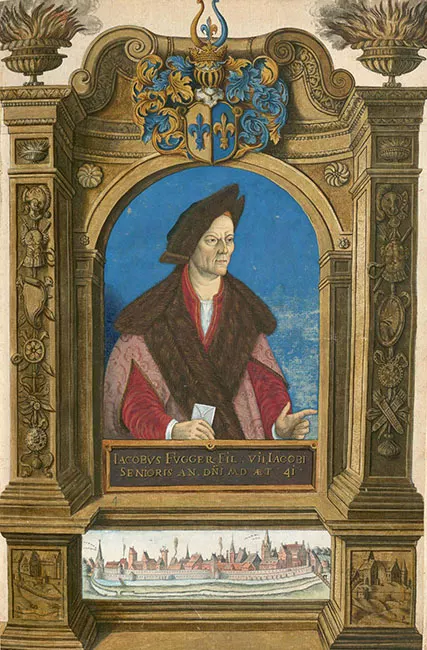
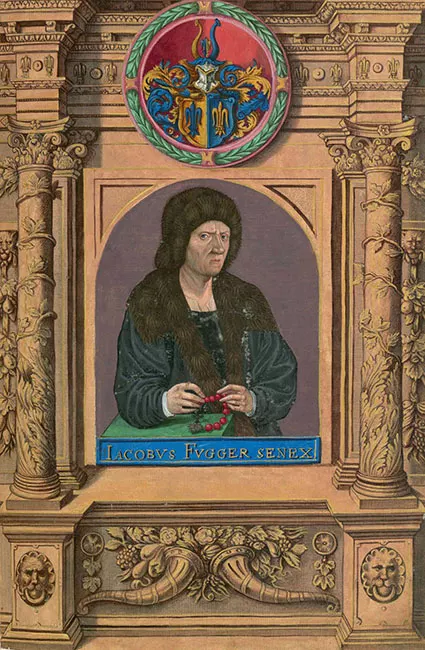
Jakob Fugger the Elder was a founder of the more prosperous branch of the family – the Fuggers von der Lilie. In 1441 Jakob had married Barbara Bäsinger, a daughter of the goldsmith and mint master Franz Bäsinger who went bankrupt three years later. Warned by this event, Jakob proceeded carefully in his business and succeeded in substantially increasing his profits. He continued to trade in textiles, and was a leader of the weavers’ guild. Jakob was described as an “upright, honest, mild and friendly towards everyone but very hard and severe on those who despised fairness and behaved haughtily towards him”. After his death in 1469, his business was continued by his sons and his widow. As a widow Barbara had more than doubled her taxable wealth, from 6471 florins in 1472 she raised it to 23293 florins by the time of her death in 1497.
Jakob the Elder had eleven children but his three sons, Ulrich, Georg, and Jakob, had particularly interesting business careers. They initially focused on the traditional long-distance trade in goods, especially in trade of silken and woolen cloths. As their relatives Fuggers vom Reh, Fuggers von der Lilie also practiced an intra-familial division of labor. Ulrich coordinated business activities from the Augsburg headquarters, George took care of commercial relations with the central and eastern German regions in Nuremberg, and Jakob was in charge of Augsburg-Innsbruck-Venice axis. The brothers were also occupied with financial transactions, and their brother Marx who occupied a position as recorder in the papal registrar’s office, where petitions to the curia were recorded, could easily promote the Roman business interests of his family. Although Marx died young (1448 – 1478), the brothers were able to intensify their business relations with the curia even further.
Typically for the time in which they lived, their economic success was accompanied with an intensifying integration into the kinship network of the Augsburg elite. These were the times when commercial activities, social status, and the choice of marriage partners were mutually dependent and reinforced one another. Fugger brothers and sisters married into other successful merchant families, thus forming alliances and adding to their social prestige and economic capital. For example, an important place of social gatherings of Augsburg’s economic and political elite, the Gentleman’s Drinking Hall or Herrentrinkstube, was opened to the Fuggers only through their marriage alliances.
Jakob, who was the most ingenious representative of the Fuggers’ trade, was the tenth of eleven children of Jakob Fugger the Elder and Barbara Bäsinger and was initially destined to become a cleric. He was the youngest of brothers and was involved into family’s trade only because of the deaths of his older brothers: his brothers Hans and Andreas died early during their commercial apprenticeship in Venice, Peter died in Nuremberg in 1473, and Marx died in Rome in 1478. After this unfortunate events his brothers Ulrich and Georg took him into business and sent him to Venice as the family firm’s representative. Contracts between the Fugger brothers, Ulrich, Georg, and Jacob, of 1494 and 1502 shows how their partnership worked. They obliged themselves to conduct no trade on their own account during the contracted period, each of them was equally entitled to represent the company in its external affairs, to do business for it, and to hire or fire employees.
George died on March 14, 1506, and Ulrich on April 19, 1510, what left Jakob as the sole surviving associate. In 1512 he included his nephews Ulrich and Hieronymus, sons of Ulrich Fugger, and Raymund and Anton, sons of Georg Fugger, into firm under the name of "Jacob Fugger and his Brothers’ Sons". The nephews were not his equals as were his brothers - they committed themselves to unconditional obedience to their uncle’s orders.
Financial and mining operations
Mining operations
Although the brothers remained active in the textile business, the bulk of their fortunes came from credit and mining operations. The latter operations were intertwined, and have started in 1485 when the Fugger brothers gave their first credit of 3000 florins to Archduke Sigismund of Tyrol (1427 – 1496). By 1489 the sum amounted to more than 268000 florins. The loans bore no interest but were paid in silver. Miners were obliged to sell silver to Archduke at a fixed price, and he ceded his option to the Fuggers who also took over the metal at fixed prices. Thus the profit lay in the difference between the fixed purchase price the Fuggers paid in Tyrol and the silver’s real market value. As the Tyrol mines were then the richest mines in Europe, these contracts enabled the Fuggers to enter the large-scale trade in metals. This kind of arrangement continued after Sigismund abdicated in favor of his relative Maximilian who later became the Holy Roman Emperor (r. 1493 – 1519).
Fuggers expanded their interests to trade in copper, which was increasingly needed for the production of various commodities, including weapons. They traded in copper for King Maximilian’s and their private account, and also invested in mining operations in Salzburg and Styria regions. In 1494 the Fuggers entered into partnership with a mining engineer Hans Thurzo of Krakow who had leased mines in Banská Bystrica in present-day Slovakia. The Fuggers provided finances and Thurzo his know-how into the partnership. The ore was submitted to a Saiger process – a separation of silver and copper by adding lead. In 1495 they acquired a lead mine near Villach in Carinthia, and gradually further expanded their mining business. Fugger’s mining operations in Slovakia accounted for 37% of total European copper production in the first decade of the 16th century and 40% in the second decade.
Financial and mining operations
Financial operations
The flow of ecclesiastical funds to Rome turned it to an important financial center. A large part of these funds came from servitia, which were due at pope’s confirmation of each newly elected bishop or prelate, and the annates, duties on offices or benefices conferred by the curia. Other funds came from crusade taxes, from the sale of indulgences, and voluntary donations to church. The Fuggers started to be involved in transfer of these funds in 1476, and from then on the volume of the Fuggers’ Roman financial transactions steadily increased. They also supplied the papacy with copper and tin and were masters of the papal mint, with interruptions, from 1509 to 1524. To tighten their relationship with papacy, the Fuggers financed their diplomatic missions and the recruitment of 150 Swiss soldiers who arrived in Rome in January 1506. This contingent of soldiers, which received their first monthly salary from the Fuggers, marks the origins of the pope’s Swiss Guard, which still exist.
Financial relations with the Habsburgs were of crucial importance to the Fuggers. As already seen, their business with Sigismund introduced them into mining and metal trade, and their loans to Maximilian (for waging wars, celebrations, diplomatic embassies, salaries of member of his court and other purposes) enabled them to receive special permission to trade with Venice during Maximilian’s war against Venice from 1508 to 1516, while his other subjects were forbidden to do the same.
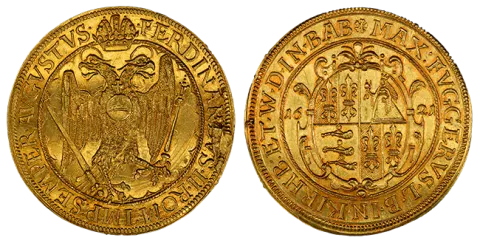
Through their financial power the Fuggers shaped European policy and history, which is best seen on the example of their support of Maximilian’s successor on imperial throne. After Maximilian’s death in January 1519 there were three candidates to become his successors; Charles, Duke of Burgundy and King of Spain, King Francis I of France (r. 1515 – 1547) and King Henry VIII of England (r. 1509 – 1547). The election of the new emperor was in the hands of seven electors, and it was not unusual for them to extort high prices for their support. Finally, Charles was unanimously elected Roman king and emperor on June 28, 1519 but only because Jakob Fugger the Rich decided to back him up. Of the enormous sum of 851918 florins Charles V (r. 1519 – 1556) had to pay for his election, Jacob provided him with 543585 florins.
Gradual decline of Fugger’s business
In 1512, when Jacob Fugger the Rich included his nephews into the firm and renamed it as of "Jacob Fugger and his Brothers’ Sons", he envisioned that the trade would be directed by two managers after his demise. In his first will, which he wrote in 1521, he appointed his nephews Ulrich and Raymund as his successors. However, Ulrich died in 1525 and Raymund showed no commercial skills or interest for business. In his second will, which he wrote in 1525, Jacob appointed his nephew Anton as the new head of the firm. Immediately after taking the helm of the firm Anton Fugger had to deal with several difficulties. The most severe were revolt of miners in Slovakia and the Hungarian crown’s decision to expropriate the Fuggers. The roots of these two problems were in a currency devaluation that began around 1521 which led to rising prices. The miners demanded higher wages, while the Hungarian nobility blamed the Fuggers and Thurzos for the price increase. The Fuggers agreed to miners’ demands but the Hungarian court confiscated their Slovakian mines. However, in 1526 Anton was successful in obtaining the mines back for the Fuggers.
During Anton’s heading of the firm the formerly rich yield of the Tirolean and Slovakian mines gradually decreased until he gave up on Slovakian operations altogether in 1547. To make up for these losses he established new trade ties with Peru and Chile and by engaging in mining ventures in Sweden and Norway, as well as in the slave trade from Africa to America. He also remained one of the most important creditors of the Habsburg family and especially of the Emperor Charles V. From roughly 28 million ducats borrowed by the Spanish crown during the reign of Charles V, the Fuggers provided 5.5 million ducats, or almost one-fifth, of the total credit provided to the crown.
Anton’s nephews and sons showed little interest in business, and he even considered dissolving the firm. However, he carried on although he could satisfy the demand for credit only by increased borrowing. An inventory taken after his death in 1560 showed assets of 5,600,000 and liabilities of 5,400,000 guilders.
Anton’s successors ran the firm, on a reduced scale, until after the Thirty Years’ War (1618–1648). The Fuggers pursued the lifestyles and occupations of landed aristocrats and the financial resources of the family were no longer drawn from urban enterprise but rather from rural estates in Swabia. These estates, acquired during Jacob’s and Anton’s time, are still today in the possession of the three Fugger families: the Counts Fugger-Kirchberg at Schloss Oberkirchberg near Ulm, the Princes Fugger von Glött at Schloss Kirchheim and the Princes Fugger-Babenhausen at Schloss Babenhausen and Schloss Wellenburg near Augsburg.