Museum / Rooms / The Five Hundred Lords of Ayyavole
Room · 3 chapters
The Five Hundred Lords of Ayyavole
The Indian businessmen associated with high-quality products and fair dealings
Indian Ocean trade
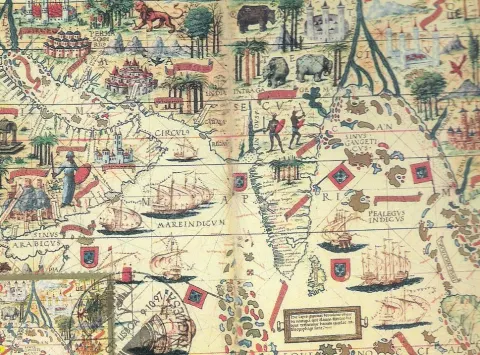
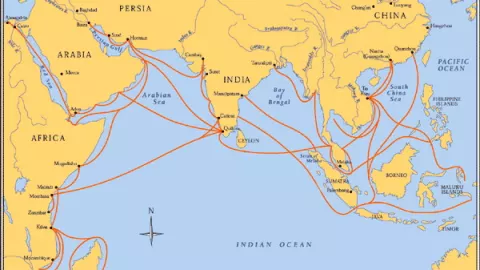
During the medieval era the international trade flourished in the Indian Ocean attracting merchants from the East Africa on the West, across Arabia and Persia to China and Japan on the Far East. Special place in this exchange network occupied India with its abundant animal, vegetable and mineral products employed in trade.
The Ayyavole merchants
The Ainnūrruvar guild also known as “the Five Hundred Lords of Ayyavole” is known as the most powerful international guild of Southern India engaged in lucrative overseas trade.
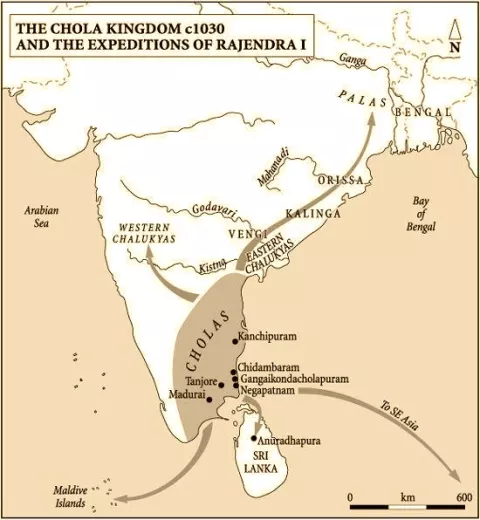
Originating from Aihole, a former capital of the Chalukyas in the modern day northern Karnataka, the Ayyavole merchants who flourished between the 8th and 14th centuries, spread their business network throughout southern India, as far afield as Persia to the west and Indonesia to the east.
As their power grew numerous merchant and artisan groups affiliated themselves with the Ainnūrruvar which ultimately included people of different castes, religions and regions. To secure their business, the Ayyavole merchants established fortified mercantile towns (“patnams”) and warehouses and even employed mercenary armies to protect their caravans.
Trade guilds were the channels through which Indian culture was exported to other lands.
Members of the guilds were governed by a code of fair conduct necessary to be followed in mercantile business known as “Vira-Bananju-dharma”, that is, the law of the noble merchants
The Ayyavole merchants enjoyed a reputation of daring entrepreneurs. Their trademark was a bull which could be seen at their flags.
Goods in which they traded
The Ayyavole dealt in wide range of commodities including foodstuffs, horses, elephants and textiles, as well as goods destined for royal courts, including silk, sandalwood, perfume, pearls, sapphires, rubies, lapis lazuli and gold.
Merchant guild that constituted a state within a state
Owning a large capital the Ayyavole merchants became the financiers of the kings receiving numerous economic privileges in return. They were also the great benefactors of the community and financed trade fairs, various local development projects and construction of temples. Owning their personal army, a large capital, and political influence the Ayyavole merchants virtually constituted a state within a state.
The Ayyavole enjoyed protection of the kings because of the various benefits which they derived from their trade. As it is written in their inscription from 1055: “they fill up the emperor’s treasury of gold; his treasury of jewels, and his armory of weapons”.
Chapters
Indian Ocean trade
The Five Hundred Lords of Ayyavolu
Indian Ocean Trade
During the medieval era, merchants from all the major civilizations of the time – from the Europeans to the Africans, Arabs, Persians and Chinese and Japanese – participated in the vibrant Indian Ocean trade.
With a 3,500 mile coastline, India held an important place in this scheme. Its physical features provide a great diversity of animal, vegetable and mineral products representing an important economic capital. In the southern part of the Indian peninsula was situated Tamil Nadu, a region that has a long tradition of seaborne commerce.
The merchant guilds involved in interregional and overseas trade represented an important factor in development of the South India. They financed local development projects, construction of temples, and served as financiers of the kings. Due to the privileges and power they exercised, such guilds almost constituted a state within state. Moreover, the respective trade guilds became channels through which Indian culture got exported to other lands.
Trade guilds
The Five Hundred Lords of Ayyavolu
Trade guilds
There were numerous groups of merchants which contributed to the establishment of trade relations between communities of India and Southeast Asia.
There was a distinction between merchants operating locally (“swadesi”) and internationally (“nanadesi”). In the medieval period (900-1300), merchants engaged in interregional and overseas trade organized themselves into guilds which were based on occupation and economic interest. In inscriptions these corporate organizations of merchants are referred to as “samaya”, meaning an organization created through an agreement or contract. Members of the guilds were governed by a code of conduct known as “Vira-Bananju-dharma”, i.e. the law of the noble merchants.
The Ayyavole and Manigramam were the most famous and powerful among them.
Ayyavole
The Five Hundred Lords of Ayyavolu
Ayyavole
The Ayyavole (Ainnurruvar) or the “Five Hundred Lords (Suvamis) of Ayyavole” merchant guild originated at Aihole in the Deccan in the 8th century. At the height of their activities, from the 8th to the 13th century, their influence extended as far north as Kolhapur and Miraj in present-day Maharashatra. The bull was their trademark and could be seen on their flag. The Ayyavole merchants enjoyed a reputation of daring and enterprise entrepreneurs.
The Ayyavole 500 was engaged in facilitating and protecting long-distance trade – both inland and maritime. The term “Five Hundred” retained its conventional usage even after the organization grew in size and composition, including people of different castes, religions and regions.
A number of land and maritime merchant groups affiliated themselves with the Ainnurruvar. At its height, the Ainnurruvar appear to have occupied a dominant position in relation to almost 50 other professional bodies, including major associations of artisans and mercenaries.
Associated with the vast trading network of the Ayyavole were a series of active corporate bodies, often in a subordinate relationship to them. These included merchants, but also agriculturists, basket-makers, village accountants and betel-leaf sellers. Perhaps among the important groups associated with the Ayyavole were the semi-military groups, armed guards, swordsmen and mercenaries, many of whom probably received a share of the profits from trade.
As the largest merchant organization, they had mercenaries to protect their goods. They employed mercenaries to protect merchant caravans and established fortified towns and warehouses to secure their goods. A wide range of commodities appears in their inscriptions, including foodstuffs, horses, elephants, and textiles, as well as good destined for royal courts, including silk, sandalwood, perfume, pearls, sapphires, rubies, lapis lazuli, and gold. They sponsored trade fairs and maintained good relations with their local communities through philanthropic activities and tribute. Inscriptions of this merchant group record their generous endowment. The Ayyavole name was adopted far and wide for over 500 years; it became a brand associated with high-quality products and fair dealings.
The following passage was a part of a long inscription recorded by the guild of the Ayyavolu merchants in 1055:
"Famed throughout the world, adorned with many good qualities, truth, purity, good conduct, policy, condescension, and prudence; protectors of the vira-Bananju-dharmma having thirty-two veloma, eighteen cities, sixty-four yoga-pithas, and asramas at the four points of the compass; born to be wanderers over many countries, the earth as their sack, the eight regents at the points of the compass as the corner tassels, the serpent race as the cords, the betel pouch as a secret pocket, the horizon as their light;
visiting the Chera, Chola, Pandya, Maleya, Magadha, Kausala , Saurashtra, Kamboja , Gauda , Lala , Parasa and Nepala;
and by land routes and water routes penetrating into the regions of the six continents, with superior elephants, well-bred horses, large sapphires, moonstones, pearls, rubies, diamonds, lapis lazuli, onyx, topaz, carbuncles, coral, emeralds and various such articles: cardamoms, cloves, sandal, camphor, musk, saffron and other perfumes and drugs; by selling which wholesale, or hawking about on their shoulders, preventing the loss by customs duties, they fill up the emperor’s treasury of gold, his treasury of jewels, and his armoury of weapons; and from the rest they daily bestow gifts on pandits and munis; white umbrellas as their canopy, the mighty ocean as their moat, Indra as the hand-guard, Varuna as the standard-bearer, Kubera as the treasurer, the nine planets as a belt, Rahu as a tassel, Ketu as a dagger, the sun and moon as the backers, the thirty-three gods as the spectators;
like the elephant they attack and kill, like the cow, they stand and kill, like the serpent, they kill with poison; like the lion they spring and kill; wise as Brihaspati, fertile in expedients as Narayana; perfect in disputes as Narada-rishi; raising a fire, they seize like death, the gone Mari they make fun of, the coming Mari they face, the tiger with a collar on they irritate; on the moving cart they place their feet; clay they set fire to, of sand they make ropes; the thunderbolt they catch and exhibit; the sun and moon they draw down to earth;
they converse about the frontal eye and four arms of Isvarabhattaraka, the loud laughter of Brahma, and the madness of Bhagavati. In the case of a sack which bursts from the contents collected from the points of the compass, an ass which runs away with grain, a bar of gold that has been seized, a tax that has been evaded, a cry of looting, an assembly connected with caste customs, a bargain that has been made, – they are not ones to fail.
Be it as it will. To the Five Hundred svamis of Ayyavole, possessed of all titles, having made prostration with the eight members, salute with joined hands raised to the head, pull out that sack, and present offerings of food, O Setti! To the Five hundred svamis of Ayyavole present the tambula in a tray, wishing them all good fortune."