Museum / Rooms / The Byzantine economy
Room · 5 chapters
The Byzantine economy
The Byzantine Empire had an economic edge over the Western Europe until the late 12th century
Successor of Rome
The Byzantine Empire derived from the Roman Empire. Because of the size of the Roman Empire, emperors found it difficult to govern it alone and from the late 3rd century there were efforts to divide it among two equal emperors, one to rule over the West and other to rule over the East. This practice was stopped by Constantine I (r. 306-337) who ruled over both part of the Empire, and had even transferred the capital from Rome to Constantinople in 330 AD. After Constantine’s death the Empire was again divided and after the fall of the Western Roman Empire in 476 the eastern half was its legitimate successor.
Preconditions of economic investment
After the fall of the Western Roman Empire, the Byzantine Empire continued as a stable political entity with all essential conditions of economic investment while the former western part of the Empire descended into a period of political turmoil. Its size enabled differentiated and complementary agricultural production while its unified market with regulated weights, measures, coins, and legislation made business easier compared to a situation in the western part of a once unified Empire.
More than 1000 years of history
To review the economy of the Byzantine Empire, which lasted for more than a thousand years, we’ll look into the role of the state in economy, Empire’s geographical position, politics, production centers, organization of trade, crafts, and agriculture. We’ll see how the economy functioned in certain time periods; rise and fall from sixth to eight centuries, recovery from eight to tenth centuries, accelerated growth in eleventh and twelfth centuries, and the events from the thirteenth century on which led to the Empire’s fall.
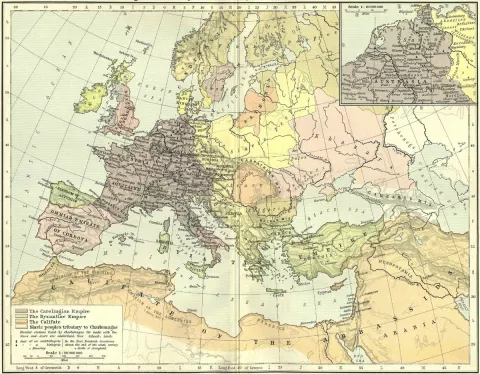
The Byzantine Empire, through all of its stages of development, was concentrated around the Mediterranean basin which gave the Empire a maritime character and lowered transportation costs and fostered trade.
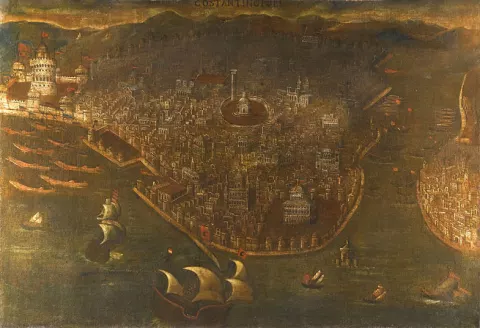
Constantinople played a central role in Byzantine commerce. It was situated on a strategical position that connected the Black Sea and the central Asian products with the Aegean Sea and all the products of the Mediterranean basin.
The silk workers of Thebes and Corinth were so famous that when in 1147 the Norman king Roger II sacked these cities, he also carried them away to Sicily and set them at work at the royal factories in Palermo.
Chapters
- The Byzantine Empire and its economy
- Rise and fall between the sixth and eighth centuries
- Recovery in the period from the eighth till tenth century
- Accelerated growth of the eleventh and twelfth centuries
- Decline of the Byzantine Empire
The Byzantine Empire and its economy
The Byzantine Empire was formed on the basis of the former Roman Empire and as such it inherited its political institutions which provided stability, protection, justice system, and ensured property rights. In short, it inherited all essential conditions of economic investment.
Early Byzantine Empire stood in sharp contrast with the West which was severely affected by invasions, civil wars and social unrest in the fifth century. The West also lost unified government which was replaced by fragmented and competing kingdoms, which maintained only partly the administrative and legal Roman traditions. The reasons above were the foundation of Byzantine economic edge over the medieval West, at least until the late twelfth century. From then on the Byzantine Empire resembled more to the 5th century West. It was almost constantly under invasions, wars, and civil unrest.
The Byzantine Empire and its economy
Primary production
The Byzantine Empire stretched through varied climate and geographical areas which enabled differentiated and complementary agricultural production: wine, dates, and cane were cultivated in sheltered coastal areas; orchards and terrace cultivation in valleys, olive, fruit and mulberry at intermediate altitude; timber exploitation as well as pig grazing in the forests on the mountains; winter cereals on plateaus with even a little rainfall provided the rains are concentrated in the spring season; stock raising in pasture lands.
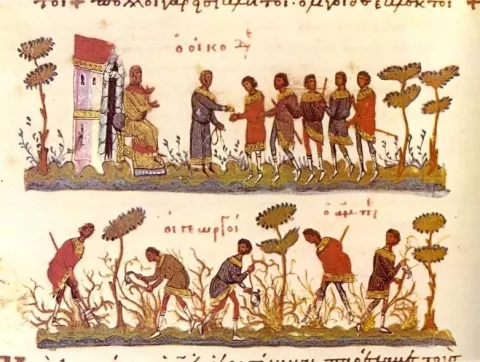
Nevertheless, marked specialization was not the rule, and the Byzantine farmer tried to develop a dry crop system based on cereals and often including orchards and vine. Usually irrigated vegetable gardens and orchard were cultivated near the villages, while orchards, cereals, vineyards, and textile plants like hemp were cultivated a bit further. Grazing land and woodland were situated yet further away.
The Byzantine Empire and its economy
Trade
The Byzantine Empire, through all of its stages of development, was concentrated around the Mediterranean basin which gave the Empire a maritime character and lowered transportation costs and fostered trade. Another economic benefit of the maritime character was easy access to fish and salt, an endless source for the alimentation of cities and export goods. However, climatic conditions prevented normal sailing in winter, which was considered a period of "mare clausum" (closed seas), from October/November to March/April because of the frequent storms, northerly winds and reduced visibility.
The state played an important role in the economy, it possessed numerous estates, mines, quarries and workshops, and it controlled the trade of materials like silk, purple dye, alum and salt over which it wielded total or partial monopolies. The state also regulated credit and banking as well as coinage. Its influence on economy started to dwindle from the 11th century. Byzantine economy was characterized by the coexistence of state regulation and a market based economy. However, the role of the state was progressively reducing as the time went by.
Rise and fall between the sixth and eighth centuries
Rise
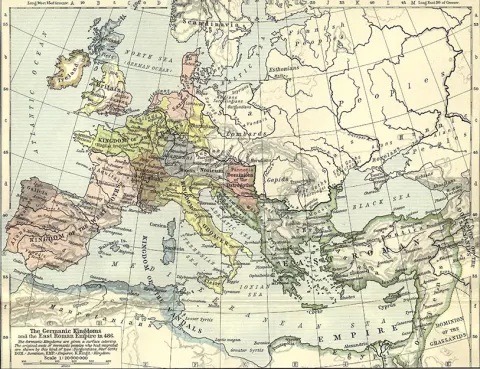
During the first half of the sixth century the Byzantine economy went through the last flourishing period after which started its long decline until the late eighth century. Emperor Justinian (r. 527 – 565) reconquered parts of the former Roman West, including North Africa, Italy and southern Iberian Peninsula, which created a revival of Mediterranean trade. Period from the fifth till the mid sixth century was a period of growth and the economy had to satisfy demand of a population of about 30 million people after the Justinian’s reconquest. The Empire also had some of the biggest cities in the word, such as Constantinople (considered to be the most populous city in the world at that time) with at least 400 000 inhabitants, Antioch with 200 000 inhabitants, Alexandria and Thessalonike with 100 000 inhabitants, and cities of around 50 000 – 100 000 inhabitants such as Apameia, Ephesus, Cesarea or Jerusalem. Rural settlement also increased in the fifth and early sixth centuries in the Peloponnese as well as in the Near East, and agriculture accounted for about two-thirds of the GNP.
Construction works carried by the state and Church in the early sixth century is undoubtedly an index of wealth and available surplus. It included religious building such as the famous Saint Sophia in Constantinople and San Vitale in Ravenna; public buildings such as aqueducts, cisterns, baths, porticoes, and agoras; the fortification program of Anastasios I (r. 491 – 518) and Justinian which was carried on a massive scale in the Balkans, in Africa and in Syria.
These works provided a living for many craftsmen, mainly active in urban areas. Among craftsmen there were masons, sculptors, stone-cutters, mosaicist and architects which were connected to construction; fullers, weavers and dyers were part of the textile industry; metalworkers, glassworkers and potters produced both luxury items and cheaper items for mass-consumption. Among more important craftsmen there were also carpenters and shipbuilders. All these crafts relied on the exploitation of natural resources; timber was available in Dalmatia, Calabria, northern Greece, Bithynia, Pontus, Lycia, Cilicia, Crete and Cyprus; marble was exploited in the island of Thasos and Proconnesos, and in various locations in Asia Minor; mines for metal and mineral resources were scattered throughout the Empire.
The long distance trade was primarily maritime and supplemented by fluvial navigation in Egypt on Nile, and Pannonia where the northern frontier provisions were sent through Danube. Maritime trade connected all areas of the Empire and the goods from the Empire were even shipped all the way to the south-west coast of England and on the other end all the way to India. Byzantine goods were also traded along the caravan routes all the way to China. As the land transport on long distances was much more costly and slower, it was generally reserved for expensive, high-profit commodities. Trade and other economic activities were facilitated by banking which was in the hands of moneylenders and changers. The state regulated lending: 12 percent for sea-loans and 4 to 8 percent for other loans.
Rise and fall between the sixth and eighth centuries
Fall
However, the mid sixth century witnessed the first signs of economic decay. The first factor was the so-called Plague of Justinian (541 – 542) and its recurrences during the next two centuries. The plague inflicted heavy demographic losses which reduced both production and demand, and consequently the imperial finances. The Empire was also under constant invasions of Slavs and Avars from the 560s, and on its eastern borders it was under attack from the Sasanian Empire. The Arab conquest starting from the 630s reduced the Empire by half within fifty years. These events resulted in deurbanization, decline in production, trade and the imperial finances.
During this period former monuments and buildings were used as a source of materials which could be reused for other purposes or, in the case of former residential houses, were transformed into workshops or divided into smaller and poorer dwellings.
Events from the mid sixth century led to a downsizing of trade at all levels, but it did not mean a complete halt. Shrinking of Byzantine territory, state finances, and decrease of population, introduced a period of smaller, insecure markets with very limited specialization. But the Empire had political, cultural, military, and material assets on which it could draw to adapt and survive. From these bases the Empire launched its progressive recovery in the late eighth century.
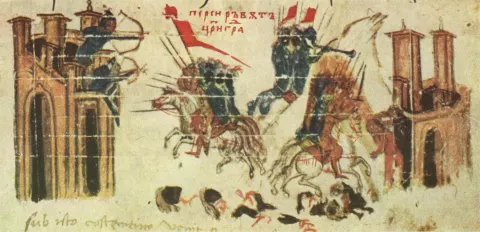
Miniature 42 from the Constantine Manasses Chronicle, 14th century. Emperor Heraclius attacks a Persian fortress, while the Persians attack Constantinople
Recovery in the period from the eighth till tenth century
With the end of plague recurrence in the 740s began a general demographic increase, which is visible from the creation or growth of villages and the expansion of cultivated and exploited areas.
Recovery in the period from the eighth till tenth century
Craftsmen
The losses inflicted by diseases and war can be seen on example of Constantinople which around 700 had a population of some 40 000 – 70 000 people, and was partly ruralized like other urban centers. Great classical cities transformed into much smaller ruralized centers, but, nevertheless, still active ones. Demand for secondary products reached its lowest point in the early eighth century, but it did not disappear and recovered slowly before expanding steadily in the tenth century. Like expected, conditions present in the Empire negatively affected on demand of luxuries, so the marble was reused and, it seems, no longer quarried during the period.
The use of precious gems, gold, and purple silks was reserved for the emperor and those who he saw fit, such as high officials and foreign potentates. Textiles and jewelry for the court was produced in imperial workshops and so were the arms and textiles for the army. But most of the imperial workshops disappeared during the seventh-century crisis, and was since reduced in scope and concentrated in the capital inside, or near, the Palace. However, this kind of development opened a door for private industry to enter the business of equipping the army.
Craftsmen and traders were organized into guilds. The guilds controlled each trade, admission of new members and training of apprentices. Most guilds had leaders which they selected themselves and who were supervised by an official of the Prefecture. The guilds which were of greater importance to the state, such as sellers of silk garments and saddlers, fell under direct authority of the Eparch. Guilds also protected their members and customers by ensuring fair trade and quality standards.
Business partnerships were regulated by law. Since the eighth century Byzantines used a form of business partnership called "chreokoinonia", which resembled the later Italian "commenda", both in its unilateral form where one partner contributes money and the other labor, and the bilateral form where both partners contribute funds and one of the two also contributes his labor.
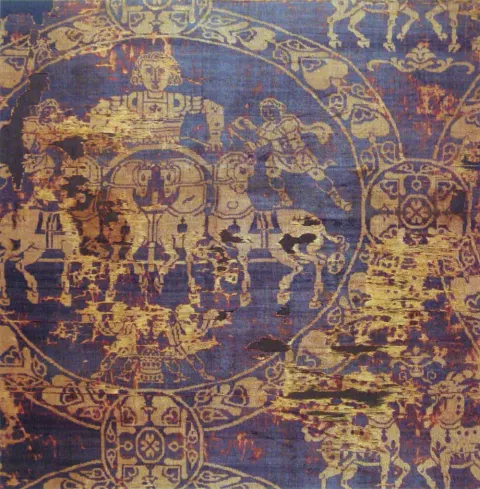
A polychrome Byzantine silk with a pattern showing a quadriga, 9th century. According to a legend this was a burial shroud of Charlemagne. Paris, musée national du Moyen Âge
Recovery in the period from the eighth till tenth century
The role of the state
Until the eleventh century the Byzantine state remained a mayor motor force in the economy. It had exclusive rights over taxation and the resources collected in this way the state redistributed in salaries of military and civil officials, in defense and military campaigns, and in public and infrastructural works. The base tax was the land tax, paid by all owners of land and estimated on the value of the land each person owned. Peasants also paid a personal tax, calculated as 1/24 of the fiscal worth of the peasant, and other taxes on domestic animals, bees and so on, as well as limited taxes for the administration of the fiscal system. They were also subject to state corvées, for defense, road building, bridge constructions and fortifications. However, there were certain categories that enjoyed a limited tax exemption, the most important being the peasant households that were responsible for military service. Commercial tax was called "kommerkion", and was a 10 percent ad valorem tax on transactions at fairs and markets. By the tenth century the tax system was almost entirely monetized.
Recovery in the period from the eighth till tenth century
Agriculture
Agriculture remained the most important sector of the economy. Its share was even greater than in the sixth century, at least until the tenth-eleventh century when it returned to values roughly similar to that of the sixth century. Agricultural production was fostered by the better climatic conditions from the ninth century onwards. By the tenth century a two-year rotation cycle was applied and fields were given over to grazing after harvest and before ploughing. The most important areas where cereals were cultivate were Thessaly, Thrace, Macedonia, Bithynia and the Pontus. Because of their significance these areas were constantly repopulated when needed.
Important part of the agriculture was cultivation of industrial textile plants like hemp and flax. They are documented to have been cultivated in Thessaly, Thrace, Macedonia, and Anatolia. The mulberry trees, whose leaves feed silkworms, were widespread in the Peloponnese to such a degree that the area was referenced to as Morea (the land of mulberries) from the ninth century onward.
From the early eighth to tenth century timber remained abundant in many regions of the Empire. Essential for the shipbuilding, timber was exploited in Calabria, Macedonia, Bithynia, the Pontus, Crete, Cyprus, and south-eastern Anatolia. In places like Crete and Cyprus timber was among strategical resources much needed by the Arabs, and thus one of the source of conflict.
Recovery in the period from the eighth till tenth century
Trade
Constantinople played a central role in Byzantine commerce. It was situated on a strategical position that connected the Black Sea and the central Asian products with the Aegean Sea and all the products of the Mediterranean basin. By the tenth century the international commerce of the Byzantine Empire and Constantinople once again regained importance. The Rus, which until then traded mostly through Khazaria with the Islamic world, now turned their trade to Constantinople. They even raided the city several times and were thus banned from entering it and were quartered near Saint Mamas. The activities and residence of other traders were also limited. Muslims, for example, were assigned to a special "mitaton", a building complex that included lodgings and storage for goods, as well as a mosque, near the Golden Horn. Other benefiting factor for the revival of international commerce in Constantinople in the tenth century was engaging of the Venetians in commerce with Egypt and Constantinople.
For centuries the high quality silks were under state monopoly. Leo VI (r. 886 – 912) was the first Byzantine emperor that allowed the sale of small pieces of highest-quality purple silk to private individuals. But the high quality silks found their way to Western Europe through illicit exports already by the second half of the tenth century.
Accelerated growth of the eleventh and twelfth centuries
The demographic growth, which had started in the late eighth century, persisted and intensified in the eleventh and twelfth centuries. The trend continued until early or mid-fourteenth century. During the eleventh and twelfth centuries there was considerable expansion in the number and size of cities, and in the countryside there was clearance of new lands and expansion of settlements. This was a period of economic growth despite territorial contraction and the urban economy reached its heights in the twelfth century.
Accelerated growth of the eleventh and twelfth centuries
Agriculture
Central Anatolia was lost to the Seljuks after the battle of Manzikert in 1071. The same year also marked the loss of Byzantine territories in southern Italy. These areas were stock-raising areas and an important source of cattle for the capital, and also of horses. After these events there was increased reliance on Thrace, Bulgaria and Macedonia.
In the remaining territories cereal cultivation remained essential, with wheat and barley as the most important crops. Other cereals were oats, presumably used as fodder for horses, and millet which was cultivated in small quantities.
From the tenth to the twelfth century there was a mayor institutional change concerning the agricultural production. The village community of landowning, tax-paying peasants gradually gave place to the estate owned by landlord and cultivated by rent-paying peasants. Free landowning peasants existed until the end of the Byzantine Empire but were no longer dominant; the estate cultivated by tenant farmers (paroikoi) became the structuring feature of the countryside. The growth of the estate became evident in the tenth century. Due to steady demographic increase the value of land relative to other factors of production increased, and thus it generated the desire of powerful people to expand their landed holdings. Mostly, the “powerful” were civil, ecclesiastical, and military officials.
Accelerated growth of the eleventh and twelfth centuries
Crafts
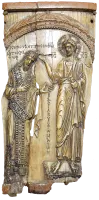
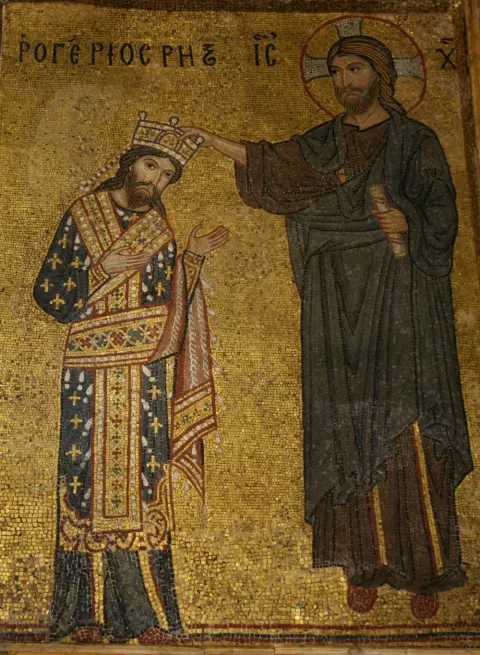
Roger II receiving the crown directly from Christ and not the Pope. Mosaic in the Martorana, Palermo. The mosaic carries an inscription Rogerios Rex in Greek letters.
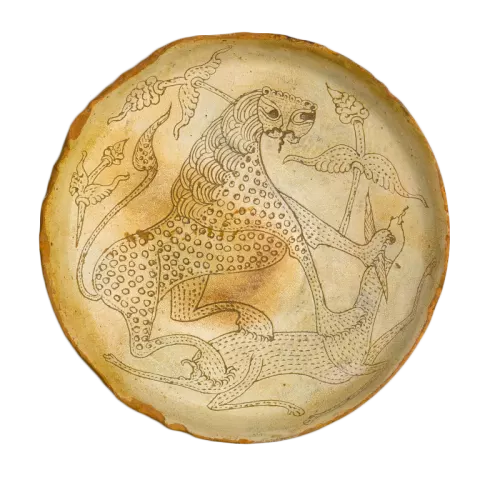
Glazed ceramics were used by a very large proportion of the population so they had an extensive, perhaps mass, market. During the twelfth century there was a change in decoration technique, and by the end of it, there was a technological change in production as well. The first change consists of the use of white slip, which permits more elaborate decoration of the ceramics, and the technological change was in the use of stilts, tiny tripods on which layers of pottery rest in the kiln. It reduces wastage, and probably facilitates the production of large numbers of pieces of pottery at one time. The two largest centers of production of glazed pottery were Constantinople and Corinth. Byzantine pottery was an important trade commodity, it was widely disseminated in the Byzantine Empire, Venice, Italy, and, in the early thirteenth century, the Middle East.
Glass production produced both luxury items and items for a mass market. Luxury items were produced by highly specialized craftsmen and were intended for a small market: the emperor, the court, high officials of all kind. The objects of everyday use such as different kinds of hollow vessels, small bottles, and beads had a mass market. Architectural glass for window panes and tesserae used for mosaics had a special market. Two mayor centers of glass production seems to have been Constantinople and Corinth.
Silk production was an important part of the Byzantine economy. Silk had a great symbolic value and was associated with the highest members of society. It was desired by the wealthy, but also by others as can be seen from the existence of half-silks, silk mixed with other yarns, which made it affordable to those of very moderate wealth. Demand for silks of all qualities increased in the course of the eleventh and twelfth centuries, both on domestic and foreign market.
Constantinople was a mayor center of silk production, at least until 1204 when the Crusaders sacked the city and divided the Empire. The silk production for the needs of the court was shifted together with the court to the Empire of Nicaea. It was the end of silk production in Constantinople, as the industry was not restored after 1261 when the city became capital of the restored Empire. Other centers of silk production developed, especially in the cities of Greece and the Peloponnese. Two mayor silk production centers were Thebes and Corinth. The silk workers of these cities were so famous that when in 1147 the Norman king Roger II sacked these cities, he also carried away to Sicily the silk workers and set them at work at the royal factories in Palermo.
Accelerated growth of the eleventh and twelfth centuries
Trade
The Byzantine cites of the seventh, eighth and ninth centuries had functioned primarily as administrative and military centers, and by the tenth they started to play an important commercial role.
Trade had been expanding since the tenth century and became very active in eleventh and twelfth centuries. One of the great trade centers of the Byzantine Empire was Trebizond, a traditional outlet for the trade of Persia and the Indian Ocean. However, with the Byzantine loss of great part of Anatolia to Seljuks after the battle of Manzikert in 1071 and the instability of the Persian Gulf area from the late tenth century, much of this trade was diverted to Egypt, and Alexandria became the Mediterranean outlet. Thessalonike was the second most important city of the Byzantine Empire. Because of its excellent port and a position as natural outlet for the products of the southern Balkan, it functioned as a center of regional and international trade.
In the course of the twelfth century Venetian and Genoese traders started to interfere in the Byzantine trade with Egypt and by the next century they dominated it. Domination of Italian traders on Mediterranean markets from the 13th century on was greatly facilitated by the events of the late twelfth century. In exchange for the naval help to Byzantium against the Norman leader Robert Guiscard, the Venetians were granted extensive commercial privileges. Other Italian maritime powers were soon to obtain similar privileges from Byzantium. Other factor that facilitated Italian domination on Mediterranean markets was the crusading movement and crusader states which were uniquely favorable to them and their activities.
The privileges granted to Venetians in 1082 granted them the right and freedom to trade in the Empire without paying either the "kommerkion" of 10 percent or a number of other charges. They also had the right to establish themselves in Byzantine cities without limit as to the time they spent there or as to the place where their activities would be carried out. In 1126 the privileges were extended: all Byzantines who bought or sold anything from or to the Venetians did not pay the transaction tax that was otherwise required. Similar privileges were granted to the Pisans in 1111 and the Genoese in 1155. The privileges also seems to have extended to items whose export had long been prohibited: gold and silver, highest-quality silks, foodstuffs, salt, iron and war materials.
Decline of the Byzantine Empire
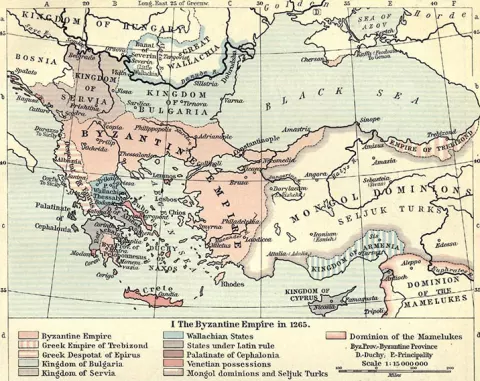
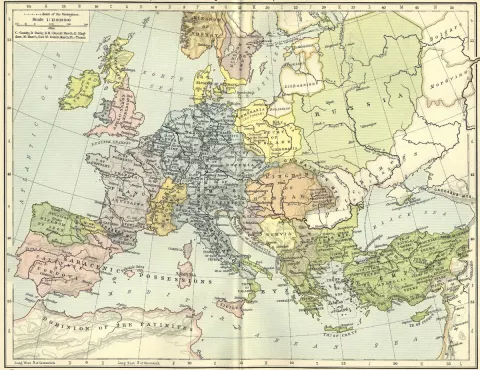
Constantinople fell to the armies of the Fourth Crusade in 1204, and the Byzantine Empire was divided to several new founded political territories. Westerners created the Latin Empire of Constantinople, the Principality of Achaia, and the Venetians held control over islands in Aegean and Ionian seas. The Greek successor states were the Empire of Nicaea, the Empire of Trebizond, and the Despotate of Epiros. The Slavic lands Bulgaria and Serbia became independent shortly before the Fourth Crusade. Loss of the Slavic lands also meant the loss of cereal and cattle producing areas and the loss of Serbian copper and silver mines. After the restoration of the Byzantine Empire in 1261 its territory was much reduced: broadly speaking it included the coastal areas of Asia Minor, Constantinople with its Thracian hinterland, Macedonia, the lands of Epiros and Thessaly, the islands of the eastern Aegean, and the Despotate of Morea.
Proliferation of weights, measures, coins, and of legislation, raised the cost of doing business compared to earlier unified market. Agriculture suffered from constant insecurity and warfare among the various states, incursions from outsiders like Tatars in the Balkans, and Turks in Asia Minor and eventually also in the Balkans. Manufacturing also suffered and became small-scale, while the participation of Byzantines in inter-regional and international trade diminished. Their role in trade was transferred to local and regional trade.
The Byzantine Empire gradually lost its territories to the rising Ottoman Empire, and by the time Constantinople fell to the Ottomans in 1453, which marked the end of the Byzantine Empire, it was already reduced to territories on Peloponnese and the ones surrounding Constantinople.