Museum / Rooms / Mountain of Silver
Room · 6 chapters
Mountain of Silver
“The famous, always greatest, most rich and inexhaustible Hill of Potosi; singular work of the power of God; unique miracle of nature; perfect and permanent marvel of the world; joy of mortals, emperor of mountains, king of hills, prince of all minerals; lord of 5,000 Indians (who extract its entrails); . . . lodestone of all wills; foundation of all treasures.” Bartolome Arzans de Orsua y Vela, Anales de la Villa Imperial de Potosi
It is estimated for late 1500s and most of the 17th century that the Far East received 90% or more of the American bullion.
Miracle of nature
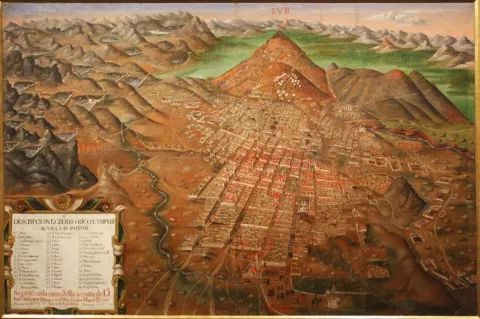
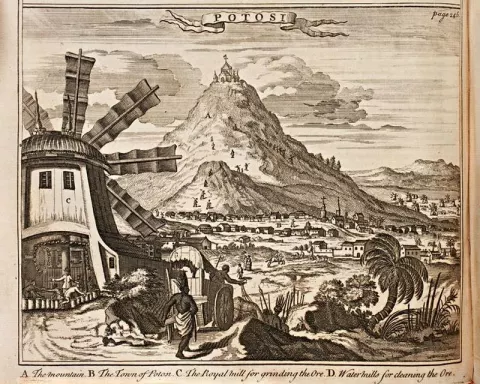
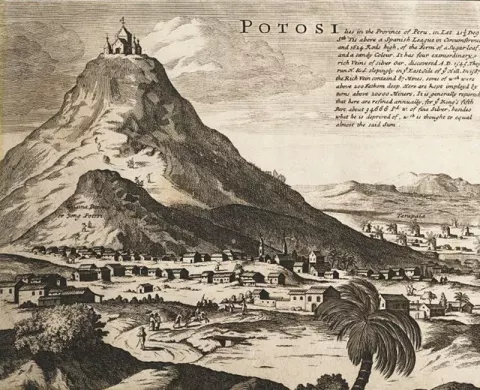
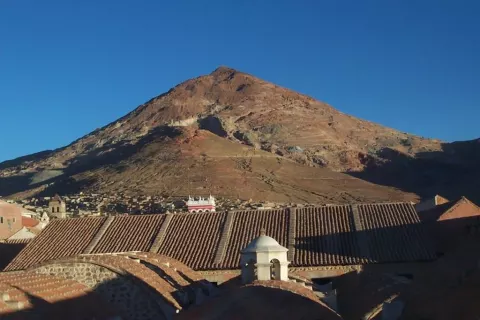
Potosi is a mountain located in Bolivia below which developed the eponymous town that is one of the highest cities in the world by elevation at a nominal 4,090 meters. In the colonial era it was believed that the mountain is made entirely of silver, thus in the imagination of men it appeared literally as a mountain of silver.
However, Potosi is most known as Cerro Rico (Rich Mountain).
Periods of extracting
Potosi’s finding in 1545 was a part of the Spanish search for gold and silver in the New World, acquired through plunder and colonization. Spain extracted its riches for two and a half centuries until the Bolivian War of Independence (1809-1825). Potosi’s colonial history can be divided into three periods; first from 1545 until the early 1570s; second from the early 1570s until 1720; third from 1720 to early 1820s.
The combination of amalgamation technology in mining and abundant Indian labor enabled to Spaniards to maximize the profits from Potosi.
Foundation of all treasures
American bullion, and especially silver from Potosi, had a dramatic impact on European and global money supplies, and thus on the world economy. Potosi’s influence stretched around the globe as its silver was largely used by the European powers to pay expensive Oriental luxury goods like silk and spices in trade with India and China.
Imagined and real wealth of the mountain was so great and important for Spain that the word "Potosi" entered the Spanish language as “an object of incomparable value”; vale un potosi (it's worth a Potosi) came to mean “priceless.”
It is estimated that during its colonial history Potosi officially produced 22,695 metric tons of fine silver, and to put this into perspective let us mention that Europe’s silver stock in 1500 was 37,500 tons.
Chapters
- Lure of treasures
- Three periods of colonial mining
- Miners and conditions of work
- Path of the silver
- Impact of silver on Spain’s foreign policy and changes in Europe
- Influence of colonial mining on other continents
Lure of treasures
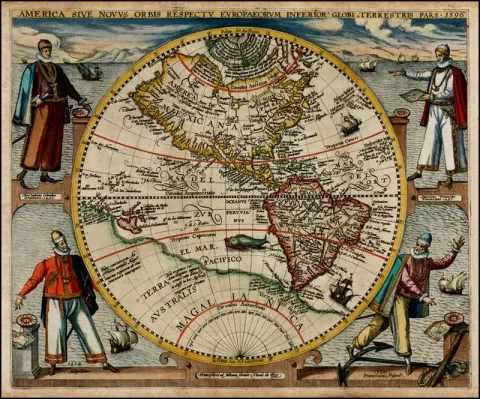
Map of America, or the New World, by Theodor de Bry. Titled “America Sive Novus Orbis Respectu Europaeorum Inferior Globi Terrestris Pars”, and dated 1596. The four figures are, clockwise from top left, Christopher Columbus, Amerigo Vespucci, Francisco Pizzaro and Ferdinand Magellan.
Great geographical discoveries at the beginning of Modern Age were propelled by trade prospects the new routes would enable. Soon, the Europeans started to plunder the New World and the bullion plundered by the conquistadors was just a foretaste of the New World's possibilities. Men like Cortes and Pizarro lusted after gold and silver, and back in Spain, Charles V was delighted to receive the royal fifth, the monarch's share of plunder seized from the Indians and the tax on mining production.
Lure of treasures
Discovery of the Mountain of Silver
Of all colonial mining districts in Latin America, Potosi most fully embodied the industry's grandeur and decadence, its dazzling wealth and miserable poverty, the euphoria and the pain of mining.
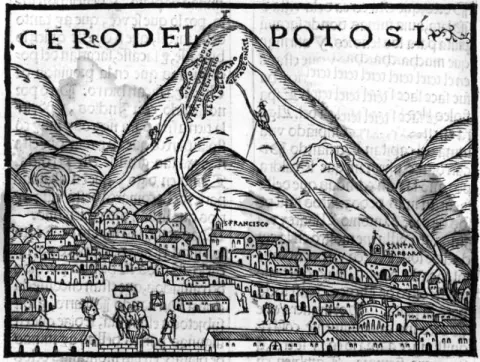
Potosi's discovery is clouded in legends. According to some accounts, Indians considered the hill a huaca (sacred place). Andeans believed that deities and ancestors inhabited natural objects, including mountain peaks and crags. Thus, Indians from the vicinity of Potosi likely visited shrines on the Cerro and may have discovered outcroppings of silver ore.
One story of the early colonial period claimed that the Incas tried to mine silver at Potosi. When they attempted to do so, however, a thunderous voice ordered them to stop: “Take no silver from this hill, for it is for other owners.” Spaniards saw this story as a prophecy of their own arrival, that God had prepared Potosi as their reward. Their desire to justify their conquest of the Incas and their seizure of Peru's wealth made it easy to believe such stories.
One of the most elaborate stories tells us about an Indian named Diego Gualpa made the find while searching for a huaca on the side of the Cerro Rico. Another version of the story has him searching the hillside for a strayed llama. While on the Cerro, wind threw him to the ground, and he found himself holding on to an outcropping of silver ore. According to a different account a fire he built to warm himself smelted the silver that he discovered in the morning. After that he tried to report his find to the Spaniards in Porco, but they paid him little attention. There is another version of the story that reports that Gualpa hid his find and secretly worked the lode. Eventually his fortune attracted too much attention, and news of the strike spread rapidly.
Three periods of colonial mining
The history of colonial Potosi divides into three main periods; first from 1545 until the early 1570s; second from the early 1570s until 1720; third from 1720 to early 1820s.
Three periods of colonial mining
First period
The first period of mining at Potosi encompassed the discovery and first boom in silver production as Spaniards rushed to Potosi to take advantage of the strike. Even some Indians went there on their own to prospect. At this first stage of mining, when work focused on the oxidized surface ores, Andean natives provided nearly all the labor and most of the technology. Surface ores were very rich, and extraction costs were not high because only a modest amount of tunneling was necessary and drainage did not pose a problem. During the first years miners managed to produce more than 40,000 kilograms of silver per year, rising to nearly 64,000 in 1565. However, production plunged to 21,000 kilograms in 1572. By the end of the first period surface ore was depleted and the remaining lesser quality ore needed more technology and work force to produce silver bars.
Three periods of colonial mining
Second period
The second period of Potosi's colonial history began with the introduction of amalgamation that enabled work on lesser quality ore in the early 1570s. During this period Potosi reached its height, when yearly output reached nearly 200,000 kilograms in 1593. After 1593 Potosi began a long, gradual decline and by 1700 its official annual production had fallen to 30,000-40,000 kilograms. Tax burden, a shortage of mitayos (forced laborers), and the lack of mercury for amalgamation process contributed to Potosi's decadence, but foremost was the poor quality of the remaining ore available in the Cerro.
Three periods of colonial mining
Technological progress
Technological progress of refining silver ores through amalgamation, introduced to Potosi’s lower grade ore in the early 1570s, was developed in 1555 by Bartolome de Medina in Mexico. Process involved mixing salt and mercury with crushed ore and adding a reagent (magistral), such as crushed copper or iron pyrites. The magistral started a chemical reaction in which the salt released the silver from the ore to form an amalgam with the mercury. The workers then washed away the dross, leaving the heavy amalgam, which they heated to volatilize or evaporate the mercury. This process resulted in silver in so-called pina form. As amalgamation spread at Potosi, demand for mercury surged, and it was mostly from Huancavelica, the prolific source of mercury in Spanish America.
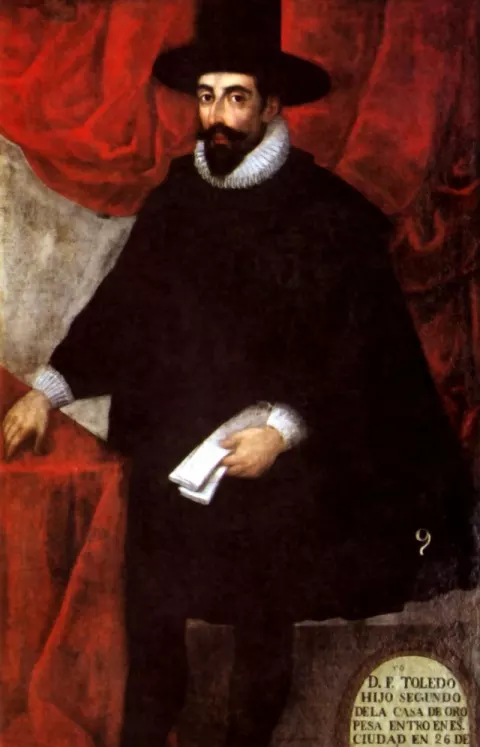
The switch to amalgamation increased demand for labor to extract and refine massive quantities of ore. Viceroy Francisco Álvarez de Toledo committed the colonial government to providing the mines and mills with workers. Toledo adopted Inca’s custom called mit’a or “turn” that required adult males to take turns laboring on public projects. Toledo adapted this custom, and created the colonial mita, a system of forced Indian labor. He assigned an annual quota of mitayos (mita workers) to Potosi. Adult male Indians in the mita provinces were to work every seventh year at Potosi. The same system was introduced to Huancavelica to meet the silver refiners' growing demand for mercury. Mitayos received a wage, although it was lower than that paid to the free workers who were employed to supplement the mita contingents.
Combination of new technology and the Spanish government's coercion of indigenous labor caused an amazing surge in silver production. In 1565, Potosi refiners had officially smelted 63,000 kilograms of silver. In 1592, with amalgamation, they refined 194,000 kilograms. From 1579 to 1610, official output of silver had only once fall below 130,000 kilograms. During the great amalgamation-fueled boom of around 1600, the Potosi district produced more than half the silver registered in Spanish America. Potosi poured forth a river of silver year after year.
Three periods of colonial mining
Crown’s share
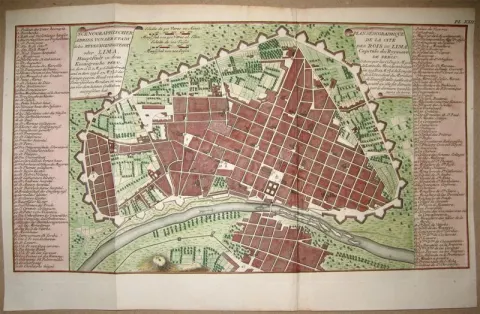
Potosi poured a river of wealth in the state treasury; of the surplus revenues remitted to the Peruvian capital by the provincial tax offices from 1607 to 1690, for example, Potosi supplied 110 million of the 180 million pesos received in the Lima treasury. Another great income for the state was monopoly on the distribution and sale of mercury.
Royal officials assayed the pina to determine its fineness or purity, charging a fee of 1.5 percent. On the remaining 98.5 percent of the silver they collected the royal fifth (quinto real), leaving the refiner with 78.8 percent of his original pina. Near the end of the second period French, English, and Dutch smugglers infested the Pacific coast, anxious to exchange their wares for Potosi's silver. Through dealings with smugglers refiners tried to avoid paying the assay fee and the quinto tax that took them 21.2 percent of the silver produced.
Three periods of colonial mining
Third period
The third and final cycle in Potosi's colonial history began around 1720 and lasted until independence in the early 1820s. At the beginning of the period the treasury registered less than thirty thousand kilograms of silver per year. Improvement began in 1736, when the Crown halved the principal mining tax from a fifth to a tenth (diezmo), hoping the lower tariff would stimulate silver output by increasing the industry's profitability. Despite the poor quality of ore, silver production increased gradually, reaching seventy thousand to eighty thousand kilograms per year in the last three decades of the eighteenth century. Resurgence was not the product only of lowered tax but of more intense exploitation of mita labor to offset production costs as well.
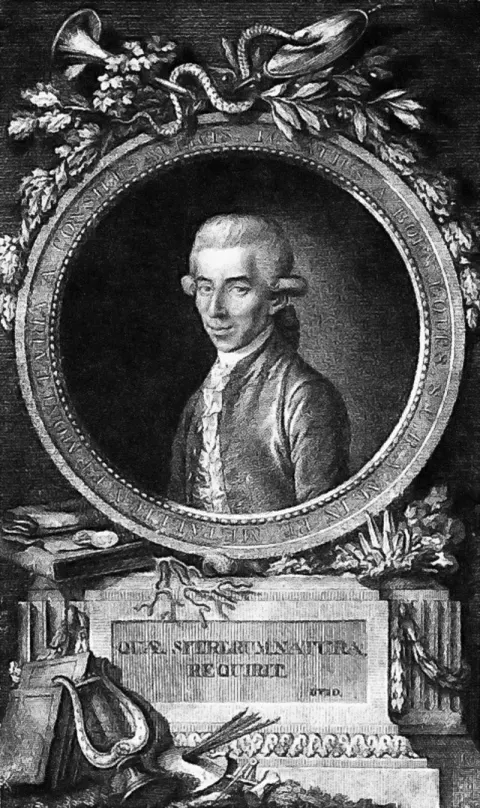
In 1789, the Crown sent central European mining and metallurgical experts headed by the Baron of Nordenflicht to Potosi. Their mission was to improve refining techniques by demonstrating a new method of amalgamation developed by Baron Ignaz von Born. Although the new process completed amalgamation in three or four days rather than weeks refiners rejected the method, put off by the cost of building the new machinery and the method’s disappointing results in experiments.
However, Potosi was not inexhaustible, its ores and output of refined silver experienced a gradual decline.
Miners and conditions of work
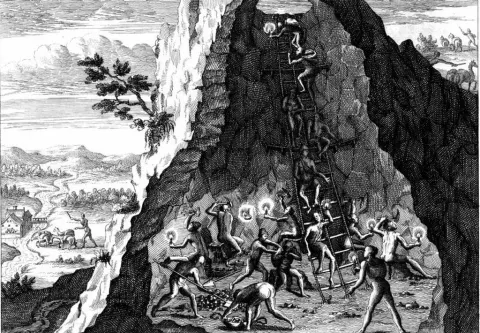
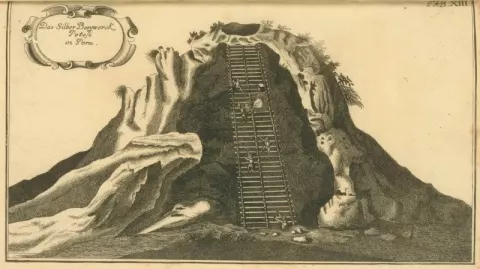
Colonial miners faced terrible conditions, in the Andes most colonial mining was underground work, and mine owners imposed little organization on the diggings. Tunnels were not planned, they followed the silver veins, climbing and descending according to the vagaries of the ore bodies. The central shaft that connects the various levels of the mine and permit the use of whims or pulleys to haul ore and workers up from the depths were rarely existent. Cheap mita labor made owners reluctant to invest capital in systematic excavation and machinery. Workers had to descend hundreds of feet into the Rich Hill on ladders made of rope or twisted leather thongs and wooden steps.
Here is a first-hand description from Jesuit Jose de Acosta that visited Potosi in the late sixteenth century and recorded his impressions of work in the mines:
"They labor in these mines in continual darkness and obscurity, without knowledge of day or night. And forasmuch as those places are never visited with the Sun, there is not only a continual darkness, but also an extreme cold, with so gross an air contrary to the disposition of man, ... Those that labor therein use Candles to light them, dividing their work in such sort, as they that work in the day rest by the night, and so they change. The metal is commonly hard, and therefore they break it with hammers, splitting and hewing it by force as if they were flints. After, they carry up this metal upon their shoulders, by ladders of three branches made of neat leather twisted like pieces of wood, which are crossed with staves of wood, so as by every one of these ladders they mount and descend together.... A man carries ordinarily the weight of two arrobas (fifty pounds) of metal upon his shoulders, tied together in a cloth in manner of a skip, and so mount they three and three.... to mount so great a height which commonly is above a hundred and fifty estados , a fearful thing and... breeds an amazement to think upon it, so great is the desire of silver, that for the gain thereof men endure any pains."
Intendant Pedro Vicente Cafiete y Dominguez also had aptly described the conditions for the mitayos laboring as ore carriers:
"For these poor wretches all the nights are extremely bad. They climb and descend overloaded with a hundred pounds, through caverns filled with horror and risk, that seem to be the homes of demons. The mineral vapors afflict them to such an extent, that together with the fatigue of these heavy tasks, as well as their copious sweat from the underground heat, and the excessive cold they encounter when leaving the mines, dawn greets them so languid and mortal that they appear cadavers."
Path of the silver
The economic impact of colonial mining in the New World had far reaching consequences. Bullion poured to Spain and the rest of Europe, and the rest of the world responded to the lure of American gold and silver. Around 1600 Potosi was Europe's main source of silver. New World’s bullion stimulated the economy of Western Europe, helped capitalism triumph over feudalism, enabled Europeans to trade for the goods of the Spice Islands and China, and touched off inflationary pressures in Spain that spread across the continent.
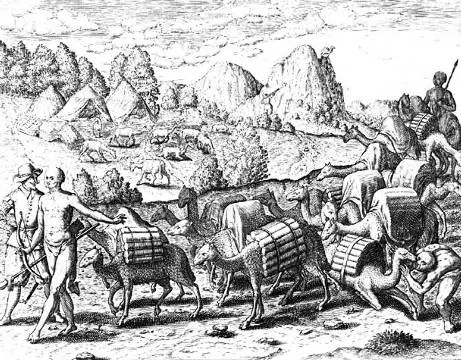
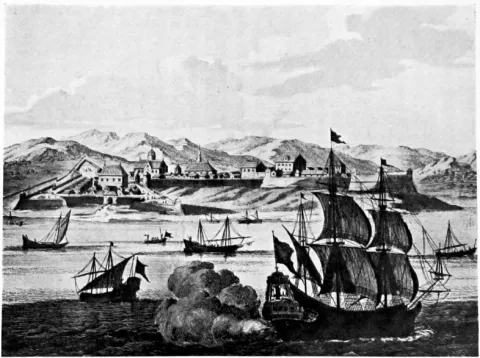
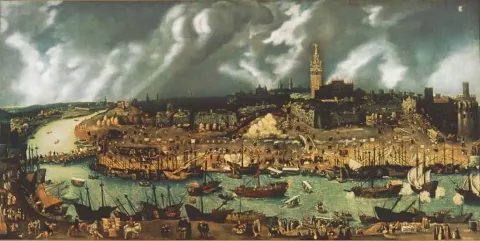
The silver was taken by llama and mule train to the Pacific coast, shipped north to Panama City, carried by mule train across the Isthmus of Panama to Nombre de Dios or Portobelo whence it was taken to Spain on the Spanish treasure fleets. The Crown, merchants, and bankers waited with anxious excitement for the return of each treasure fleet. Even when the fleet crossed the Atlantic there were still threats to the treasure, from English privateers lurking off the coast and from the dangerous bar at SanhIcar that hindered entry into the Guadalquivir River. Once safe, the fleet made its way up the river to Seville where it was welcomed by Church bells, crowd that admired the great treasure and by welcoming salute of guns. Once the fleet docked officials from the Board of Trade (Casa de la Contratacion) boarded the ships to compare the cargoes with the bills of lading.
After that the treasure was transported in the Seville mint where two hundred workers made coins out of bullion. A sixteenth century observer Alonso de Morgado wrote that enough treasure had arrived by the 1580s to pave the city's streets with gold and silver. Needless to say, American mines transformed Seville into one of the world's most dynamic commercial centers.
Path of the silver
Flow of silver from Europe to Asia
During the late Middle Ages Europe’s trade with the Levant for goods from India and the Far East intensified, as did the import of fine furs from Russia through the Baltic. This drained Europe’s bullion which was used to pay off its commercial deficit.
With the great geographical discoveries at the beginning of Modern Age, and intensified trade between Europe and the Far East, Europe's gold and especially its silver, much of it obtained from the New World, flowed to India, China, and the Spice Islands as payment for silks and spices. Around 1600 the value of silver, in terms of gold, was worth roughly twice as
much in China as it was in Europe. Indeed, one observer reported that to the Chinese, “silver is blood.”
Europeans traded some woolen textiles, metal products and other goods for the luxuries of the East, but Asian demand for European goods was not nearly as strong as the European demand for Asian goods. Because of this Europeans had to pay for 40 to 50 percent of their purchases in silver that was used as a medium of exchange in East Asian economies. Most of the European bullion used in East Asian trade came from Spanish colonies in America, and the bulk of it from our observed Mountain of Silver. We can see the importance of silver bullion in East Asian markets obtained through trade with Europeans on Indian and Chinese example. Coinage on Indian subcontinent was minted from bullion imported through trade, and in China silver was the basic instrument of large-scale exchanges, all the more so under the Mings (1368-1644) as a monetary and capitalist economy came to life.
Impact of silver on Spain’s foreign policy and changes in Europe
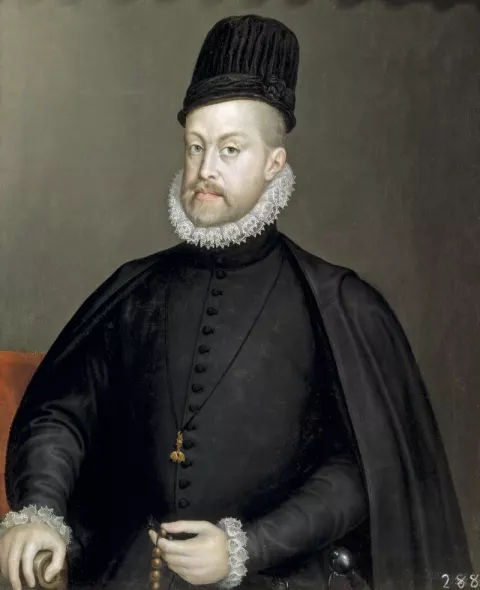
Spanish monarchs saw American gold and silver as a windfall they could use to achieve political goals. They undertook geopolitical campaigns such as crusades against Protestantism and preserving the Habsburg Empire, encouraged in the quest by the scale of American treasure. Colonial revenues made them less dependent on feudal assemblies and thus allowed them to pursue more absolutist policies than otherwise would have been possible.
Mountain of Silver
Changes in Europe
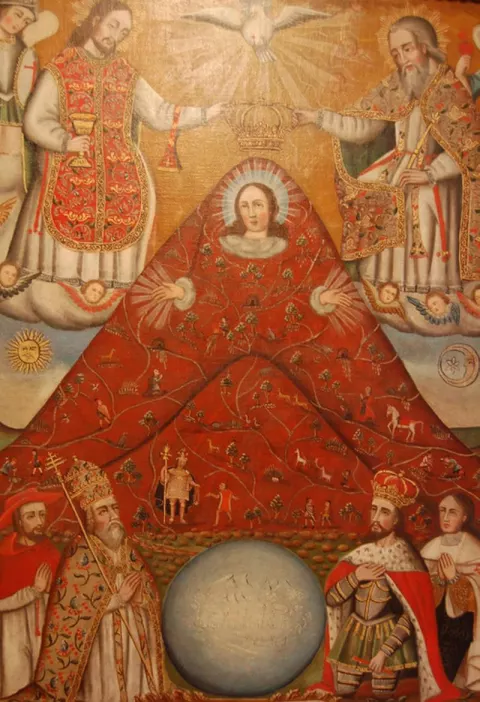
Painting of the Virgin Mary inside Mountain of Silver yet her merging with the landscape suggests Pachamama (the Andean goddess of earth and creation). On the mountain is depicted the indigenous man attributed for finding the silver and below the Spanish king and the Pope giving thanks for the huge wealth it generated for Europe.
American bullion helped form the European economy that developed with the rise of capitalism. By the mid-1500s, Spain began suffering from inflation and contemporary writers blamed the rise in prices on the imports of American gold and silver. The abundance of precious metals reduced their value relative to other commodities. Great quantities of American silver also had an impact on European mining activities; unable to compete with the lower cost of American silver German mines stagnated in the 16th century.
Spain felt the effects of the “Price Revolution” most strongly, although other nations also experienced inflation. Precious metals from the colonies led Spaniards to consume imported manufactured goods rather than establish their own industries. Competing regions, such as Low Countries or Italy possessed comparatively strong and efficient industries but lacked bullion. With such market conditions, bullion flowed out of Spain in exchange for manufactured goods produced elsewhere.
American bullion helped foster the economic transformation of Europe during the sixteenth to eighteenth centuries; the population rose, manufacturing expanded, capitalism replaced feudalism, European commerce intensified, and the Industrial Revolution began.
Influence of colonial mining on other continents
American gold and silver did not affect only Europe but it played important role in increasing world monetary flows. American treasures, Spanish silver and Portuguese gold from Brazil, fueled international trade. Brazilian gold rush increased demand for labor and thus stimulated the Atlantic slave trade. This provoked ethnic warfare as African tribes fought to take captives to sell to the European traders on the coast. Asians expanded spice and silk production to trade those commodities for bullion. As American economist Charles P. Kindleberger wrote “China and India were sponges that soaked up the streams of silver flowing through Europe (and the Philippines) from Spanish America.” It is estimated for late 1500s and most of the 17th century that the Far East received 90% or more of the American bullion. The 18th century saw a decline in Potosi’s output and the lack of silver to fuel the trade with the East. At this point Westerners introduced opium to Chinese market, which resulted in social problems and the loss of Chinese supremacy in trade with the West.
Mining in Latin America dominated its economic life, especially in the Spanish Andes. Town that sprung up under the Cerro Rico constituted the foremost market in South America. With its population over 100,000 Potosi was the largest city in the hemisphere at the time, and in Europe only London and Paris were bigger. Potosi’s residents consumed goods from the surrounding hinterland, from Europe, and from the Far East. Food arrived from Cochabamba, coca leaves from the eastern slopes of the Andes, wine and brandy from southern Peru, woolens from Quito, fine cloth from Europe, and silk and spices from the Orient.
However, little of the capital obtained from mining seems to have been reinvested in activities that might have made these economies more dynamic and self-sustaining. The colonial system tended to drain bullion and capital out of the Americas, merchants and state bureaucracies shipped vast quantities of gold and silver from the mining centers to colonial entrepots and from the New World to Europe and beyond. Because of the reasons mentioned above treasures coming from the mines did not produce conditions leading to self-sustaining growth in other parts of the economy of Latin America.