Museum / Rooms / Karimi merchants
Room · 4 chapters
Karimi merchants
During the Middle Ages merchants of the Islamic world were the principal purveyor of African gold and Indonesian spices for Christendom
Who were the Karimi merchants?
Karimi merchants were Egyptian entrepreneurs who were one of the most important merchant groups from the 12th until 15th century. As importers of spices, they were mostly involved in intermediary trade between India - abundant in spices - and Europe – hungry for spices.
Organization of the Karimi merchants
Karimis functioned as a loose confederation of merchants bound together by professional interests. The richest and most esteemed among them decided on questions which gave rise to discussion and represented them before the government. Both the Egyptian and Yemenite governments recognized the value of this prosperous merchant group. Because of their connections and influence built through trade, Karimis often acted as diplomats.
Importance of the Karimi merchants
Karimis were valued by Egyptian and Yemenite rulers not only because of their diplomatic role but also because they were the source of availability of loans and taxation on their traffic provided governments with high profits. Their loans proved especially helpful in times of war. Their importance was such that the Egyptian government even provided their fleet with an armed protection on the Red Sea.
Decline of the Karimi merchants
Eventually Egyptian Sultans decided that they could profit even more from the spice trade if they take more direct involvement in it. Government decided on the price of spices, changed the traditional trade routes, and introduced new kind of officials who acted as state merchants. These changes deteriorated the position of Karimis and eventually they ceased to be the dominant force in the Red Sea and Indian Ocean traffic.
One of the most accepted theories about the term Karimi is that it is in origin a Tamil word, "karyam", meaning “business” or “affairs”.
Area of operation of the Karimi merchants was Egypt and ports along the Red Sea. In times when sea route along the African coast from Europe to Asia was unknown they were the link which connected them.
Chapters
Commerce of the medieval Islamic world
The medieval Islamic world was a civilization whose great economic centers were tied together by successful and esteemed merchants who skillfully exploited the regional variety of the Muslim world. It also drew many of the essential commodities upon which its wealth was constructed from beyond the borders of Islam.
In the eleventh century merchants from the Islamic world dominated the trade routes of both the Mediterranean and the Indian Ocean, but as the Italians gathered Mediterranean commerce into their hands the long-distance merchants from the Islamic world turned their attention increasingly towards the Red Sea and India.
The emergence of thriving communities of Christian merchants in western and southern Europe only increased the commercial importance of the Islamic world which became the principal purveyor of African gold and Indonesian spices for Christendom.
Although Islamic regions of Egypt, Anatolia, and Iraq were important consumers of the luxury items throughout the Middle Ages, the demand from the West shaped much of the fluctuations in business of the Islamic world. A merchant group which particularly exploited and thrived upon these impulses were the Karimi merchants, a group of Egyptian (mostly) spice merchants which meet the western demand for eastern goods in great Islamic ports such as Alexandria.
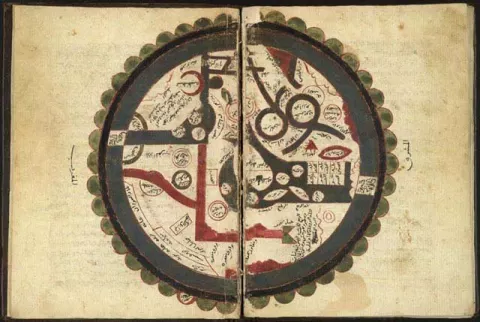
Ibn al-Wardi's 14th century atlas of the world, a manuscript copied in 17th century. Mecca and Medina, the two holiest cities of Islam, are in the middle of the map
Karimi merchants
In the late Middle Ages the Karimi merchants dominated the only trade route under Muslim rule that can really be described as the preserve of Muslim merchants - the Red Sea route from the port of Aydhab, in eastern Egypt, to the straits of Aden, with the accompanying land route along the Arabian coast, through Mecca and Medina.
The Karimi merchants rose from the end of the twelfth century with commercial interests in Yemen, India and also nearer home in Damascus. In addition to their mercantile acumen they were also granted considerable political favors. The reason for Egyptian rulers to involve themselves heavily on commercial matters from the late 12th century onwards was because they saw in it, and spice trade especially, a source of funds to cover their war expenses.
The origin of the term Karimi has many explanations. One of the most accepted is that it is in origin a Tamil word, "karyam", meaning “business” or “affairs”. At first it was applied to Indian merchants with whom the future Karimis had extensive contact, and by 1200 it started to refer to great Muslim merchants in trade with the East.
The word Karim was also used to designate a convoy between Egypt and India in the 12th century. However it designated trade convoys of merchants among whom were Muslims and non-Muslims, but from the late 12th century it designates Muslim merchants trading with the East and enjoying protection by the sultans. From then until their status was substantially eroded in the fifteenth century they were the dominant group trading through the Red Sea. Throughout the period their prime interest lay in the spice trade to Egypt from the East; but they also handled many of the "matjar" commodities (commodities required by the state), such as wood, wheat, flour, sugar, rice, weapons and textiles. They were also major source of armaments from India and the East.
It seems that the Karimi merchants limited their eastwards movements, establishing a terminus at Aden. Indian shippers controlled navigation between Aden and their homeland, while the Karimis controlled it up the Red Sea to Egypt.
Ties with the state
How merchant became Karimi, accept by his own business acumen, is enigmatic. Some of them started as tailors, poor merchants or have acquired wealth by inheritance. Their prime specialty was the spice trade which reaped high profits. The profit on the Aden to Egypt run was up to 100%, and the sales of goods was virtually assured by the presence of the Italian merchants.
Although there were Karimi funduqs, or warehouses, at Cairo, Fustat, Aden, Alexandria, Jiddah, Qus, Zabid and Ta'azz, that is along the Red Sea and Nile routes, it is hard to determine whether the Karimi merchants possessed a corporate identity. Certainly among them there were those who were more respected than others, even being titled as the chiefs of Karimis, but it seems that each Karimi merchant made his business decisions independently from some central governing body.
It is most probable that they were a loose confederation of merchants bound together by mere professional interests while the richest and most esteemed Karimi always decided on questions which gave rise to discussion, that he, with some other prominent members of the group, represented them before the government, and that his authority was recognized by all the Karimis.
The value of a prosperous merchant group was recognized by both the Egyptian and Yemenite rulers. They benefited enormously from taxation on Karimi traffic, and the Egyptian government even provided armed protection for the Karimi fleets on the Red Sea. The Karimi merchants even played a role as ambassadors and helped to maintain good relations between the Egyptian government and the Rasuliyyid court in Yemen.
Not only did Egyptian and Yemenite governments reap high profits from the taxes on the Karimi trade, but they were also the source of availability of loans. The Karimis put their surplus capital to use in moneylending, financing both the rulers of Egypt and Yemen, and other more modest clients. But the life was not all peaches for the Karimis. They were sometimes forced to make loans, mostly for wars expenses of the Egyptian rulers such as when the Mongols threatened the Mamluk empire in 1300, when Syria rebelled in 1352, and when Mamluks were preparing for conflict with Tamerlane (d. 1405) in the late 14th century. Other notable instance when the Karimis were forced to make loans happened in 1288 when the Sultan Qalawun (r. 1279-1290) brought some eminent Damascus merchants to Cairo and fined them; he then made the Karimis provide the Damascenes with a loan, since the latter did not have the money to hand.
Decline
The start of the Karimis’ downfall began with the reign of the Sultan Barsbay (r. 1422-1438) which marked the transition to a new Mamluk policy in which government involvement in the spice trade was more direct, and Karimi influence was correspondingly reduced. Barsbay forbade the Karimis to sell spices directly to the Italian merchants in Alexandria, and the government henceforth fixed the prices at which spice and sugar could be put on sale to the Europeans.
Sultan Barsbay also made Jiddah, a Mamluk-held town, an important base for the disembarkation of goods brought from the East. This decision detracted the status of Aden as the principal intermediate trading station between Egypt and the Indies, and eased the taxation of the Karimi merchants.
The Mamluk sultans further deteriorated the position of Karimis by the creation of a new merchant cadre whose tasks were dominated by the needs of the sultans themselves. These state merchants bought spices on sultan’s behalf and were supervised by the “king of the merchants” "malik al-tujjar", a government official who looked after the Red Sea and Indian Ocean traffic. Gradually the private Karimi merchant lost ground to his better patronized successor, who combined a commercial career with public service.