Museum / Rooms / International trade through Tsardom of Russia
Room · 5 chapters
International trade through Tsardom of Russia
A period which transformed Russia into a pan-Eurasian commercial power
Tsardom of Russia
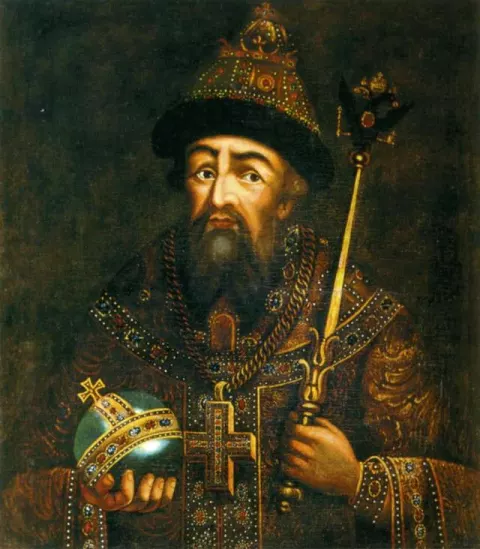
The period of Russian history known as the Tsardom of Russia was the period running from Ivan IV’s (1530 – 1584) claim to be the tsar and grand prince of all Russia in 1547 to the foundation of the Russian Empire by Peter the Great (1672 – 1725) in 1721. During this period Russia went through fast expansion - it is estimated that from 1550 to 1700 Russia’s territory grew by 35000 km2 a year. Most of these territories were in Siberia what added to Russia’s importance as a venue of Eurasian transit trade, and created the basis for its transformation into a pan-Eurasian commercial power.
Russian goods that lured Europeans
The European merchant nations such as the English, Dutch, and French who were constructing merchant fleets for the Ocean trade depended on Russian commodities such as hemp, tar, flax, wax, tallow, timber and other ship necessities. No less important, the European elite wanted Russian luxuries like furs and delicacy such as caviar. In exchange the foreigners brought broadcloth and other textiles, munitions, luxury goods, and precious metals.
Artic coast
The White Sea port of Arkhangelsk was the leading outlet of Russian exports to world market during the tsarist’s period. One of the advantages of Arkhangelsk was its connection to the central Russian heartland by the Dvina-Sukhona waterway, thus serving the enormous hinterland while transportation of goods over long distances could be done in a reasonably cost-effective fashion. The foreign merchants were also attracted to Arkhangelsk because by doing business there they avoided paying taxes and duties to third parties, as they would be required if doing business with Russians in the Baltic Sea.
Baltic basin
Commercial interaction with Western merchants in the Baltic area had to take place through Swedish and Danish territories, thus raising the cost of doing business. Russian cities which dominated this part of the trade were Novgorod and Pskov. Although this route suffered for much of the first half of the 17th century, no temporary setbacks or political decisions could ultimately undermine the basic economic and geographic advantages of the Baltic basin, which paved the way to a dramatic recovery of Russian transit trade by the 1650s, and especially after the 1661 Russian-Swedish Kardis peace.
Border with Europe
The importance of the overland routes to the Central Europe declined in comparison with the Medieval period mostly as a result of the rise of seaborne trade and increased political instability of the region. The major trade points were the border cities of Smolensk and Putyvl.
Border with Asia
The most important border point to the south was the Volga port of Astrakhan through which most of trade with Asia was channeled. Astrakhan was a truly cosmopolitan city, frequented by merchants from Central Asia, Persia, Turkey and Trans-Caucasia already in the 16th century. Astrakhan-Arkhangelsk axis eventually emerged as a crucial pillar in Russia’s integration into the world economy.
Russia’s long border was a scene of increasingly lively exchange with foreign merchants, whether in key positions for long distance trade such as Arkhangelsk or Astrakhan, or on various locations of short-distance cross-border trade.
Arkhangelsk was built in 1583 to foster international trade. By the middle of the 17th century it was established as a substantial center of economic importance.
Average trip from Moscow to Beijing and back took three years, and the dominant route between Nerchinsk and Beijing took three months in one direction.
Great trade centers such as Novgorod and Pskov possessed special guesthouses which served to facilitate merchant’s needs for rest, trade, and storage of goods.
Chapters
- Tsardom of Russia in international trade
- Trade on the Artic coast
- Baltic route
- Trade on central European border
- Trade with Asia
Tsardom of Russia in international trade
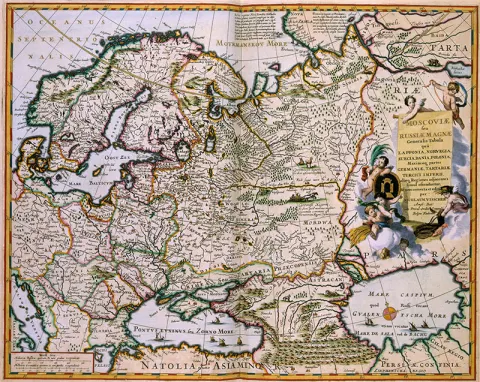
The period of Russian history known as the Tsardom of Russia was the period running from Ivan IV’s (1530 – 1584) claim to be the tsar and grand prince of all Russia in 1547 to the foundation of the Russian Empire by Peter the Great (1672 – 1725) in 1721. During this period Russia went through fast expansion, it is estimated that from 1550 to 1700 Russia’s territory grew by 35000 km2 a year. Most of these territories were in Siberia what added to Russia’s importance as a venue of Eurasian transit trade, and created the basis for its transformation into a pan-Eurasian commercial power.
Russia’s long border was a scene of increasingly lively exchange with foreign merchants, whether in key positions for long distance trade such as Arkhangelsk or Astrakhan, or on various locations of short-distance cross-border trade.
The White Sea port of Arkhangelsk was the leading outlet of Russian exports to world market during the tsarist’s period. One of the advantages of Arkhangelsk was its connection to the central Russian heartland by the Dvina-Sukhona waterway, thus serving the enormous hinterland while transportation of goods over long distances could be done in a reasonably cost-effective fashion. The foreign merchants were also attracted to Arkhangelsk because by doing business there they avoided paying taxes and duties to third parties, as they would be required if doing business with Russians in the Baltic Sea.
Commercial interaction with Western merchants in the Baltic area had to take place through Swedish and Danish territories, thus raising the cost of doing business. Russian cities which dominated this part of the trade were Novgorod and Pskov. Although this route suffered for much of the first half of the 17th century, no temporary setbacks or political decisions could ultimately undermine the basic economic and geographic advantages of the Baltic basin, which paved the way to a dramatic recovery of Russian transit trade by the 1650s, and especially after the 1661 Russian-Swedish Kardis peace.
The importance of the overland routes to the Central Europe declined in regard to the importance it held in the Middle Ages, partly because of the rise of seaborne trade and the political instability of the region. The major trade points were the border cities of Smolensk and Putyvl. Russian trade with Poland-Lithuania received serious blows due to wars in the first half of the 16th century, the Livonian War (1558–1583), the Polish–Russian War (1605–1618, the Smolensk War (1632–1634), and, above all, the Thirteen Years’ War (1654–67).
The most important border point to the south was the Volga port of Astrakhan through which most of trade with Asia was channeled. Astrakhan is regarded as the southern equivalent of Arkhangelsk, through which most of the trade with Europe was channeled. Astrakhan-Arkhangelsk axis eventually emerged as a crucial pillar in Russia’s integration into the world economy.
Trade on the Artic coast
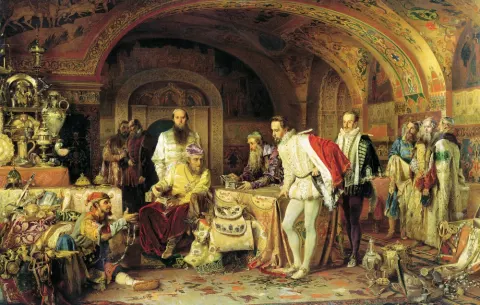
Trade with Russia and Western Europe on the White Sea developed largely due to an accident while searching for the Northeast Passage to China. "The Mystery Company and Fellowship of Merchant Adventurers for the discovery of unknown lands etc.", established in London in 1552, sent three vessels in 1553 in search for the Northeast Passage. Two of the ships, the "Bona Esperanza", and the "Bona Confidentia", under the direction of Hugh Willoughby, wintered in a harbor on the Kola Peninsula but the crew passed-away. The third ship "Edward Bonaventure" under the command of Richard Chancellor, reached Rose (Iagry) Island in the estuary of the Northern Dvina on November 23, 1553. Chancellor journeyed overland to Moscow where he was received by Ivan IV as the English ambassador, and received a letter granting the English favorable conditions for trade with Russia. His successful negotiations with the tsar resulted in the formation of the Muscovy Company in 1555, which was given a monopoly of Russian trade.
At first, trade in the Dvina estuary came to be effectively monopolized by the English, while a more established area of Russian-Western interaction was the more northwesterly coast of the Kola Peninsula. The economic potential of the region was limited by its low population density, inhospitable climate, and Danish pirates, but it did possess some real assets for international commerce. Export-oriented production included whaling and fishing of cod and salmon, and even pearl extractions from the local river mussels. In the second half of the 16th century the Kola coast, visited by Danish, Norwegian, and especially Dutch merchants, emerged as an economic center of nationwide importance.
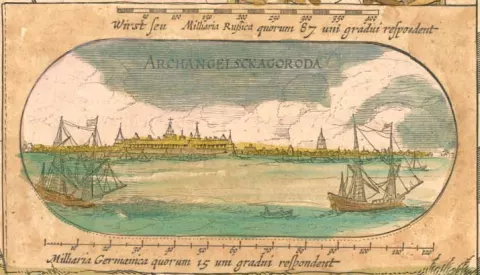
The transfer of trade to the Dvina estuary was gradual. The English made their base on the Rose Island and used the small port of St Nicholas, around the Nikolo-Korelsky Monastery in Severodvinsk, which was far from ideal for large-scale trade. The situation improved after the Dutch accidentally discovered a far superior and more protected harbor in the Pudozhemsk branch of the Dvina estuary in 1582. To foster trade, Ivan IV issued an order on March 4, 1583 for a new city to be built, first named Novogorodok but subsequently changed to Arkhangelsk after the monastery of St Michael the Archangel. The government issued an order in 1585 to all foreign merchants in the north to move their operations to the new city, the Dutch arrived in 1586, and the English in 1591. Arkhangelsk developed swiftly and by the middle of the 17th century it was established as a substantial center of national economic importance.
Baltic route
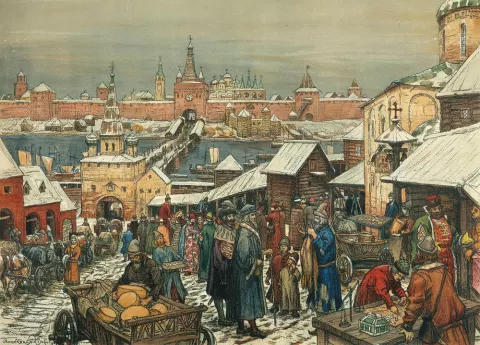
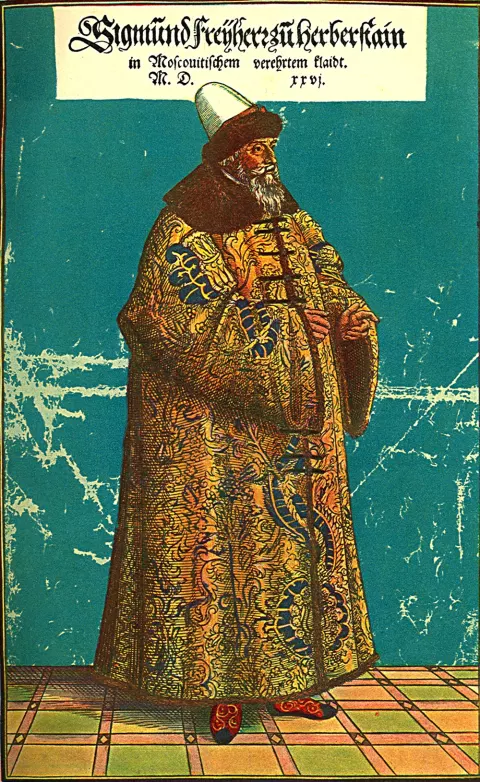
The main northwestern Russian cities during the tsarist period for commercial interaction with Western Europe were Novgorod and Pskov. At the very beginning of the period in question, Sigismund Herberstein, a diplomat of the Holy Roman Empire, praised Novgorod in 1549 as the premier international commercial center of Russia, one which attracted large numbers of wealthy merchants from all corners of the country, as well as from Lithuania, Poland, Sweden, Denmark, and Germany.
Part of the Novgorod’s success as a northwestern Russian commercial hub was due to its ideal geographic location with easy access to the rest of Russia and the Baltic ports, advantages also enjoyed by Pskov.
The northwestern Russian cities and the Baltic route remained pre-eminent in Russian international commerce well into the second half of the 16th century. Only after the Swedish conquest of Narva in 1581 is that the White Sea route began to eclipse the traditional axis of Russian export trade. The long Livonian War (1558–1583) fought between Russia, Polish–Lithuanian Commonwealth, Denmark-Norway, and Sweden, whose effects were amplified by the Oprichnina (oppressive policy of Ivan IV between 1565-1572), contributed to disastrous de-population of the Russian northwest with the core Novgorod lands in many cases losing over 70 percent of their prewar population. The return to normalcy was aided by the Treaty of Teusina signed in 1595 to end the Russo-Swedish War (1590–1595) which, among other things, allowed Swedish merchants to visit Moscow, Novgorod, and Pskov. The speedy recovery of trade in Novgorod was hampered by the Time of Troubles (1598-1613), and Swedish occupation of the city between 1611 and 1617. It took two decades for the city to recover to a significant degree. In contrast to Novgorod, Pskov remained beyond Swedish control and its economic development was marked by relative stability.
The most important foreign merchants in the Russian northwest were German merchants of the Hanseatic League, headed by the merchants from Lübeck, and Swedish merchants. These groups also possessed special guesthouses in great trade centers, such as Novgorod and Pskov, which served to facilitate merchant’s needs for rest, trade, and storage of goods.
Trade on central European border
Commercial exchange along the Russian land border tended to be much less centralized than trade in Arkhangelsk or in the Baltic area, as reflected in the large number of crossing points that covered the length of the border. The area was susceptible to relatively frequent political changes of the borders between Russia and its neighbors, but nevertheless the Dnieper-Daugava basin was an important economic region. On the Lithuanian side the leading centers were Mogilev, Polotsk, Vitebsk, and nearby capital of Vilnius, while on the Russian side the leading centers were Pskov, Velikiye Luki, Toropets, Vyazma, Bryansk, and Smolensk.
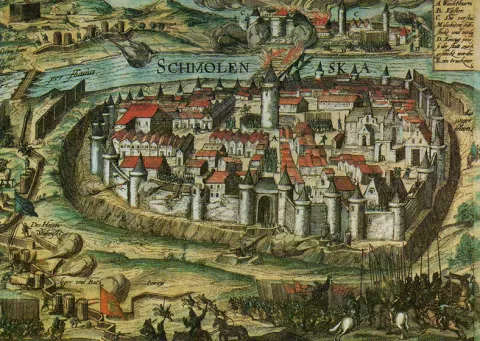
Belorussian city of Mogilev was the main center of Lithuanian-Russian trade in the 17th century. Its rise as the leading commercial center of the Grand Duchy of Lithuania began after the old commercial center of Lithuania, Smolensk, was conquered by Vasilii III (1479 – 1533) in 1514 and thus became part of the Grand Duchy of Moscow, an immediate predecessor of the Russian Tsardom. Smolensk changed hands again in 1611 when it was taken by the Polish–Lithuanian Commonwealth. Russia recaptured it by in 1654. Nevertheless, Mogilev prospered due to trade with Russia and it grew steadily from 7000 inhabitants in 1577, 10000 in 1609, and over 15000 inhabitants in the second half of the 17th century.
Prosperity of Polotsk and Vitebsk was based on long-standing river trade with Riga. During the 16th century Polotsk was more prosperous then Vitebsk, while in the 17th century it was the other way round.
Smolensk was the main Russian border city, with population estimated at some 30000 in 1609. In 1650, while the city was under the authority of the Polish–Lithuanian Commonwealth its population fell to some 10000 inhabitants. However, the growth of the city in subsequent decades broadly mirrored the rapid economic revival of western Russia. While Smolensk was a part of Commonwealth from 1611 to 1654 its role as the center of Russian-Lithuanian border trade was taken over by Vyazma - located some 150 kilometers east of Smolensk on the Moscow road.
Overland trade between Russia and Polish-Lithuanian Commonwealth in the Dnieper-Daugava region took place along a number of trade routes which together constituted an elaborate network. From Russia trade routes led to Warsaw, Minsk, Königsberg, and then these routes connected with a whole network leading to Saxon, Silesian, and Bohemian economic centers such as Leipzig, Wrocław, and Prague. Also there were north-south routes connecting aforementioned Russian centers with the Ottoman-controlled northern littoral of the Black Sea.
Trade with Asia
Russian trade with Asia went through trade with the Ottoman Empire, through the Volga port of Astrakhan which established itself as the principal focus of Russian-Asian trade in the 17th century, and through the network of Siberian border fortresses.
Moscow was the main center of the trade with the Ottoman Empire. Routes from the Black Sea to Moscow usually started from Kaffa (modern Feodosiya) or Akkerman (modern Bilhorod-Dnistrovskyi) from where it followed Dnieper to Kiev, and on to Moscow by way of Vyazma. Merchants traveling from the west gathered in Moldavian capital Iași, where they formed caravans for a joint journey to Russia.
From the mid-16th century Russians were in possession of the lower Volga basin what opened a window on more distant lands through the trade routes that crisscrossed the territories around the Caspian Sea. This window was the city of Astrakhan in the Volga estuary. The great Volga waterway connected it with much of the Russia’s economic heartland, while the Caspian Sea provided connections with Trans-Caucasia, Persia, Central Asia, and even India.
Astrakhan developed into a truly cosmopolitan city, frequented by merchants from Central Asia, Persia, Turkey and Trans-Caucasia already in the 16th century. By 1619 it had developed shipbuilding industry, and artisan production of which the most important was the leather industry which produced horse hides, the so-called "khozy" and "savry" which were of considerable importance among the city’s exports. Astrakhan became a true commercial hub with guesthouses for Russian, Persian, Trans-Caucasian, Armenian, Indian and central Asian merchants. To protect Russian ships and trade on the Caspian Sea the government even built the first Russian military ship "Orel".
Russian expansion into Siberia created a long new border and new potential for trade with Asia, eventually also with Qing China. Between 1586 and 1661 key Siberia cites were established – Tyumen in 1586, Tobolsk in 1587, Tomsk in 1604, Yeniseysk in 1619, Nerchinsk in 1657, and Irkutsk in 1661. Although these cities were built for military purposes, the development of regional commerce was greatly promoted. Among the most important trading partners with these new cities were Bukharan merchants who were instrumental in supplying the Russian settlers with foodstuffs and other important commodities.
The end of the 17th century saw the gradual rise of commerce with China, in spite of the challenges. Average trip from Moscow to Beijing and back took three years, and the dominant route between Nerchinsk and Beijing took three months in one direction.