Museum / Rooms / How commodities shaped the world
Room · 5 chapters
How commodities shaped the world
Trade in certain commodities encouraged exploration, cultural exchange, advancement of economy and industry, alliances, and, unfortunately, wars
Bare necessities
Some commodities were, and are, traded out of necessity, such as grain for food, wood for shipbuilding and fire, textiles for clothing, metals for production of tools and weapons. Most of the commodities were essential for living and their shortage would seriously affected the quality of life in a community where they lacked.
Although such essential commodities comprised great part of the world trade and brought wealth to certain areas, they were not the game changer. It seem that commodities that cannot be described as essential to communities were the ones that really shaped the world.
Game changers
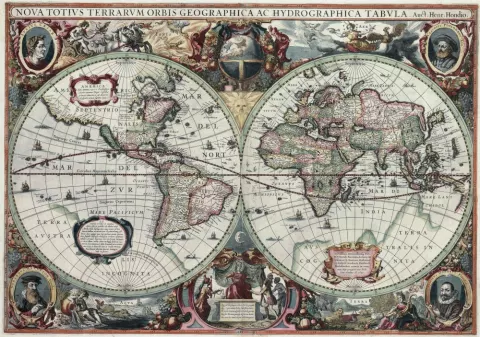
Some of these nonessential, at first even luxury commodities, such as amber, pepper, silk, and tea are represented here and are given short history. Through daring traders these commodities connected the far ends of the known world, created networks of trade routes that brought civilizations together through exchange of knowledge and ideas, and, unfortunately, they even started wars.
Amber from the Baltic coast may have led to the beginning of the Bronze Age in northern Europe, as the earliest amber traders brought metal objects and metallurgic knowledge back with them around 1800 BC. Pepper was regularly traded between India and the rest of the world for more than 3000 years, and as the Roman author Pliny the Elder said “its only desirable quality being a certain pungency; and yet it is for this that we import it all the way from India!".
Through history silk was so desirable that it connected Eurasia culturally, commercially, and politically. Another Asian commodity which was in high demand within Europe was tea. It comprised the bulk of goods imported to Europe from China, and it fostered development of the pottery industry, plantation systems, and of a new kind of public establishment - the teahouse.
The European hunger for eastern spices and pepper resulted in finding new sea routes to India, the discovery of America, rise of colonial powers such as Portugal and Spain, and subsequent establishment of the world’s most powerful companies such as English and Dutch East India Companies.
Silk was so important to Chinese government that taking the eggs of the silkworm outside of China was an offense punishable by death.
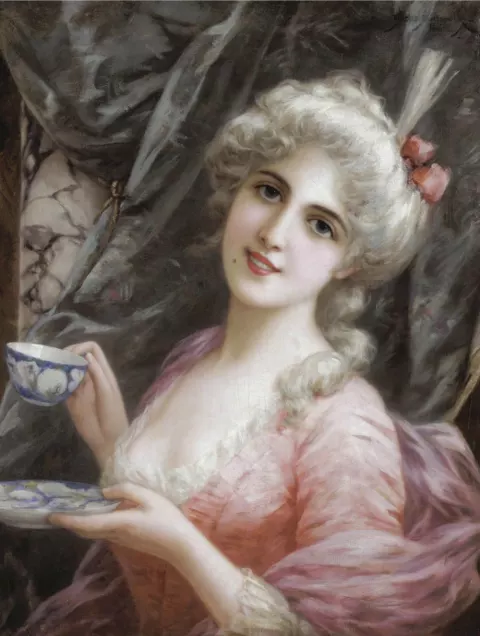
At first tea was drank in the context of a health fad which appeared in France, Britain, and the Netherlands, and well into the 18th century tea for home use was available mainly from apothecaries.
Chapters
Introduction
Some commodities were, and are, traded out of necessity, such as grain for food, wood for shipbuilding and fire, textiles for clothing, metals for production of tools and weapons. Most of the commodities were essential for living and their shortage would seriously affected the quality of life in a community where they lacked.
Although such essential commodities comprised great part of the world trade and brought wealth to certain areas, they were not the game changer. It seem that commodities that cannot be described as essential to communities were the ones that really shaped the world.
Some of these nonessential, at first even luxury commodities, such as amber, pepper, silk, and tea are represented here and are given short history. Through daring traders these commodities connected the far ends of the known world, created networks of trade routes that brought civilizations together through exchange of knowledge and ideas, and, unfortunately, they even started wars.
Amber
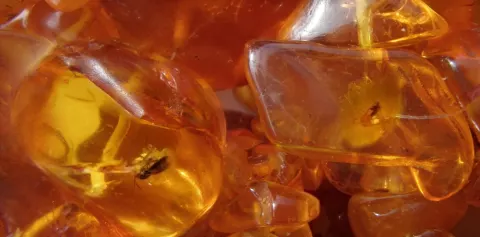
The trade in amber brought economic development and the diffusion of knowledge between Europe, Asia, and Africa. It may also have led to the beginning of the Bronze Age in northern Europe, as the earliest amber traders brought metal objects and metallurgic knowledge back with them around 1800 BC.
Amber is a fossilized tree resin produced between 40 and 60 million years ago by a number of now-extinct species of trees, mostly conifers. Amber used and traded for its decorative value through history was found primarily in the Baltic region. It was incorporated into art, culture, and religion, and through trade it was also incorporated into culture of the rest of the world. Although it is an organic substance, amber is treated as a gem, and was, and is, carved into different shapes and used as jewelry, or small artistic items.
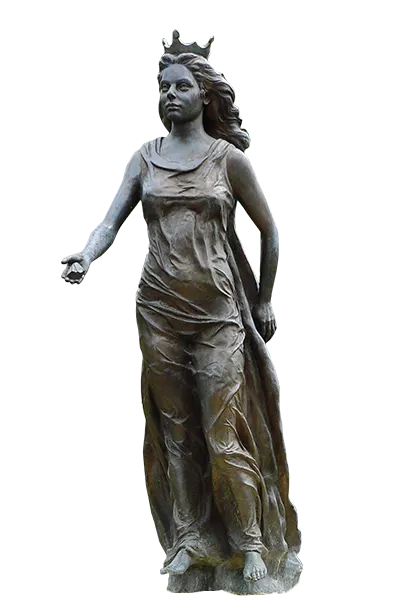
According to an ancient Lithuanian legend Baltic amber comes from the amber palace of the sea-goddess Jūratė. The goddess fell in love with a fisherman Kastytis what angered the thunder-god Perkūnas, the most powerful of the Lithuanian gods, who killed Kastytis and destroyed the palace. Thus, pieces of amber washed up on the Baltic shores are broken pieces of Jūratė's undersea palace.
People living along the Amber Coast of the Baltic started to trade amber in Neolithic period and this commodity spread from the main centers of its extraction from the Jutland peninsula, Latvia, Lithuania, Estonia, and parts of Germany, Poland, and Sweden, to the Central and Eastern Europe and even reaching Egypt. The Baltic amber was found during the excavations of Troy (1871-1890) and is considered that it was imported 3000 years ago. It was also found in graves from the Mycenae period of Greek history (c. 1600–1100 BC) and in Egyptian pyramids dating to 3rd millennium BC.
The amber routes were a series of roads and waterways that for centuries led from Europe to Asia and vice versa, and from northern Europe to the Mediterranean. Most routes combined land routes with waterways of the Danube, Dnieper, Dniester, and Prut Rivers to the Black Sea from where it could easily be distributed to the Greeks and further to Asia and Africa. A purely overland route developed during the Roman times and it lead across Alps to the Adriatic Sea port of Aquileia. There was also a sea route which hugged the coast of the Baltic and North Seas until it reached Britain, where it was transported to the Mediterranean by ship.
The Romans called amber the Northern Gold and the Emperor Nero even sent a military expedition north in attempt to capture its source. The expedition returned with amber, but reported that it lay too far to the north to come under imperial control.
Amber declined in use after the fall of Rome, but remained important trading commodity. It made a huge comeback in the late 8th century when it was traded with Arabs for the silver Arabic money dirham.
Pepper
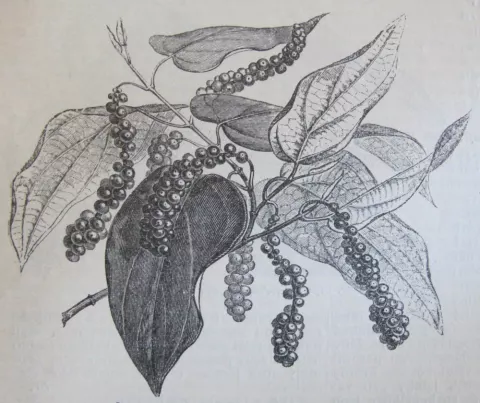
Pepper, or black pepper (Piper nigrum) is a perennial climbing shrub that produces pea-sized fruit called peppercorn, and is indigenous to the Malabar Coast of India. It’s dried fruit, and the thing we immediately imagine when talking about pepper, is the most widely used spice in the world today.
From early in the history pepper was an important article of trade between India and the rest of the world. Examination of the mummy of the Egyptian Pharaoh Ramses II (d. c. 1213 BC) revealed that two peppercorns were lodged inside his nose. Regardless of their part in the mummification process, these two peppercorns are astonishing evidence of spice trade in the 13th century BC.
During the first millennium BC a regular caravans linked India to Arabia and further to the Mediterranean Sea. The sea trade between Europe and India started to develop under the Egyptian Ptolemaic dynasty (r. 305 BC – 30 BC) but its true expansion began when Egypt was conquered by Rome in 30 BC. By the mid-1st century AD Romans traders sent more than a hundred ships to India each year. The importance and widespread of pepper can be seen from the Roman cookbook "Apicius" in which 80% of the recipes contain the spice.
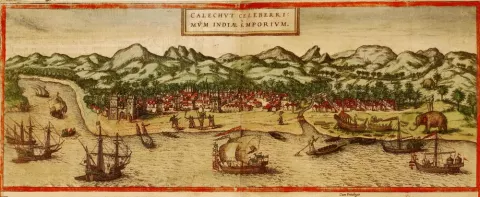
A panorama of Calicut, on the Malabar coast, the major trading point of eastern spices. Georg Braun and Franz Hogenbergs atlas Civitates orbis terrarum, 1572
Also a testament to the importance of pepper as a trade commodity is the name of the spice warehouse complex in Rome built during the second half of the 1st century. It was named "Horrea Piperataria", meaning the Pepper Warehouses.
Roman author Pliny the Elder (c. 23 – 79) complained that trade with India drained the Roman coinage and specifically moralizes about the consumption of pepper: "It is quite surprising that the use of pepper has come so much into fashion, seeing that in other substances which we use, it is sometimes their sweetness, and sometimes their appearance that has attracted our notice; whereas, pepper has nothing in it that can plead as a recommendation to either fruit or berry, its only desirable quality being a certain pungency; and yet it is for this that we import it all the way from India!"
After the fall of the Western Roman Empire pepper trade with Europe was in decline but it became prominent once again as the Italian traders gained the upper hand in Mediterranean commerce by the 12th century. Through trade with Muslim world, Genoa and Venice became the biggest suppliers of pepper for Europe.
The European hunger for eastern spices and pepper in particularly greatly contributed to the Age of Discovery. Search for spices resulted in finding new sea routes to India, the discovery of America, rise of colonial powers such as Portugal and Spain, and subsequent establishment of the world’s most powerful companies such as English and Dutch East India Companies.
Silk
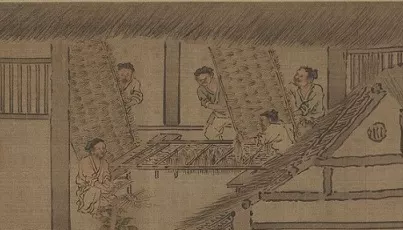
Silk is a natural fiber produced by the larva of Bambyx mori, or mulberry silkworm, as building material for cocoons. To produce fiber from the cocoons they are first steamed to soften the gum, then the filament is unwound, producing a usable length of about between 600 to 900 meters from each cocoon. Next, multiple strands of filament are woven together to produce a stronger thread called raw silk. Afterward, it is prepared for the loom by twisting and doubling a number of strands, and then it is boiled to remove the gum. In the final stage silk is dyed and a variety of finishing processes are undertaken.
The process of sericulture, as the cultivation of the silkworm is known, and production of silken products originated in China. As the legend say it was discovered by an accident in the 27th century BC by the Empress Hsi Ling Shi, and it remained a Chinese monopoly for almost 3000 years.
In China silk was a common commodity produced in almost every household and the taxes by the government were collected in silk. However, the secret of its production was successfully kept within Chinese borders – no wonder considering that taking the eggs of the silkworm outside of China was an offense punishable by death. This monopoly was broken in 550 when two missionaries smuggled the eggs together with the seeds of mulberry trees to Byzantium.
The impact that trade in silk had on the world can only be underestimated. By the second century silk was exported throughout Eurasia, creating the trade network known for its number one commodity as the Silk Road. This network of trade routes helped to disseminate knowledge, culture, art, religion, and ideas throughout the known world. In addition to being a commodity that created the Silk Road it was also important as the commodity used by the producing states as a mean of diplomacy for creating political stability.
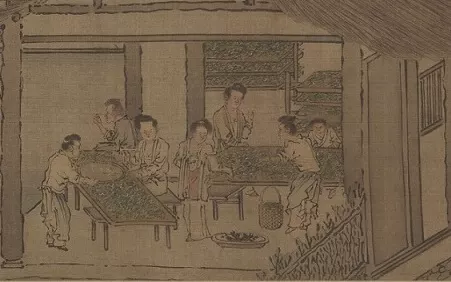
Women placing silkworms on trays together with mulberry leaves (Sericulture by Liang Kai, 1200s)
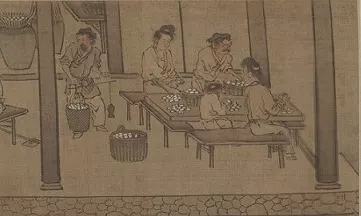
Weighing and sorting the cocoons (Sericulture by Liang Kai, 1200s)
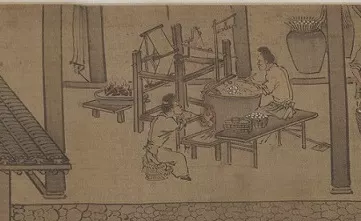
Spooling the silk (Sericulture by Liang Kai, 1200s)
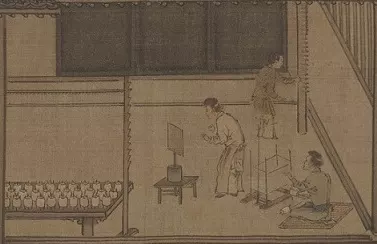
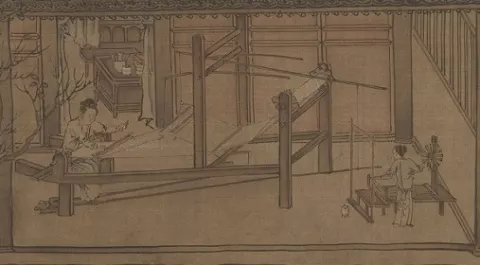
Weaving the silk (Sericulture by Liang Kai, 1200s)
Tea
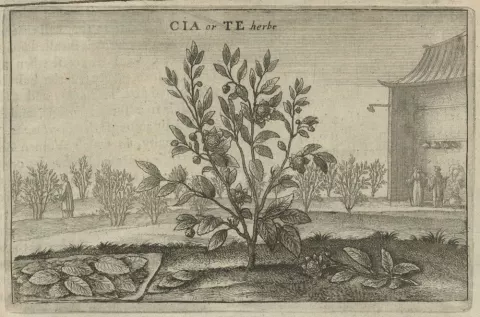
Tea is a beverage made from the heated and fermented leaves of the tea shrub, Camellia sinensis, which is indigenous to southwestern China and adjacent areas. It is believed that tea has been known in China since about 2700 BC, but it became a daily drink around the 3rd century. Around the year 800 tea seeds were brought to Japan, where cultivation became established by the 13th century. The 19th century saw tea cultivation beginning in Taiwan in 1810, in Java in 1826, in India in 1836, and in Sri Lanka in 1867.
By the early 17th century Europeans started to see tea as a herbal medicinal product which had a potential market in Europe. The biggest quantities were imported by sea routes around the Cape of Good Hope through the facilities of the Dutch and British East India Companies. The Dutch were the first to carry significant consignment of China tea to Europe in 1610. The English followed them in 1669.
At first tea was drank in the context of a health fad which appeared in France, Britain, and the Netherlands, and well into the 18th century tea for home use was available mainly from apothecaries. Tea also became a staple of a new kind of public establishment, the coffeehouse or teahouse, that multiplied rapidly in the cities of western Europe and became a fixture of social life in the late seventeenth and eighteenth centuries.
European tea consumption increased the demand for pottery and thus it stimulated the modernization of the pottery industry. The habit of drinking tea with sugar which became common in about 1700, was a major stimulus to the expansion of sugar production in the eighteenth century and to the extension of the West Indian plantation system.
In the 18th century tea became the principal commodity in trade with China but the westerners lacked the appropriate commodities that China desired, so the tea trade greatly drained the western silver reserves. To stop and revers the silver drain English merchants started to sell opium in China, and soon the drug represented 57 percent of all imports into China. Devastating impact on Chinese population and economy caused by the opium started the First and Second Opium War of 1839 to 1842 and 1856 to 1858, respectively, which forcibly opened China to international trade.