Museum / Rooms / Commerce through the territory of Kievan Rus’
Room · 6 chapters
Commerce through the territory of Kievan Rus’
Kievan Rus’ was a commercial hub on the trade routes connecting Europe, the Byzantine Empire, the Abbasid Caliphate and the Khazar state
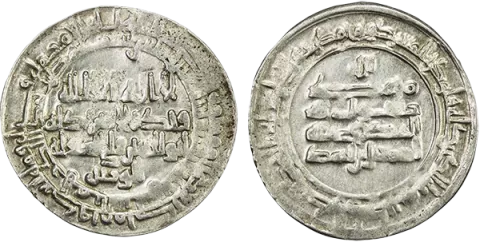
Dirhams were imported into northern Europe from the 9th until the close of the 10th century. Just during the 10th century 125 million whole Samanid dirhams or 3,750 kilograms of silver was imported into northern Europe.
Territory
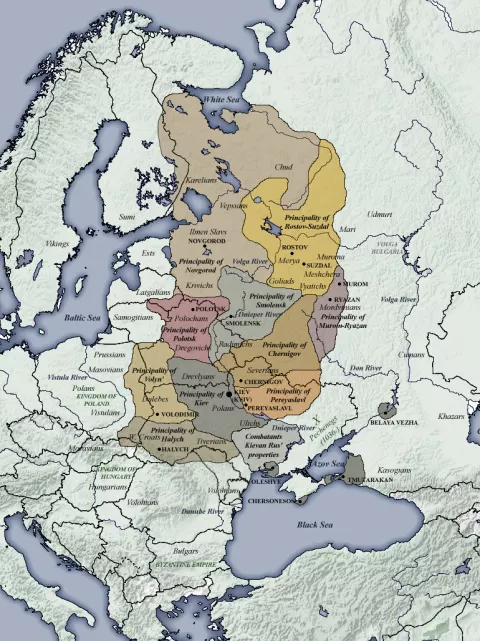
Kievan Rus' came into existence in the late 9th century. The state prospered due to its favorable geographic position and because it had an abundant supply of furs, wax, honey, and slaves for export. At its heights the Kievan Rus’ stretched from the Carpathian Mountains to the Volga River, and from the Black Sea to the Baltic Sea. However, its power was terminated by the Mongol conquests in 1241.
Capital and capital city
At first the center of Kievan Rus’ was at Novgorod but it soon shifted to Kiev, most likely as a result of the shift of trade routes from the Volga River to Dnieper River. By the late 12th century Kiev became one of the most splendid and populous cities in Europe, it had about fifty thousand citizens.
North-South
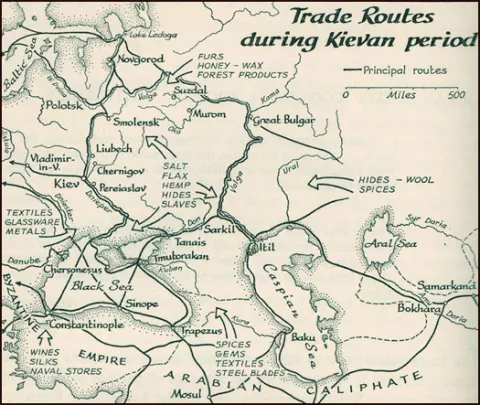
Territory of Kievan Rus’ had four major trade routes and two of them can be described as north-south routes.
The first route – following the Volga River to the Caspian Sea – connected Northern Europe with the Middle East. This was the path through which the Islamic luxuries such as textiles, jewelry and precious metals reached North Europe. However, its most important function was as a conduit of silver dirhams from the Islamic world to Europe.
The second route – following the Dnieper River to the Black Sea – is known as the “route from the Varangians to the Greeks” and was connecting Scandinavia with the Byzantine Empire. The most common Byzantine goods going north were silks, glass beads and bracelets, and amphorae containing wine, oil, and naphtha. This route also served as a cultural conduit, as the Byzantine culture and religion had a profound impact on Kievan Rus’.
East-West
Kievan Rus’ did not connected only Baltic area with the Middle East, but it was also important in connecting lands east and west of it. One of these routes was a maritime one - based around Baltic Sea and stretching from Scandinavia to England. The other one was a land route extending from Mainz and Regensburg in German Empire to Central Asia.
Not only was Kiev one of the biggest cities in Europe but also one of the major commercial centers of medieval western Eurasia.
At its height in the 11th century Kievan Rus’ was the largest political entity in medieval Europe.
The importance of salt from Galicia in domestic and international trade contributed to continuous struggles between the Kingdom of Poland and the Kievan Rus' over the territory.
Varangians, as Vikings were called in Eastern Europe, though remembered mostly as raiders, they were also renowned explorers and traders. This mercantile component of their culture was crucial for their involvement in Eastern Europe.
Chapters
- Kievan Rus’
- The center of Kievan Rus’
- The north-south route
- From Varangians to the Greeks
- East-west trade
- Northern trade zone
Kievan Rus’
Principalities of the later Kievan Rus’ (after the death of Yaroslav I in 1054). (the background map is a modern map of Europe showing current national boundaries, and modern artificial waterway
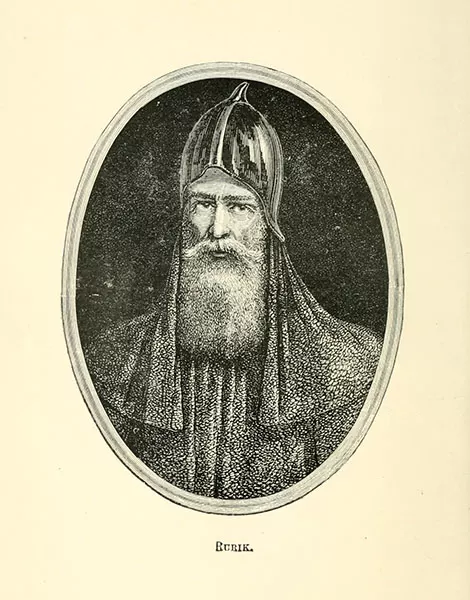
From the 9th century Kievan Rus’ was comprised of city-states, each ruled by prince. Its conception is dated to 862 when the citizens of Novgorod invited a Varangian Riurik (r. 862 – 879) to rule them, and his dynasty would continue to rule in Russia until 1598. The accounts of Riurik’s coming to power is often disputed and it may be that he actually seized power over Novgorod by force. The Swedish Vikings, known in eastern Europe as Varangian, made their way from the Baltic Sea down to Constantinople. Although Vikings are remembered mostly as raiders, they were also explorers and traders. This mercantile component of their culture, was crucial for their involvement in eastern Europe.
The shift of power to Kiev happened in 881/882 when Riurik’s successor Oleg (r. 879 – c. 913) conquered Kiev and made it the center of his power. Shift of trade routes from the Volga River to Dnieper River at the beginning of the 10th century may have had a role in such a decision. Kiev thus became the center of the state from which the grand prince ruled over his subjects and princes of other principalities. The princes of Kievan Rus’ collected tribute from the Slavic people in the form of local products, which were then traded in the foreign markets. Products such as fur, wax, and honey were abundant in region and had limited domestic use but through trade they were converted into valuable items.
The state rapidly expanded and developed, largely due to its advantageous location at the intersection of major north-south and east-west land and water trade routes, and favorable local conditions for the development of agriculture. However, the state's great size led to the development of centrifugal tendencies and local interests that limited its political and social cohesion. For illustration, from the death of the Grand Prince Yaroslav I the Wise in 1054, until the first major battle with the Mongols in 1223, there were 64 different principalities, and 83 civil wars were waged between them. The state finally disintegrated under the pressure of the Mongol invasion of Rus' and sack of Kiev on November 19, 1240, fragmenting it into successor principalities who paid tribute to the Golden Horde.
The center of Kievan Rus’
Kiev arose in the ninth century as a commercial hub on the trade routes connecting Europe, Byzantium with its capital at Constantinople, the Abbasid Caliphate ruled from Baghdad, and the Khazar state of the lower Volga and northern Caucasus. It was the ruling center of the first great Slavic state, named after Kiev – Kievan Rus’, which at its height in the 11th century was the largest political entity in medieval Europe, covering territory stretching from the Carpathian Mountains to the Volga River, and from the Black Sea to the Baltic Sea.
Kiev was also one of the most populous cities of Europe, with about fifty thousand citizens around the year 1200. At the same time Paris’ population was estimated at about the same numbers, while London had an estimated population of thirty thousand.
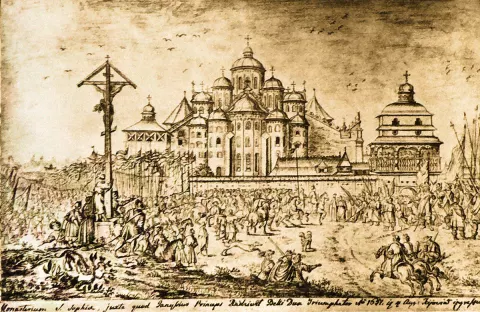
Chronicle dating from the beginning of the 11th century states that Kiev had eight marketplaces and 400 churches. The number of churches is regarded as an exaggeration, but the number of marketplaces is not. Kiev was one of the major commercial centers of medieval western Eurasia between ca. 900 and 1240, and those markets were designed not simply to further intra-Rusian commerce but also to serve the long- distance trade routes and the merchants who traveled them.
There were two mayor trade routes through Kievan Rus’, one leading from the North to South and the other from East to West. North-south route can be divided to the one along the Dnieper River leading to the Black Sea, and the other following the Volga River to the Caspian Sea. East-west route extended from Mainz and Regensburg in the German Empire through Bohemia and Poland or Hungary into Rus’, and eventually into Central Asia. There was also another, northern, east-west route on which the Rusian merchants were particularly active. It was on the Baltic Sea, and in the late eleventh and early twelfth centuries Rusian merchants traded as far afield as England.
The north-south route
Long-distance trade through the territory of Kievan Rus’ began before its creation. It was established by Varangians’s quest for silver, furs, and other trade goods. The silver, which lacked both in Scandinavia and Rus’, was available in the Middle East, and it drew northern traders deeper and deeper into the eastern European river systems, where they expanded their trade in amber and furs in the mid to late eighth century.
The silver came in the form of silver dirhams, the currency of the Abbasid Caliphate, which was acquired mostly through trade in furs. Rus’ thus became an important supplier of dirhams to northern Europe, supplying dirhams not only to Scandinavia, but to the Baltic in general, as well as increasing their ties with the various Balts and West Slavs along the rim of the Baltic Sea. Already in the late 8th to early 9th centuries, over one-third of the dirhams imported into Rusian territory were exported to Scandinavia. This percentage increased over time, as well as the total number of dirhams coming into the area. The export of Islamic dirhams to northern Europe was enormous. It is estimated that during the tenth century alone, some 125 million Samanid (a central Asian dynasty) dirhams or 3750 kilograms of silver was imported into northern Europe. Eventually Rus’ also began to use dirhams as internal currency, and the Kievans began to mint their own imitation dirhams by the tenth century.
The Rusian territory was a link between European and Central Asian or Middle Eastern exchange zones, with the Volga as the main artery of trade. By the tenth century the supply of silver from the Middle Eastern exchange zone in the south began to dry up, and the Rusian economy that had been built on that silver was forced to refocus. In this period began the decline of the cities which prospered due to Islamic trade, such as Riurikovo Gorodishche, Gnezdovo, and Staraia Ladoga. It was also the period of the rise of Kiev and a Rusian refocusing on both Byzantine and western European exchange zones.
From Varangians to the Greeks
The most famous trading route of Kievan Rus’ was the route from the Varangians to the Greeks. It stretched from the Baltic Sea down the waterways of eastern Europe, chiefly down the Dnieper to the Black Sea, and thence to Constantinople. The primary source for information on this trade is the "Povest’ vremennykh let", also known as "The Tale of Bygone Years" and as "The Rus’ Primary Chronicle", among others, compiled around the year 1113 in Kiev by a monk named Nestor. It is interesting to note that the chronicle depicts this route starting from Constantinople, although the Varangians were descending the eastern European river systems to the Black Sea and Constantinople. This fact probably reflects a vision of Constantinople as the center point of the route. Although the route from the Baltic Sea to Constantinople is seen as the artery of this trade, the chronicle depicts that the route extended from the Baltic to Rome and from there back to Constantinople.
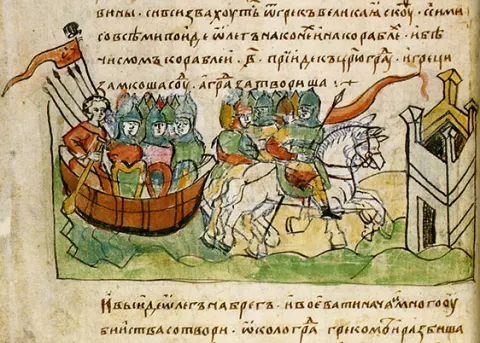
The importance of Rusian trade ties with Byzantium are attested in peace treaties from the early 10th century. The first agreement is dated to 907, and it seem to have served as a preliminary agreement until more detailed one was concluded in 911. The treaty was a result of successful attack against Constantinople in 907 led by Prince Oleg. The treaties exempted Rus’ traders from customs duties and provided them with a special place of residence within St Mamas quarter of the city, with free lodging for up to six months during their trading missions in the Byzantine capital. The treaties secured the financial basis of the Kievan state, since the Rus’ were thereby given preferential rights in their commerce with Byzantium, the richest power in the region.
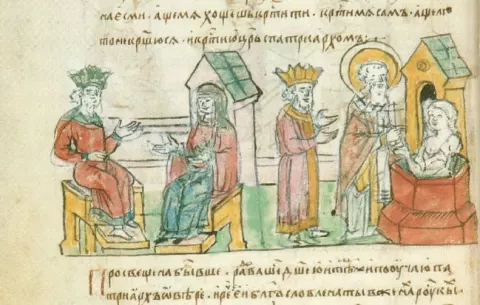
Reception of Olga by Constantine VII. Miniature from Radziwiłł Chronicle (early XV century).
Another important mission for fostering trade between Rus’ and Byzantium occurred in 957 when the regent Olga made a visit to Constantinople. The purpose of the trip is most often recorded as Christianization, but trade may have been at least as important. Among Olga’s retinue there were 44 merchants, all of whom received gifts from the emperor.
The most common goods in trade were Rusian furs, honey, slaves, and wax going south, and Byzantine silks, glass beads and bracelets, and amphorae containing wine, oil, and naphtha going north. The route also served as a cultural conduit, for Rus’ brought in Byzantine architects and mosaicists, who worked on a variety of buildings, most famously the St. Sophia churches in both Kiev and Novgorod erected in the eleventh century.
East-west trade
The east-west trade route ran from the German Empire through Bohemia, Poland or Hungary and into Rus’. Besides trade, this route was also the main path for western Europeans to enter and interact with Rus’. The earliest written source for this route dates from 903/906 and is known as the Raffelstettin Regulations. It describes the customs regulations in Raffelstettin (now part of the town of Asten in Austria), a toll-bar on the Danube, of the East Frankish Empire.
The route highlighted in Regulations extends from Regensburg down the Danube past Raffelstettin and Passau before turning for Prague and continuing through Cracow, Przemysl, and on to Kiev. The main trade goods coming from the east are listed as furs, slaves, and horses. The Rusian trade route also extended to Mainz on the middle Rhine River, the famous medieval center for production of swords. These sword were traded as well as copied by the Rusians.
Salt was one of the most important medieval commodities, and another item of commerce on this trade route. The Rus’ obtained it from Galicia, specifically from Przemysl. The importance of the region’s salt in domestic and international trade contributed to continuous struggles between the Kingdom of Poland and the Kievan Rus' over the territory.
Northern trade zone
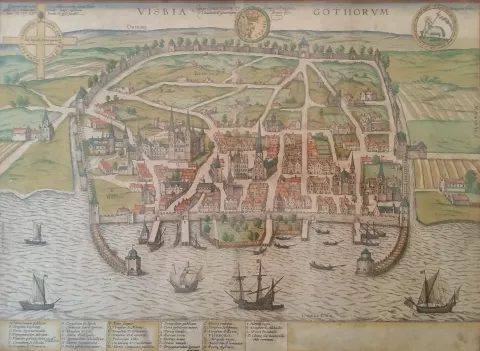
Rusians were also part of the trade system based around the Baltic Sea. The area encompassed Scandinavia, the Balts, the German Empire, Flanders, and England. There were several towns which had prominent Rusian trading presence, such as Sigtuna in Sweden, which had a Rusian trading center with its own church. Other prominent centers were Birka in Sweden, Hedeby in Denmark, and Oldenburg in Germany. Swedish island Gotland had especially strong trading connection with Novgorod, and the island was home to a group of Rusian artisans who designed multiple pieces of art for the churches on the island, probably for a Rusian, or Rusian-influenced, audience who had spent time in Rus’ or Rusian churches. In these, and other towns of northern trade zone, and Rusian towns, excavations have revealed many of the same trade goods at each place: Frisian bronze combs, found in northern Rus’, Scandinavia, Poland, and elsewhere in the Baltic from the eighth through eleventh centuries; glass beads, which were manufactured at both Ladoga and Birka with similar designs; clay disks, which were designed and made in Rus’ for export to Scandinavia; glazed ceramic eggs, manufactured in Kiev and found throughout the Baltic.
Rusian trading in the Baltic extended to Saxony, Frisia, and England. The best-known German trading port on the Baltic was Lübeck. It especially came to prominence after Henry the Lion in 1158– 1159 rebuilt it after a devastating fire, with the particular mission of creating a German trading center on the Baltic to compete with Gotland for the Rusian trade. Metals lacking in Rus’, such as silver and copper, were among the most important items of trade, and the Germans seems to have made a taste for the Rusian enamelwork and niello. Metals were also imported from England, with English silver supplementing the German silver in Rus’, and English tin even being used to manufacture Rusian goods. Flemish cloth from Ypres began to appear in Novgorod in the early twelfth century and became a medium of exchange throughout the Baltic.
Map of Visby on Gotland from Braunius Theatrum urbium IV, 16th century. In the middle is the so-called Russian Church, non-existent today.