Museum / Rooms / American fur trade
Room · 4 chapters · 3 lives
American fur trade
Furs were symbols of power, wealth and status from ancient times
Furs did not enjoy the same popularity in all periods. During the Middle Ages it was believed that flea-infested furs were responsible for spreading the Black Death across Europe in the 14th century.
Fashion and business
The American fur trade became an important part of the world trade from the 16th century. At first the American fur trade was only a secondary activity of the European explorers and fishermen on the North American continent but changes in European fashion transformed it into one of the most lucrative commercial enterprises.
Beaver hats
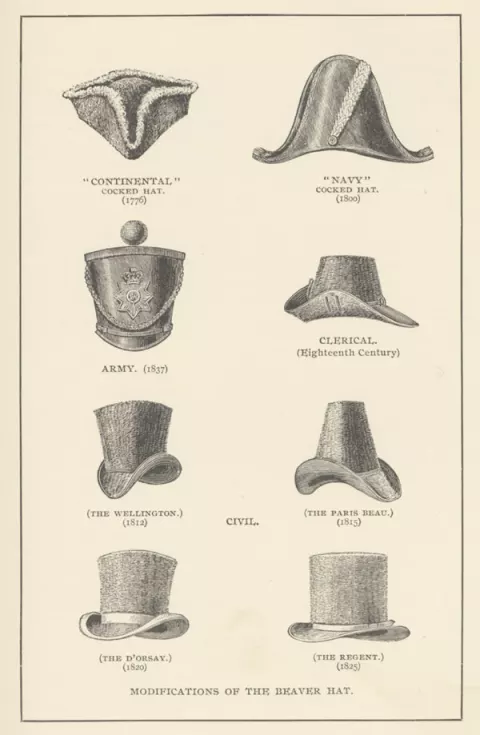
The most important fur in the trade was beaver fur because in the 16th century beaver hats became very popular in Europe. The rising popularity of beaver hats coincided with the severe depletion of the European beaver populations - the only remaining supply of beaver was located in the northern part of the North American continent. French were first to profit from the American fur trade, but the Dutch and the English entered into competition in the 17th century.
Until revocation of the Edict of Nantes (1598) in 1685, which had allowed Huguenots the freedom to practice their religion, France was the leading center of hat-making industry. From then on over 10,000 Huguenots hatters emigrated to England, thus making it the center of production.
Conducting of trade
Most of the fur trade was organized through chartered companies and the biggest profiteers, until the American Revolution, were French and English companies. Furs were supplied mostly by Native Americans who hunted the animals, and transported and traded the pelts or skins to European intermediaries. English and French had different business strategies, and while the English waited in their posts for the Indians to come to them, the French moved into interior and came directly to the hunters.
From the end of the 15th century hats made of beaver wool began to be predominate, and were replaced by more fashionable silk hats only in the 19th century.
During the process of hat making mercury vapors evaporated and attacked the nervous system of the hatters. Thus in the 18th century “mad as a hatter” expression was coined.
Because of different business strategies the French explored much more regions between the Great Lakes and the mouth of the Mississippi River than their English rivals in the fur trade.
Chapters
Beaver pelts
There were two types of beaver furs - parchment beaver (castor sec – dry beaver) and coat beaver (castor gras – greasy beaver). Parchment beaver came from the freshly caught animals, whose skins were only dried before entering into market. Coat beaver came from the skins that were worn as clothing for a year or more what resulted in breaking of the keratine and falling of the longer guard hairs. The combination of the two varieties produced top-quality material.
The need to combine the two varieties of beaver pelts disappeared with the introduction of the carotting process. Before the carotting process had been introduced coat beaver fetched a higher price than parchment beaver, averaging 6.6 shillings per pelt as compared to 5.5 shillings. However, from the 1730 the prices were reversed.
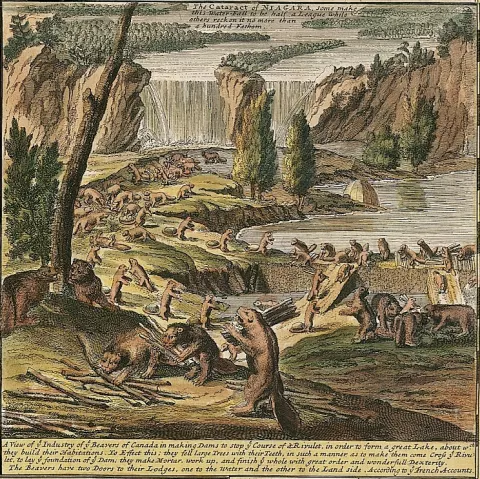
The increased demand for beaver and felt hats in the 18th century led to over-harvesting, and gave rise to serious depletion of the beaver and possibly other animals such as marten that were also being traded. The impact on beaver population can be seen from the Hudson’s Bay records from Fort Albany. In the first two decades of the 18th century the number of beaver skins received at Fort Albany averaged roughly 19000, for the next two decades the average returns declined by about 5000 skins. With few exceptions in some years the returns continued to decline. In 1756 fewer than 6000 beaver pelts were received, and in 1770, Fort Albany took in just 3600 beaver pelts.
Beginnings of the trade
American fur trade began as secondary activity of European fisherman who were netting cod on the Grand Banks off Newfoundland and on the Bay of Gaspé near Quebec. Primarily concerned with fishing these early colonists made contacts with Indians and started to trade pelts for textiles and iron based products.
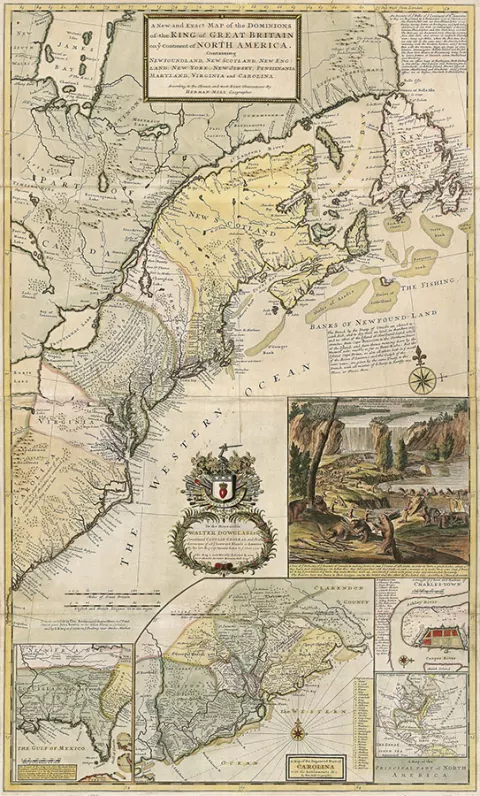
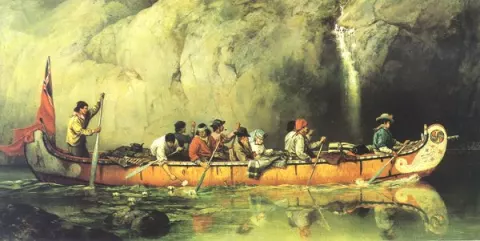
As the trade in furs became increasingly lucrative French explored further inland and spread the trade along the St. Lawrence and Ottawa Rivers, and down the Mississippi. In the 17th century the Dutch and the English also developed their fur trade in the North America, Dutch through their possessions of New Netherland and English through their possessions of New England.
Furs were classified as fancy or staple. Fancy furs were characterized by the beauty and luster of their pelt and have come mostly from mink, fox, and otter. Staple furs were prized for their wool that grows next to the animal skin and is guarded by longer and stiffer hairs called the guard hairs. The prime staple fur has been beaver, while the other notable wool came from muskrat and rabbit.
Mad as a hatter
The American fur trade supplied the luxury clothing market and the felting industry, of which hatting was the most important. The bulk was shipped to Europe for processing and final sale where hats were a mandatory part of everyday dress, for both men and women. From the end of the 15th century hats made of beaver wool began to be predominate, and were replaced by more fashionable silk hats only in the 19th century.
The market for beaver hats grew dramatically from 1700 to 1770. In 1700 a 69500 beaver hats were exported from England and almost the same number of less expensive felt hats. In 1760 over 500000 beaver hats, and 370000 felt hats were exported. It is estimated that between 1700 and 1770, 21 million beaver and felt hats were exported from England.
What made felt the ideal material for hats was its durability, resistance to water and lightness. Felting was a highly skilled activity and it required the wool to be separated from the guard hairs and the skin, and that some of the wool have open barbs, since felt required some open-barbed wool in the mixture. The animal hairs were naturally covered with keratin to prevent the barbs from opening, thus to make felt, the keratin had to be stripped from at least some of the hairs. This stage of the process was the most difficult to master and the one that took many experiments to perfect.
In the 1720s the hat industry developed the carotting process which eased the felt making but as the process consisted of salts of mercury diluted in nitric acid, which was brushed on the pelts, it resulted in widespread cases of mercury poisoning among hatters. As the mercury vapors attacked the nervous systems of hatters, the expression “mad as a hatter” was coined.
Organization of trade
Most of the trade was organized through chartered companies of whom the biggest were the Hudson’s Bay Company, an English company chartered in 1670, and the Compagnie d’Occident, a French company founded in 1718.
The Hudson’s Bay Company was organized along hierarchical lines with salaried managers, what allowed it for more control from the London head office, but required systems that could monitor the managers of the trading posts. The Compagnie d’Occident issued licenses (congés) or leased out the use of its posts, what made monitoring unnecessary, but led to a system where the center had little influence over the conduct of the trade.
This two companies also differed in how they interacted with the Natives. The English established posts around the Hudson’s Bay and waited for the Indians, often middlemen, to come to them, while the French moved into the interior, directly trading with the Indians who harvested the furs. The way the French did business made them explore more regions than the English, so they moved beyond the St. Lawrence and Ottawa rivers into the western Great Lakes region, the heart of the Hudson Bay hinterland, and river systems to the south, setting up a post at the mouth of the Mississippi.
Indians supplied the most of the North American fur, they hunted the animals, and transported and traded the pelts or skins to European intermediaries. The pelts or skins were traded for variety of European made goods which can roughly be categorized as the producer goods, luxury goods, and household goods. Into the category of producer goods there were items such as guns, powder, twine, fishhooks, and knives, the household goods comprised of items such as blankets, kettles and awls, and the luxury goods were divided into two broad categories: “tobacco and alcohol,” and “other luxuries,” dominated by cloth of various kinds. In different times and places the percentage of the items from each category used for trade differed but for example in 1740 at York Factory, the distribution was: producer goods – 44 percent; household goods – 9 percent; alcohol and tobacco – 24 percent; and other luxuries – 23 percent.
Besides providing most of the fur, the Indians also supplied Europeans with much of the food consumed in trading posts. They helped provision the posts with fish and fowl, and their role of food purveyor grew in the nineteenth century as groups known as the “home guard Cree” came to live around the posts. Indians also supplied pemmican which was an important source of nourishment for Europeans involved in the buffalo hunts.
After 1794 the French were replaced in the Mississippi region by U.S. interests which later formed the American Fur Company. After the English takeover of New France in 1763 the French management was replaced by Scottish and English merchants operating in Montreal who formed the new company called the Northwest Company. The new company presented serious competition for the Hudson’s Bay Company, but in 1821 the two companies merged under the name of Hudson’s Bay Company.
3 lives in this room
More lives in this room
- Jean Sarcel du Prevert 1550
- John Henry Cox 1750-1791