No. 1161
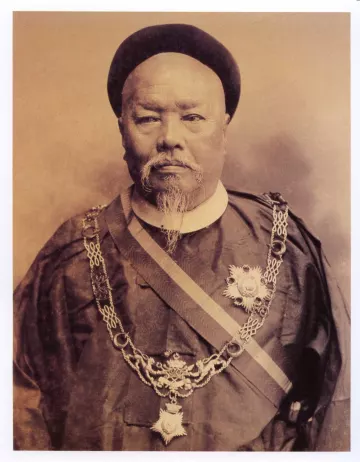
Tan Hiok Nee
Tan Hiok Nee was a powerful and influential Teochew businessman in 19th century Singapore and Johore. Tan, who amassed great wealth through opium and spirit farming, played an important role in the development of the region, particularly Johore.
Tan was born in Jin Sha village in Shang Pu (present day Caitang) of Chaozhou, China. He lost his father when he was young. As a youth, Tan was such a compulsive gambler that he used the money he borrowed for his mother's funeral. At the age of 17, Tan left his hometown to seek opportunities in Nanyang (Southeast Asia). He reached Pahang and worked in the mines of Pahang to pay for his travel expenses. After paying off his debts, he shifted to Singapore and became a textile peddler. Tan operated daily at Telok Blangah area and was popular among the residents due to his honesty. Among his regular customers was Temenggong Ibrahim whose son, Abubakar, became his good friend.
At that time, Johor was largely undeveloped and the Temenggong was eager to attract enterprising Chinese to develop the territory. The Temenggong started the kang-chu system. This meant that chosen Chinese were appointed as kang-chus (or port owners) and enjoyed jurisdiction and rights over certain rivers and their banks. As a result, the kang-chus have access to large tracts of land, which they used for revenue farming.
With the help of the Temenggong, Tan moved to Johor in 1853. Tan, in partnership with Tan Ban Tye, obtained the kang-chu rights of Bukit Beranganon, a tributary of the Johore River. There, he began cultivation of pepper and gambier. Tan also traded in other types of merchandise and started a market on an island, midpoint of Sungai Segget. In 1862, Temenggong Ibrahim passed away and Abubakar succeeded his father as the Temenggong. From the middle of 1863, Temenggong Abubakar accelerated the pace of Johore's development. In September that year, Tan obtained four additional kang-chu rights within a one-week period. By then, he was the most prominent businessman in Johore with seven kang-chu rights. This meant controls over the entire left bank of the Johore River which spanned from the south of Kota Tinggi to Pulau Ubin.
On 11 September 1863, Tan was given the sole control of the revenue rights to the town of Iskandar Putri in Johor Bahru. Within the next two years, Tan was involved in the trading of pepper, gambier and opium. Tan was also involved in the Singapore and Johor opium and spirit Farms, partnering with Tan Seng Poh and Cheang Hong Lim. Tan Seng Poh was a Teochew tycoon while Cheang was a Hokkien businessman whose family held the monopoly to the opium and spirit farms for some time. In 1866, he set up the Kwang Hong Company in Singapore and became an established trader at Boat Quay. Tan Yeok Nee soon amassed a great fortune, which he prudently invested in the lucrative real estate. In 1868, Abubakar gained the title of Maharaja and two years later, he appointed Tan as Major China of Johor, the highest-ranking Chinese official in his government. In 1874, Tan was appointed as one of the two Chinese members in the State Council.
In 1875, Tan fled from Johor to Singapore and gave up all his connections to Johor. It was speculated that his political rivals had removed him during the Maharaja's absence due to their resentment of his prominence and power. After his flight, Tan's assets and kang-chu rights were repossessed by the Johore government. His family-home mansion at Tank Road, Singapore, which was built in 1885, was acquired for the purpose of the Singapore-Johore Railway. Subsequently, Tan returned to his hometown in China and passed away on 21 May 1902 at the age of 75.