No. 10319
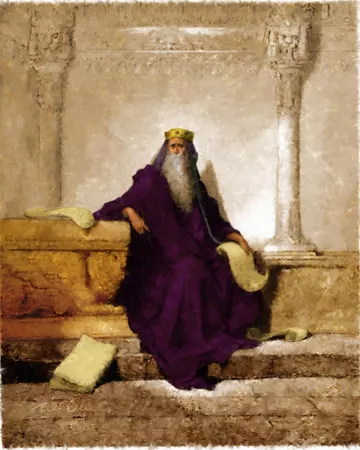
Solomon
According to the Old Testament, or Hebrew Bible, Yahweh, the Hebrew god, granted Solomon an understanding heart, wisdom, and riches. However, Solomon strayed from Jewish laws, and his reign is
an example of great riches lost through poor decisions and extravagance. He wrote the book of Ecclesiastes, which describes his realization that happiness and a meaningful life do not come through
riches.
Early Life
Solomon was the son of King David of Israel. His father granted him the throne at the request of his mother Bathsheba, and at the age of twelve, Solomon superseded his firstborn brother Adonijah to become king. Solomon sought guidance to be the king. With a sacrifice on Gideon, a high place, Solomon dreamed that Yahweh (the Hebrew name for God) asked him what he wanted. Solomon responded that he desired an understanding heart to judge the people of his kingdom fairly. Yahweh was pleased with this mature and selfless answer, so he granted Solomon not only an understanding heart but also wisdom, riches, and honor like no other king of his time. The story of King Solomon is found in 1 Kings:1-11 in the Old Testament.
First Ventures
Solomon inherited the wealth of his father, King David. Because Solomon was the younger son of David, some thought it unfair that his older brother Adonijah was not chosen king. Unsuccessful schemes were devised to trick King Solomon into abdicating his throne, but he eliminated those who plotted against him. Solomon was wise in his knowledge of the Jewish Torah, as well as in the science of his time. He became known throughout the surrounding lands for his wisdom. People from other countries, including royalty, came to speak with him and received his advice. Many bought gifts of silver, gold, spices, horses, and weapons. His reputation spread as he became wealthier, securing even greater riches than his father King David had acquired. Solomon would write several books containing three thousand sayings, more than one thousand poems, and one thousand songs. His reign was the golden age of Israel, an era of peace and prosperity.
Mature Wealth
Solomon secured lucrative commercial relationships with strong countries near his kingdom, such as Tyre. His goal was peace and prosperity. His competitors, Egypt and Assyria, were weak. The geographic location of his nation supported trade paths from Egypt to Asia Minor, and ships transported the gold, ivory, and silver that Solomon desired. He secured a trading agreement with the queen of Sheba for chariots and horses. Solomon married the daughters of key nations’ rulers in order to forge peaceful political alliances; he added Siamun, the daughter of Egypt’s Pharaoh, to his harem. Solomon’s wealth could be measured by his possessions. His court required as many as 335 bushels of flour and 670 bushels of meal to be used in one day. The daily consumption of meat within his court included thirty
oxen, one hundred sheep, and various fowl. Solomon also had seven hundred wives and three hundred concubines, representative of his wealth. He decorated his buildings, furniture, and tables with gold, and his bodyguards carried shields covered with gold. Solomon’s throne was made of ivory and cloaked in gold. The six steps leading to his ornate throne were adorned with fourteen statues of lions. He boasted fourteen hundred chariots, four thousand stalls for his horses, and about twelve thousand horsemen for his army. His court included musicians, artists, and scholars.
Solomon demonstrated his wealth with his plan for buildings leading to the Temple of Jerusalem. The lowest building was used for government purposes; a slightly higher buildingwas his home. He also built a royal palace for his queen. His chief lifetime achievement was to construct and furnish the sacred Temple of Jerusalem for Yahweh. King David planned the temple, but he could not build it because he had blood on his hands from waging war. The temple was constructed on the site where Abraham was called to sacrifice his only son, Isaac, but was stopped by Yahweh before the deedwas done. This building, commonly called Solomon’s Temple, took seven years to construct. Over time, the income of Solomon’s kingdom could not match his lavish lifestyle, so he resorted to heavy taxes and mandatory labor by the Israelites to support his wealth. History reports that he commanded ten thousand people to
work for several weeks to a year in order to help with his building projects. His subjects became resentful. Solomon made another critical error when by taking seven hundred wives and three hundred concubines. Moses warned the Hebrews in Deuteronomy that a king should avoid too many wives or horses. Rashi, a medieval French rabbi who was an expert on the Torah, suggested that the number should be no more than eighteen wives in order to avoid distraction from the responsibilities of the kingdom. Solomon’s father King David had only six wives. Some believe that Solomon may have thought he was too wise to succumb to the corruptive power of materialism and to the influence of his harem. He wed many of his wives in political marriages designed to align Israel with the leaders of foreign countries.
Instead of turning to Yahweh, these wives brought their own idols and customs to Solomon’s court. In 1 Kings 11, Yahweh expressed his disappointment by telling Solomon that He would honor his father, King David, by allowing Solomon to keep his kingdom until his death. However, Solomon’s son, Rehoboam,
would receive only a portion of the kingdom.
Solomon wrote the book of Ecclesiastes. In this book he expressed his discontent with his life, including his many wives and concubines and all of his material accomplishments. He sought a meaning to his life that could not be purchased with riches. He explained that a human life is subject to various seasons before it ends. Solomon concludes this book and life search with this scripture in Ecclesiastes
12:13-14:
The conclusion, when all has been heard,
is: fear God and keep His commandments,
because this applies to every person. For
God will bring every act to judgment, everything
which is hidden, whether it is good or
evil.
Solomon, in all his glory and wealth, recognized that life was vain and empty without a
relationship with Yahweh. He learned that riches and material wealth cannot bring happiness. Solomon died around 930 b.c.e., although there is no description of how or where he died. At the time of his death, people were plotting to kill him, his country was in debt, his land was mortgaged to Tyre’s leader
Hiram, and his kingdom faced division without peace or prosperity under his son’s rule.
Legacy
King Solomon left a painful legacy to his son Rehoboam and the nation of Israel. Solomon’s poor choices, a lavish lifestyle, and debt in his later life led to his misery and Israel’s discontent. The people’s commitment to Yahweh was replaced with loyalty to the kingdom. Living standards for some increased in the prosperous times, while living standards for others decreased, leaving a gaping division between the poor and the rich. At Solomon’s death, the northern tribes rejected Rehoboam as king and broke apart from the nation. The peaceful, consolidated nation of Israel was no more.