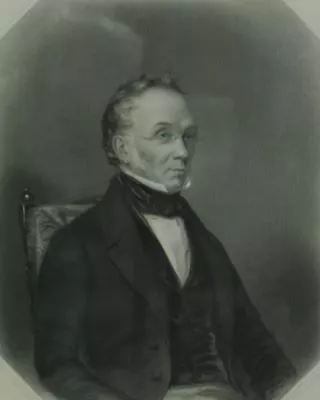
No. 1938
Sir William Brown
Sir William Brown was a British merchant and banker, founder of the banking-house of Brown, Shipley & Co. and a Liberal politician who sat in the House of Commons from 1846 to 1859.
He was the eldest son of Alexander Brown of Ballymena, county Antrim, and Grace, daughter of John Davison (1764–1834) of Drumnasole, was born at Ballymena, Ireland on 30 May 1784. At twelve years of age he was placed under the care of the Rev. J. Bradley at Oatterick, Yorkshire, whence in 1800 he returned to Ireland.
Soon afterwards he sailed with his father and mother for the United States of America, and at Baltimore, Maryland, where his father continued the linen trade in which he had been engaged in Ireland, received in the counting-house his commercial education. He was sent with his brothers, George (1787–1859), John (1788–1852), and James (1791–1877), to be educated at the school of the Revd J. Bradley in Catterick, North Yorkshire. In a few years the house at Baltimore became the firm of Alexander Brown & Sons, consisting of the father and his sons, William, John, George, and James.
In 1809, William returned to the United Kingdom, established a branch of the firm in Liverpool, and they shortly afterwards abandoned the exclusive linen business and became general merchants. The transactions of the firm soon extended so as to require further branches. James established himself at New York City and John at Philadelphia, and on the death of their father the business, then the most extensive in the American trade, was continued by the four brothers, George remaining in Baltimore. The disastrous aspect of affairs in financial crisis of 1837, induced the brothers George and John, who had by this time realised ample fortunes, to retire from the firm, leaving William the eldest and James the youngest to continue the concern. Brown persuaded the Bank of England to advance him £2,000,000 to tide matters over in view of the firm's multiple interests. Brown only needed half the amount, which he repaid within six months. His business, both mercantile and banking, continued to increase, and in 1844 he was held one sixth of the trade between Great Britain and the United States.They now became bankers in the sense of conducting transmissions of money on public account between the two hemispheres, and in this pursuit and the business of merchants they acquired immense wealth.
In 1825, William took an active part in the agitation for the reform in the management of the Liverpool docks. He was elected an alderman of Liverpool in 1831, and held that office until 1838. In 1846, Brown was elected Liberal Member of Parliament for South Lancashire, and held the seat until 23 April 1869.
His name is probably best known by the munificent gift which he bestowed on his adopted town. He erected the Free Public Library and Derby Museum at Liverpool, which was opened on 8 Oct. 1860, at a cost to himself of £40,000, the corporation providing the site and foundation and furnishing the building. At the inauguration of the volunteer movement in 1859, he raised and equipped at his own expense a corps of artillery, which ranked as the 1st brigade of Lancashire artillery volunteers. In 1863, he was selected as High Sheriff of Lancashire. He was created a baronet on 24 January 1863, and in the same year he served as sheriff for the county of Lancashire. He did not, however, live long to enjoy his honours, as he died at Richmond Hill, Liverpool, on 3 March 1864.