No. 606 · dated by century
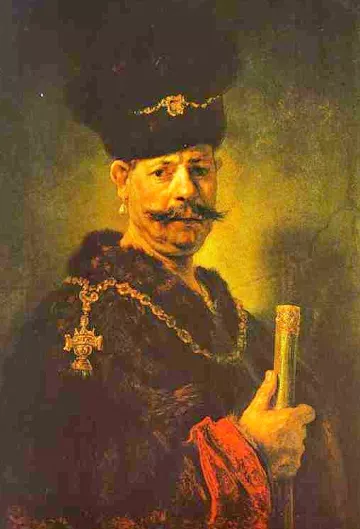
Sefer Muratowicz
Sefer Muratowicz was an Armenian merchant and Ottoman subject who emigrated to the Polish-Lithuanian Commonwealth in the late 16th century. Soon after, he appeared before Safavid Shah ‘Abbas I as the personal envoy of King Sigismund III Vasa on a royal diplomatic mission unsanctioned by the Commonwealth’s parliament. His mission and travel is described in a document called Relacyja. Though the trajectory of Sefer Muratowicz’s life is not without precedence in the heterogeneous social milieu of Poland-Lithuania, his documented involvement in the private royal embassy of 1601-1602 to Safavid Persia presents an exceptional view into the critical role of the diasporic Armenian population in the diplomatic and economic relations between Europe’s largest republic and the Islamic world in the early modern period.
Sefer Muratowicz came to the Polish-Lithuanian Commonwealth from the north Anatolian Ottoman village of Karahisar. He first arrived in the city of Lwów in 1597 by way the Ottoman Black Sea trade port at Caffa and the via tartarica trade route stretching over the Pontic Steppe into the heart of the Polish-Lithuanian Commonwealth. In Lwów, where Muratowicz was classified in the town acts as an “Turkish Armenian” (armenus turcicus), he joined a well-ensconced community of Armenian merchant and artisan families, whose presence is confirmed as early as the Magdeburg law privileges awarded to the city by King Kazimierz III in 1356. The Lwówian Armenian community had its own law codes, prelate, cathedral, churches, monastery, hospital and school. At the time of Muratowicz’s arrival the city had some 17,000-20,000 inhabitants, around ten percent of whom were Armenian.
In 1598, soon after his initial arrival in Crown Polish territory from the Ottoman Empire, Muratowicz returned to Ottoman lands as an agent of Lwówian Armenian merchants Murat Kierymowicz and Norbeg Popowicz. According to the town Acts of Lwów he continued to work for these prominent merchants until the death of Kierymowicz in 1599. In 1600, Muratowicz was struggling to obtain payment after the dissolution of his former employers’ jointly managed business when two Ottoman envoys, İbrahim and Mehmet, arrived in the Commonwealth. As a legal subject of the Sultan, Muratowicz was able to petition the Ottoman envoys to advocate on his behalf at the royal court. King Sigismund III Vasa was persuaded to draw up two mandates in favor of Muratowicz as he was bound by mutual agreement with the Sultan to provide care for one another’s respective subjects. Although there is no conclusive evidence regarding the final outcome of the case, his successful engagement of the representatives of the Sultan managed to draw the attention of the King. Following the conclusion of the envoys’ business, Muratowicz returned briefly to the Ottoman Empire with the Ottoman envoys.
The Relacyja tells us that, while King Sigismund III openly sent Sefer Muratowicz to Persia in the official capacity of his personally appointed merchant, he was also engaged by the royal translator, Krzysztof Dzierżek to carry a message of the King’s friendly intentions towards the Shah. The pro-Habsburg King Sigismund III, however, commissioned Sefer Muratowicz as a private royal envoy to the court of the Shah in hopes of damaging Safavid-Muscovite relations and resuming dialogue with a potential ally against the Ottomans.
From the Relacyja we also know that once in Kashan, Muratowicz “ordered for His Majesty the King a few carpets of silk and gold, as well as a tent, and a damascene saber.” His connection to the Armenian community there would have been useful given their prominence in the local textile industry. King also ordered embroidery of the royal coat of arms on a number of carpets that Muratowicz ordered to be made.