No. 2009
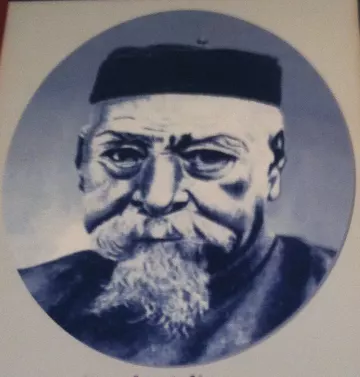
Seah Eu Chin
Seah Eu Chin was a wealthy Teochew merchant who made his fortune from the cultivation of pepper and gambier. A prominent member of the Chinese community in early colonial Singapore, Seah is also well known as the founder of Ngee Ann Kongsi, a charitable welfare organisation set up by the local Teochew community.
Seah Eu Chin was born in 1805 in Chenghai county of Guangdong Province in China. His father, Seah Keng Liat, held an appointment in the local government bureaucracy and was able to provide his son with a traditional education in the Chinese classics.
One of the few literate migrants during his time, Seah arrived in Singapore in 1823 and worked as a clerk and accountant aboard several trading ships. He established useful contacts with the local merchants and familiarised himself with their business practices. In 1830, at the age of 25, he established his own trading firm along Circular Road and served as a middleman between European merchants and native traders, dealing primarily in local produce.
Seah’s early trading ventures were successful, allowing him to diversify into other businesses like real estate investment. He also ventured into the planting of pepper and gambier and is commonly regarded as the first merchant to own such plantations on a large scale. In 1835, Seah acquired an eight-mile stretch of land between River Valley Road and Bukit Timah Road that he converted into large gambier plantation. A subsequent rise in the price of gambier netted him a large fortune as well as the title “king of pepper and gambier”. At the same time, Seah consolidated his trading business under the company Eu Chin & Co., as well as branching out to deal in a wider assortment of goods such as Chinese tea and Western firearms. These business successes established Seah as one of the wealthiest persons in the local Chinese community. In 1840, he was admitted as a member of the Singapore Chamber of Commerce, an association dominated mainly by European businessmen, becoming one of the few Chinese merchants to be accorded what was considered a privilege at the time.
As a prominent businessman, Seah enjoyed high social status and exercised leadership over the Teochew community. In 1830, Seah gathered 12 other clans based on surnames to form a social welfare organisation known popularly as Ngee Ann Kun, whose main role was to administer the Yue Hai Ching Temple in which the Teochew community worshipped. It also dealt with the acquisition and maintenance of cemetery grounds for the burial of deceased Teochews. In 1845, the cooperative was officially renamed Ngee Ann Kongsi with Seah nominated as president, a post he held until his death.
s an elite member of the Chinese community, Seah interacted frequently with the colonial government. In appreciation of his services to the Crown, Seah received a monetary reward from Lord Dalhousie, Governor-General of India, during the latter’s tour of the Straits Settlements in 1850. Seah was naturalised as a British subject in 1853.
From 1851 onwards, Seah was routinely appointed as a senior member of the jury councils that presided over local lawsuits. The colonial government also called on him to help adjudicate disputes between Chinese, especially in matters relating to Chinese custom. He played a similar mediating role during various instances of violent conflict among the Chinese, such the 1851 Anti-Catholic Riots and the 1854 Hokkien Teochew Riots. In recognition of his efforts, he was officially appointed Justice of the Peace by the colonial government in 1867 and elevated to the position of Honorary Magistrate in 1872. Such was his influence within the local Chinese community that he was known colloquially at the time as “Emperor Seah”.
Besides Ngee Ann Kongsi, Seah also sat on the committees of several social organisations. He was a trustee of a Teochew burial ground located along Orchard Road, as well as a member of Tan Tock Seng Hospital’s management committee. He also sat on the boards of various schools. In addition, his philanthropic activities sometimes extended beyond the local Chinese community, such as when he made a significant contribution to a fund aiding victims of the Bengal Famine in 1874.
In 1837, Seah married the eldest daughter of Tan Ah Hun, the Kapitan Cina (Chinese headman) of Perak. Her death from smallpox shortly after led Seah to marry her younger sister, a union that produced four sons and three daughters. His sons all grew up to be prominent figures within the local establishment, and three of them were later appointed Justices of the Peace. They also continued to dominate the leadership of Ngee Ann Kongsi after his death. Through his marriages, Seah also became the brother-in-law of Tan Seng Poh, who was responsible for the Seah family business after Seah’s retirement in 1864. Tan himself was a wealthy businessman, jointly controlling the opium revenue farms of Singapore and Johore.
After his retirement from business, Seah devoted much of his time to the study of Chinese literature. In poor health during the last years of his life, Seah died on 23 September 1883 at the age of 78 at his house in North Boat Quay. He was later buried in the family-owned plantation at Thomson Road, leaving behind an estate worth some $1,359,000.