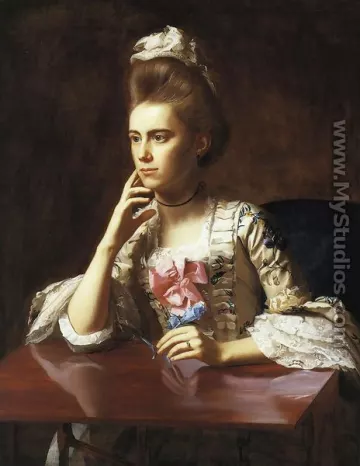
No. 8518
Sarah Kemble Knight
Colonial American society assumed that a woman needed a male figure, usually either a father or husband, to manage her financial affairs. However, widows fell into a different situation. Having lost their husbands, and usually their fathers as well, these women had little choice but to become financially independent, and society had little choice but to allow them to do so. Not surprisingly, many of these women not only survived but prospered as independent businesswomen, usually as owners of taverns, inns, and boardinghouses but occasionally in other business ventures as well. An example of the colonial era’s self-made woman is Sarah Knight, successful merchant, innkeeper, and land speculator.
Knight was born Sarah Kemble on April 19, 1666, in Boston, Massachusetts. Her father,
Thomas, was a merchant, and her mother, Elizabeth, was a homemaker. Little is known about the
first 38 years of her life other than she married Richard Knight, with whom she had a daughter,
Elizabeth, and by 1704 both her father and husband had died. In 1704 Knight went to New York to tie up
several loose ends regarding a family estate, possibly in connection with the death of either Thomas
Kemble or Richard Knight. She kept a diary of her trip, which depicts her as being an intrepid woman. At a time when women rarely ventured away from their hometowns except in the company of a father or husband, she traveled alone and on horseback through a country with poor roads, signage, and accommodations. She overcame all these problems and settled the legal affair to her satisfaction.
By 1707 (and probably much earlier than 1704) Knight was supporting herself and Elizabeth
232 Knight, Sarah Kemble by running her father’s old shop in Boston. She also took in boarders and served as a notary public, copying legal documents and witnessing deeds. When Elizabeth married John Livingston in 1713, Knight moved with the newlyweds to New London, Connecticut; whether she sold her shop in Boston is unclear. She opened a shop in town and purchased a tavern and inn on the outskirts of town on the road to Norwich, Connecticut. Using the profits from these businesses and drawing upon her experience as a notary public in Boston, she began to speculate in land, at which she evidently did quite well. She was able to re-acquire some land that her son-in-law had sold, then entered
into a lucrative partnership with Joseph Bradford, a wealthy local landowner. Her holdings gradually
increased to the point that she had to employ Joshua Hempstead, a local jack-of-all-trades, to
survey her land and draw up leases for her tenants. In 1718 she ran afoul of the local authorities for
selling alcohol to a small band of Mohegan Indians who lived near Norwich. At the time of her death
on September 25, 1727, in New London, her estate was valued at more than 2,000 pounds, a considerable amount for the day.
Knight’s diary of her adventures in 1704 was published in 1825 by Theodore Dwight. Known
today as The Journal of Madam Knight, this diary gives many insights into the nature of colonial living
in early 18th-century New England and New York. Knight’s life also serves as a good example of
what colonial women could do in business when given an opportunity.