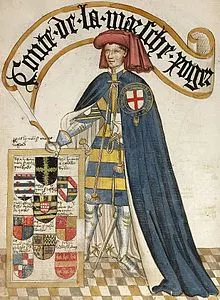
No. 3100
Roger Mortimer, 2nd Earl of March
Roger Mortimer came from one of the most prominent and powerful English noble family. His life and lives of his family members depicts how feudal wealth and power was highly connected to military power and the good will of the monarch.
Roger’s grandfather, Roger Mortimer, 1st Earl of March, was highly ambitious and at one point the most influential and powerful man in England. Roger, 1st Earl of March, was de facto ruler of England for three years (1327-1330). He had deposed Edward II (r. 1307-1327), but was himself overthrown by Edward's eldest son, Edward III (r. 1327-1377), and was executed by hanging at Tyburn. This kind of development certainly was not in favor of his heirs, but his grandson Roger Mortimer, 2nd Earl of March, managed to recover his ancient patrimony.
Although his grandfather was hanged by charges of treason, and his father died when Roger was only three years old, Roger’s family was old, powerful, and well connected both from his father’s and mother’s side. This and friendship with Edward III enabled him to restore his patrimony by 1354. Friendship with the monarch lay behind a series of arbitrary decisions, thinly veiled as legal judgments, which restored to the young earl in addition many of the lands acquired by the 1st earl during his years of power, notably the lordship of Denbigh. The friendship was further strengthened by Roger’s military service with Edward from 1346.
Roger Mortimer died at Roveray, in Burgundy, on the 26th February 1360, whilst in command of the English forces on that station.