No. 9158
Richard Beaple
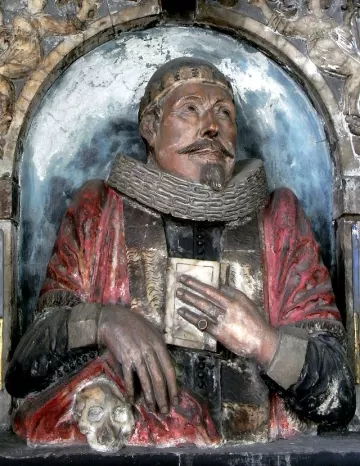
Richard Beaple (1564-1643) of Barnstaple, Devon, was a wealthy merchant, ship owner and member of the Spanish Company and was thrice Mayor of Barnstaple, in 1607, 1621 and 1635. His elaborate mural monument survives in St Peter's Church, Barnstaple.
He was one of the four sons of James Beaple (d.1616) of Barnstaple (son of Walter Beaple of Barnstaple), Mayor of Barnstaple in 1593 and 1604, by his first wife Elizabeth Goldsmith, daughter and heiress of a certain Mr Goldsmith of Devon. His uncle was Roger Beaple (1540-1604), a tanner who was twice Mayor of Barnstaple, in 1590 and 1599. His two sisters Anne and Joane married into the prominent Barnstaple mercantile families of Delbridge and Horwood respectively. The first recorded member of the Beaple family to have occupied the position of mayor was John Beaple, Mayor in 1559.
Little if anything is known of his mercantile career, although his merchant mark appears to be shown on the chaplet surrounding his arms on his monument in St Peter's Church, interwoven with the initials "RB". Three ships, presumably belonging to him and used in trade with Spain, for which he was licenced by his membership of the Spanish Company, are depicted on his monument in St Peter's Church.
Richard Beaple was thrice Mayor of Barnstaple, in 1607, 1621 and 1635. His career in the government of the Borough of Barnstaple appears to have started in August 1598, when he was elected a Common Councilman in place of Roger Cade, who was "put out for that he dwell'd out of this Towne above one year". Roger Cade was the father of his second wife Catherine Cade.
Pediment of monument to Richard Beaple in St Peter's Church, Barnstaple, showing centre, arms of Beaple with crest (On a wreath of the colours, two arms embowed issuing out of clouds all proper, holding in the hands a globe or) and supporters (Two sea horses argent, finned or) of the Spanish Company. At left are shown the arms of the Borough of Barnstaple Gules, a castle of three towers conjoined argent the centre tower larger than the others, at right the arms of the Spanish Company Azure in base a sea, with a dolphin's head appearing in the water all proper, on the sea a ship of three masts, in full sail, all or, the sail and rigging argent, on each a cross gules, in the dexter chief point the sun in splendour, in the sinister chief point an estoile of the third; on a chief of the fourth, a cross of the fifth, charged with the lion of England.
Richard Beaple was a member of the Spanish Company, the members of which had been granted by royal charter in 1605 exclusive rights to trade with Spain. His membership is evidenced by his use of the Company's arms, supporters and crest on his monument in St Peter's Church. Barnstaple was one of the "privileged ports" of the Spanish Company, whose armorials are visible also on the mural monument in St Peter's Church to Richard Ferris (Mayor in 1632), who together with Alexander Horwood, received a payment from the Corporation of Barnstaple in 1630 for "riding to Exeter about the Spanish Company", on the decorated plaster ceiling of the former "Golden Lion Inn", 62 Boutport Street (now a restaurant next to the Royal and Fortescue Hotel) and on the 1630 plaster strapwork overmantle of Higher Rookabear House, Fremington, the country house of the Paige family, merchants of Barnstaple. The royal charter of 1605 which re-established the Spanish Company names several hundred founding members from named English ports, the 12 Barnstaple members being: William Gay, John Salisbury, John Darracott, John Mewles, George Gay, Richard Dodderidge, James Beaple, Nicholas Downe, James Downe, Robert Dodderidge, Richard Beaple and Pentecost Dodderidge, "merchants of Barnstaple". Richard Dodderidge and James Beaple were named as amongst the "first and present assistants and chief councillors of the fellowship".
Between 1624 and 1627 he and his four co-executors of the will of his son-in-law John Penrose (d.1624), Mayor of Barnstaple in 1620, built the large structure in Litchdon Street, Barnstaple, known today as Penrose's Almshouses. It consists of a cobbled courtyard around which are twenty almshouses, for forty poor residents, with chapel and board room, with vegetable gardens behind. His achievement in carrying out the terms of the bequest is recalled to the viewer by the depiction of the almshouses on the monument of Richard Beaple.
Richard Beaple married thrice.Richard Beaple died on 30 December 1643, aged 79, as is recorded on his surviving monument in St Peter's Church.